Who Accepts Bitcoin for Payment: 7 Real-World Examples
Discover who accepts bitcoin for payment in 2026. Explore 7 real-world examples, from electronics to travel, plus strategic insights and regional caveats.
Can you pay with Bitcoin at the brands you already use? The honest answer is yes, though the checkout experience rarely matches the simple logo lists circulating online. In 2025, 39% of U.S. merchants surveyed said they already accepted cryptocurrency at checkout, according to a PayPal and National Cryptocurrency Association Harris Poll of 619 payment-strategy decision-makers. Yet a Spark Money merchant acceptance analysis highlights a stark usability gap: only about 2% of U.S. adults used crypto to buy something or make a payment during the year.
Asking who accepts Bitcoin for payment only gets you halfway to a working transaction. Real-world checkout flows split across a wide spectrum, from fiat-to-crypto gateways and third-party processors like BitPay to self-hosted account top-ups and indirect gift-card platforms. Regional rules, eligible product categories, and wallet compatibility decide whether a payment succeeds or stalls at the final screen.
Below is a practical breakdown of seven live payment models, showing how each one moves money behind the scenes and where buyers and merchants run into friction.
1. NexaPay
Large enterprises lead crypto checkout adoption because they have dedicated compliance and engineering teams. Reporting by The Block on the PayPal and National Cryptocurrency Association survey shows that roughly 50% of surveyed U.S. businesses with more than $500 million in annual revenue accepted cryptocurrency in 2025, compared with 34% of small businesses and 32% of midsize businesses. Smaller online stores face the opposite problem: their customers want to pay by card, while the merchant wants instant crypto settlement without chargebacks.
NexaPay built its infrastructure to bridge that exact gap across more than 195 countries, accepting payments from anywhere in the world without currency conversion or international fees. Here is how the checkout interface connects standard fiat methods directly to cryptocurrency delivery:
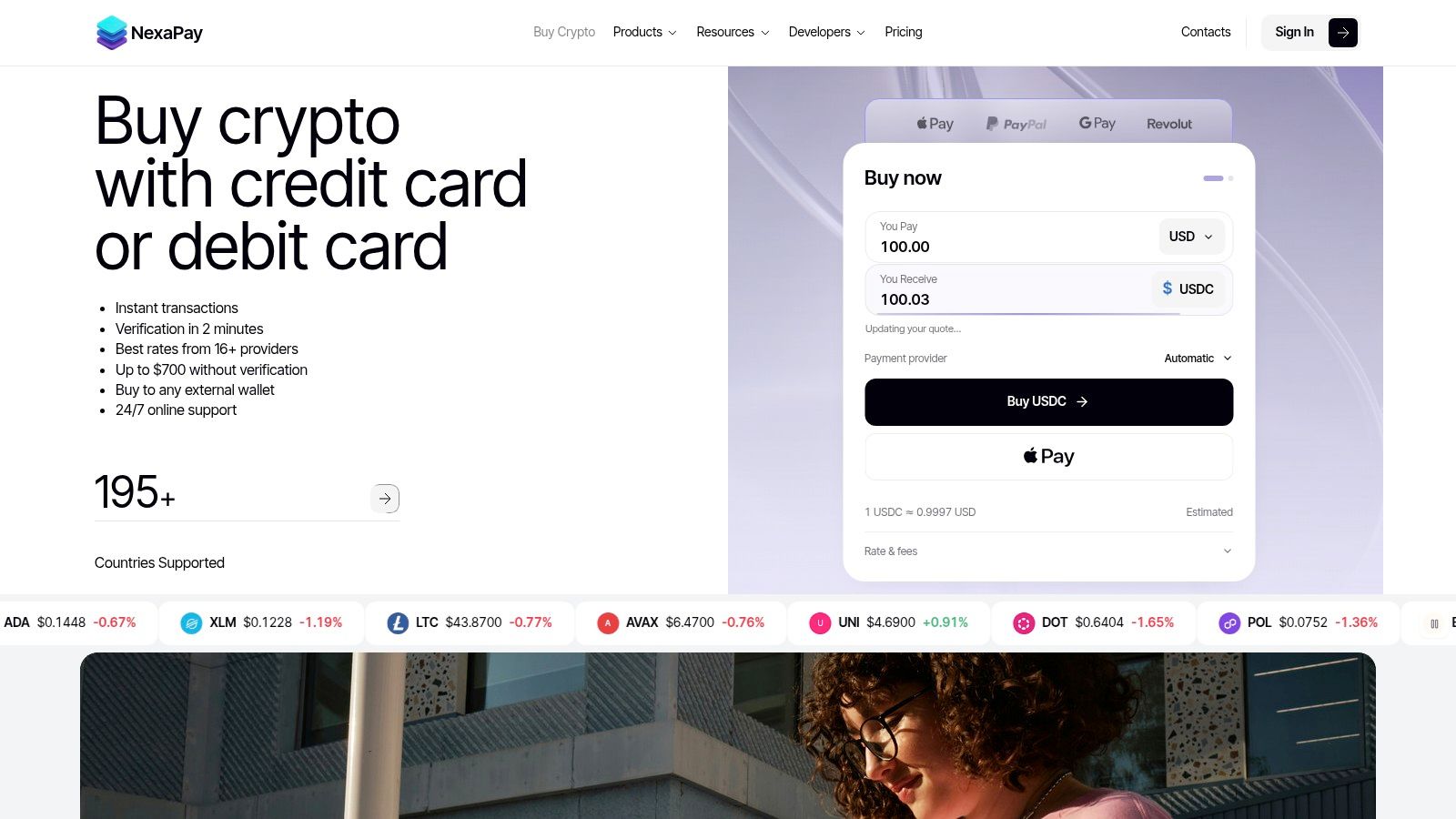
How NexaPay Instant Routes Fiat to Crypto
The live merchant product, NexaPay Instant, connects your store to licensed third-party providers including Alchemy Pay, Cash App, Stripe, PayPal, Banxa, and Transak. Customers pay with Visa, Mastercard, American Express, Apple Pay, or Google Pay on the provider's hosted checkout across USD, EUR, GBP, AUD, JPY, ILS, and 25+ other ISO 4217 currencies. Every fiat payment automatically converts at the current market rate and settles straight to your configured crypto wallet, with transfers typically initiated within 1 to 2 minutes after confirmation.
No merchant identity verification is required to start with Instant, and lawful businesses across digital goods, SaaS, and supported high-risk sectors can integrate in five steps: create an account for API keys, set a wallet address, generate a payment session via API, redirect customers to the hosted checkout, and receive crypto. Teams that want a deeper technical walkthrough can review the guide on setting up a fiat-to-crypto payment gateway. On the consumer side, individuals can buy Bitcoin (BTC), Ethereum (ETH), USDT, USDC, Solana (SOL), and over 40 supported assets by entering an amount, choosing their crypto, and paying by card, with no account required for basic purchases.
Regional Limits and Costs to Watch
No multi-provider setup works identically everywhere, so verify the operational boundaries before launch:
- Provider geography matters: PayPal and Cash App apply to U.S. buyers only, Stripe supports the U.S. and EU, Revolut covers the EU and UK, and Klarna serves Sweden only.
- Buyer verification still triggers conditionally: Merchants face no KYC on Instant, but individual providers may still request buyer identity checks depending on the region, transaction, and provider.
- Third-party fees apply: Provider processing costs and blockchain network fees sit on top of every transaction, so model those into your margin before pricing crypto checkout as a revenue channel.
- Upcoming features stay separate: NexaPay Flow, with planned native checkout, smart routing, and automatic provider fallbacks, is still listed as coming soon rather than active in Instant.
Card details route strictly through PCI DSS Level 1 certified third-party providers, and NexaPay does not store card data itself, though that certification belongs to the underlying processors rather than NexaPay directly. For merchants wanting USDC settlement on Polygon, white-label tools, or developer webhooks without building a compliance desk from scratch, Instant delivers a practical path to crypto revenue.
2. Newegg
Say you're building a workstation and want to spend Bitcoin on graphics cards, monitors, or storage drives. Newegg remains one of the longest-running mainstream electronics retailers to support crypto directly in its checkout flow. In December 2025, Capital One Shopping Research estimated that approximately 2,300 U.S. retailers accepted cryptocurrency as payment alongside 15,174 businesses worldwide, making established specialty retailers with clear checkout documentation relatively scarce.
Newegg processes Bitcoin and multiple other cryptocurrencies through BitPay, a third-party payment processor that handles wallet compatibility, exchange-rate locking, and merchant settlement. At checkout, you select BitPay, scan a QR code or connect a compatible wallet, and broadcast the payment within the invoice window. Because Newegg publishes detailed payment instructions on its site, buyers rarely have to guess which steps come next.
Where the BitPay Checkout Draws the Line
I recommend checking every item in your cart before choosing crypto on Newegg, because processor-backed retail checkouts enforce strict eligibility filters. Newegg excludes Marketplace items, subscriptions, pre-orders, and several other order types from BitPay checkout. You also can't complete a BitPay order everywhere on the platform: crypto checkout is restricted to Newegg's desktop site, and country availability varies.
Checkout rule: If a single third-party Marketplace cable sits inside a cart full of Newegg-fulfilled PC parts, the BitPay payment option won't work for that combined order. Split the cart so only directly eligible items go through crypto checkout.
From a merchant architecture standpoint, Newegg's setup shows why large retailers favor intermediaries like BitPay. The retailer keeps crypto settlement isolated from third-party seller payouts, recurring billing logic, and multi-channel mobile edge cases. Buyers get a dependable way to spend BTC on computer hardware, provided they stick to desktop browsers and first-party inventory.
3. AMC Theatres
Can you pay for a ticket with Bitcoin if the box office has no crypto terminal? At AMC Theatres, the answer depends on the channel, not the brand. AMC supports Bitcoin and several other cryptocurrencies through BitPay, and that option sits on the website and the mobile app. Physical theatre counters do not guarantee the same path.
That split is the practical lesson for any merchant weighing in-person crypto. Online rails can be configured once and reused across locations. Counter terminals depend on local hardware, staff who know the flow, and a point-of-sale setup that may disappear when a store changes vendors. Brick-and-mortar Bitcoin acceptance fluctuates over time for those reasons. Stores close, switch terminals, or drop crypto training, so a directory listing from last season is a weak signal for tonight's concession stand.
Online Checkout Over Counter Terminals
I would treat AMC as a digital pre-order, not a walk-up register. Buy tickets and eligible food or drink on the official site or app before you leave for the venue. BitPay is the processor on that checkout, so the wallet has to be one BitPay accepts, and it has to be ready before the invoice window closes. Confirm crypto still appears for that cart and theatre. Item rules and regional availability are not uniform across the chain.
The trade-off is control versus convenience. Keeping BitPay on web and app flows removes counter training and holds settlement on one integration. Buyers give up the chance to decide at the snack line. For entertainment spend, the documented digital checkout is the reliable route. Show up with a paid order, not an assumption that the register takes Bitcoin.
4. Namecheap
Most retail stores settle Bitcoin one cart at a time, which turns refunds and partial cancellations into an accounting tangle. Namecheap takes a cleaner operational route by accepting Bitcoin through BTCPay to top up your account balance rather than tying every domain renewal to a separate on-chain invoice. That approach directly addresses one of the biggest barriers keeping merchants away from crypto: in Block's Bitcoin payments report, 23.6% of businesses that don't accept Bitcoin cited tax and accounting complexity as a reason.
Here is the Namecheap storefront where site owners manage domains, hosting, and SSL certificates funded through those prepaid balances:
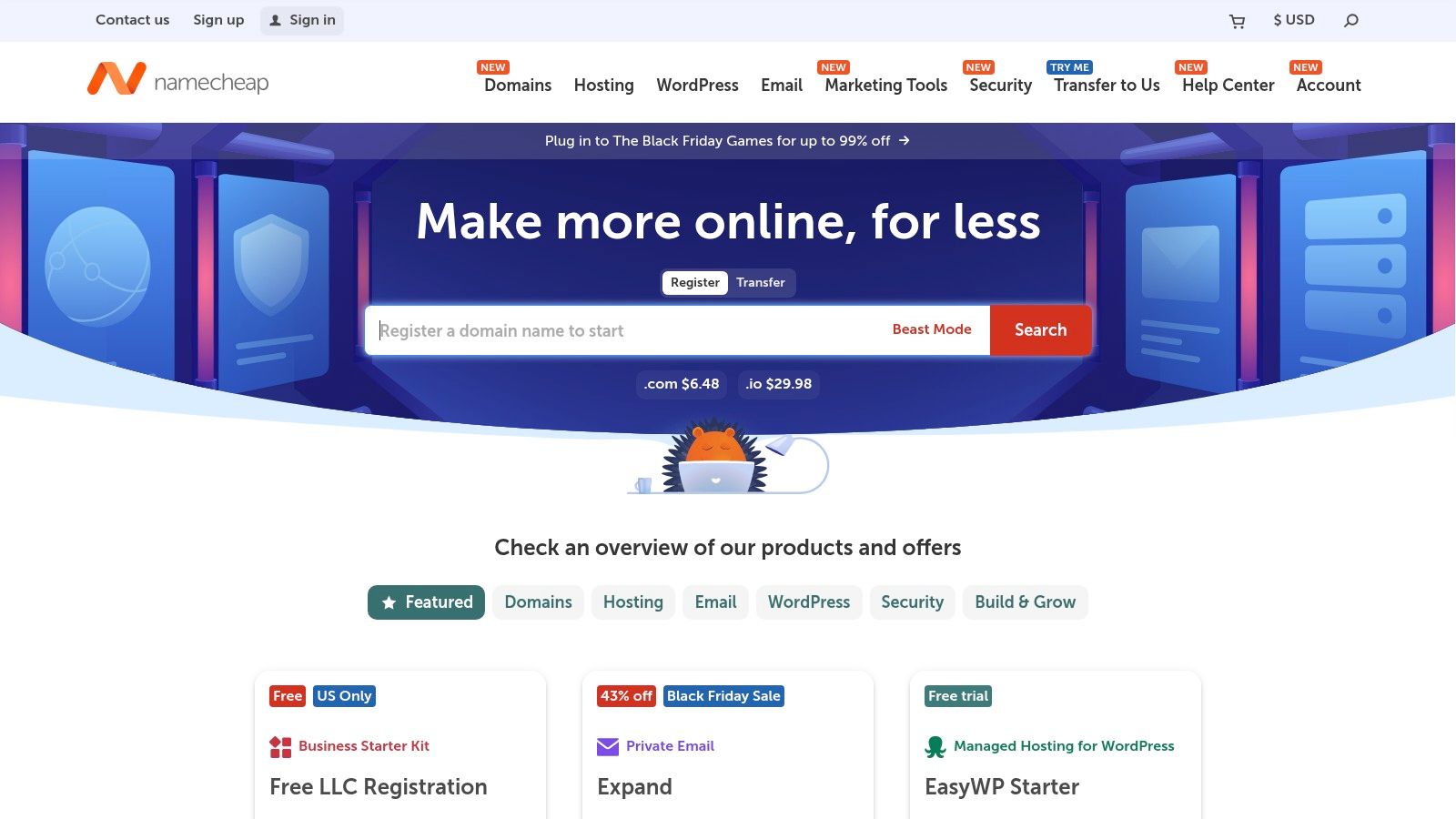
Prepaid account top-ups shift exchange-rate timing to a single deposit event, sparing both the merchant and the buyer from recalculating tiny domain renewals across volatile price swings.
Prepaid Balances Versus Direct Checkout
Namecheap lets you deposit between $1 and $100,000 into your account via BTCPay from any standard Bitcoin wallet, with no requirement to use a specific wallet brand. Once credited, that balance pays for domains, web hosting, SSL certificates, and related online-business services. Namecheap documents the exact flow clearly, which helps technical buyers fund annual infrastructure renewals in one transaction.
The trade-offs require careful planning before you send funds. BTCPay deposits are non-refundable, so never overfund an account expecting a cash-out later. Account crediting can also take longer than the on-chain confirmation itself, and standard Bitcoin network fees apply. For merchants evaluating Namecheap's model, running self-hosted open-source software like BTCPay eliminates processor middlemen and fees, but it shifts node security, patching, and uptime monitoring squarely onto your own engineering team.
5. Travala
Hospitality is where direct Bitcoin spending has built its deepest global footprint. A 2025 peer-reviewed study analyzing approximately 11,000 merchants worldwide on BTC Map, archived via the German National Library (DNB), found that merchant adoption concentrated particularly in hospitality (alongside alternative healthcare and IT services), with at least one recorded merchant in 131 of 256 defined countries and territories. Travala captures that demand online by letting travelers book hotels, flights, and travel products across more than 230 countries.
Unlike single-processor retail checkouts that limit your asset choices, Travala's help center lists BTC among more than 100 accepted cryptocurrencies, alongside conventional payment cards. If you're deciding whether to pay a high-value flight invoice with BTC or another coin, comparing network confirmation speed and fees matters; our breakdown of Ethereum or Bitcoin explains how those settlement dynamics differ in practice.
Exact Amounts and Confirmation Timing
Paying for live travel inventory with raw on-chain Bitcoin leaves very little margin for user error. Before sending funds on Travala, verify these checkout rules:
- Send the exact quoted amount: Travala generates a specific payment address and BTC figure; underpaying by even a tiny exchange withdrawal fee can stall confirmation and delay ticket issuance.
- Budget time for three confirmations: BTC bookings require three blockchain confirmations, which means you shouldn't wait until minutes before a flash hotel deal or flight fare expires to broadcast a low-fee transaction.
- Read supplier booking terms: Availability, cancellation windows, and refund formats depend on the underlying airline or property rather than Travala's payment screen alone.
Travala proves that Bitcoin works smoothly for high-ticket cross-border bookings where card international fees sting. Just pay from a self-custody wallet where you control exact send amounts and miner fees, rather than withdrawing straight from a centralized exchange that deducts fees from the output.
6. Bitrefill
Try paying for groceries, rideshares, or mobile data directly with Bitcoin in an average suburb and you'll hit a wall fast. Independent spatial research published in Financial Innovation via Springer confirms that verified Bitcoin merchant clusters form locally around grassroots initiatives and social networks, such as Berlín in El Salvador, rather than spreading evenly across a country. Bitrefill solves that geographic gap through indirect acceptance: you pay Bitrefill with Bitcoin and receive digital gift cards, mobile top-ups, or eSIMs redeemable at everyday brands that don't touch crypto themselves.
Below is the Bitrefill catalog interface, where shoppers filter gift cards and digital services by country before checking out:
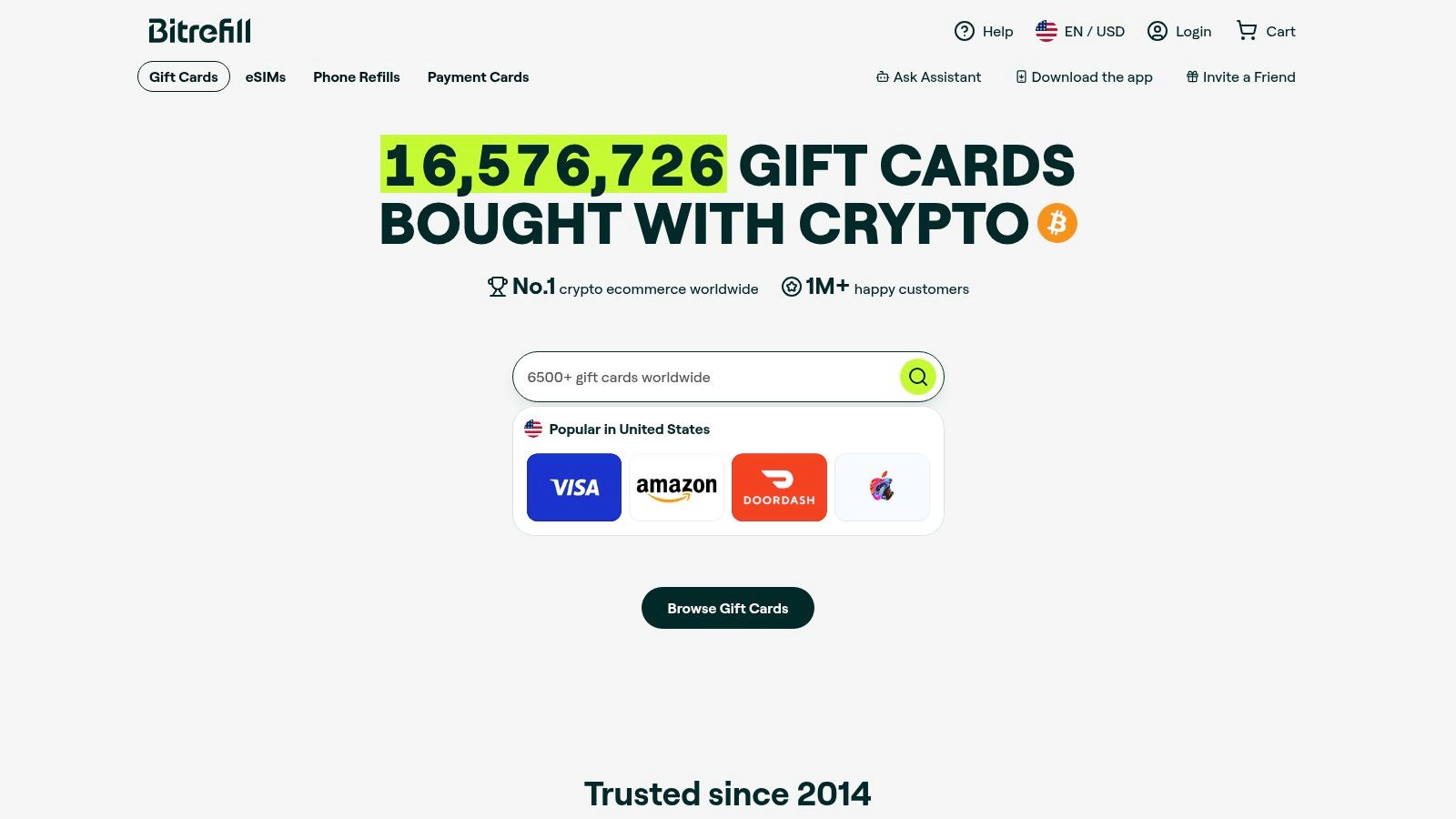
Why Indirect Acceptance Works Where Direct Checkout Stalls
Bitrefill accepts Bitcoin both on-chain and over the Lightning Network, along with several other cryptocurrencies and some conventional payment methods. Lightning support changes the day-to-day experience completely: buying a $20 eSIM or coffee voucher settles in seconds instead of waiting on on-chain block times, and you can pay directly from your own wallet. Buyers who want to fund a wallet quickly before purchasing vouchers can also check how to buy Bitcoin with no ID within provider limits.
Wallet warning: Double-check both the asset and the network before scanning a Bitrefill invoice. Sending unsupported coins or choosing the wrong network may result in non-refundable funds.
Keep two constraints in mind before relying on indirect workarounds. First, brand selection, denominations, and product availability vary heavily by country, and gift-card returns follow the underlying retailer's policy rather than a simple crypto refund. Second, network fees and any applicable service fees still sit on top of your purchase, so Lightning usually beats on-chain BTC for smaller everyday vouchers.
7. Playasia
Cross-border gaming commerce runs into card declines and currency friction constantly, especially when buyers order region-specific consoles, physical imports, or digital codes from overseas. Playasia bridges those gaps by offering cryptocurrency checkout through BitPay alongside its specialist catalog of video games, collectibles, and gaming merchandise.
Inside checkout, eligible orders let you select BitPay and pay from a compatible wallet using either a QR code or manual payment details. That dual option matters when you're ordering on a desktop computer while holding funds in a separate mobile or hardware wallet that doesn't connect directly through a browser extension.
Cross-Border Pricing and BitPay Limits
Because Playasia ships globally and handles mixed physical and digital inventory, checkout rules shift depending on what you buy and where it ships:
- Processor intermediary applies: Payments route through BitPay rather than settling directly to Playasia's own node, meaning BitPay governs wallet compatibility and invoice expiration windows.
- Eligibility varies by order and region: Supported cryptocurrencies, eligible catalog items, and checkout methods can change depending on your shipping destination and cart contents.
- Landed cost shifts by destination: Final totals reflect product pricing plus regional shipping rates, so confirm the full invoice before locking in a crypto payment rate.
For international gamers who already hold Bitcoin or other BitPay-supported coins, Playasia offers a straightforward alternative to cross-border card processing. As with Newegg and AMC, check cart eligibility early if you mix pre-orders, digital codes, and physical merchandise in a single shipment.
Bitcoin Payment Acceptance at a Glance
| Item | Category | Bitcoin Payment Method | Key Limitation | Best For |
|---|---|---|---|---|
| NexaPay | Crypto payment gateway | Fiat payment methods for buying Bitcoin; merchant checkouts can settle in crypto | Availability, verification, and fees vary; some features are not yet available | Buying crypto or accepting crypto settlements as a merchant |
| Newegg | Electronics retailer | BitPay checkout on desktop | Excludes some purchase types; availability varies by country | Buying computer parts and electronics |
| AMC Theatres | Entertainment | BitPay on the website and app | Online checkout only; eligible purchases may vary | Movie tickets and eligible food or drinks |
| Namecheap | Domain and hosting provider | Bitcoin via BTCPay account top-up | Deposits are non-refundable and may take time to credit | Funding an account for domains and online services |
| Travala | Travel booking site | Bitcoin checkout for travel bookings | Exact payment amount required; three confirmations needed | Booking accommodation, flights, and other travel |
| Bitrefill | Digital goods and services | Bitcoin on-chain or Lightning | Often indirect spending through gift cards; availability varies | Using Bitcoin for gift cards, mobile top-ups, and eSIMs |
| Playasia | Gaming retailer | BitPay checkout using a compatible wallet | Supported coins and eligible orders vary | Buying video games and gaming merchandise |
Turning Bitcoin Acceptance Into a Practical Strategy
Does adding Bitcoin change how a business gets paid? A National Bureau of Economic Research working paper combining a nationally representative survey of 1,800 households in El Salvador with Chivo Wallet blockchain analysis found that, even under nationwide legal-tender status, only 20% of firms reported accepting Bitcoin and just 11.4% recorded positive Bitcoin sales (averaging 4.9% of total sales). 88% of firms converted Bitcoin receipts immediately into U.S. dollars rather than holding BTC on their balance sheets.
Treat Bitcoin as an incremental payment rail beside cards and local currency. Direct acceptance is growing in hospitality, tech services, and specialty retail, but country exclusions and cart limits still leave some orders that a native Bitcoin checkout will not clear. Buyers then fall back on indirect bridges such as gift cards. Fiat-to-crypto gateways invert the flow: the customer pays with a card or a digital wallet, and the merchant is settled in crypto with no manual conversion step.
Action Steps for Bitcoin Buyers
Check the checkout before you fund a wallet. Confirm whether the brand takes Bitcoin on mobile, desktop, or both, whether marketplace items are excluded, and whether the payment goes through BitPay, BTCPay, or a direct address. Match the rail to the order. Lightning fits small vouchers and mobile top-ups, where a long confirmation wait costs more than the purchase. On-chain BTC fits larger invoices, provided you can send the exact amount and wait out the confirmations that merchant requires. Keep the timestamp, the fiat value at the moment of payment, and the refund policy. Non-refundable prepaid balances, including account top-ups, do not come back if the amount or the address is wrong.
Settlement Decisions for Merchants
Set the back office before you turn on the button. The first choice is who holds price risk. Retaining BTC means you accept swings and the security work of self-custody. Instant conversion to fiat or stablecoins keeps accounting predictable, which is what nearly nine in ten firms in that El Salvador sample already chose. Next, map the countries, payment methods, and verification thresholds your providers support. Do not advertise a global card-to-crypto or Bitcoin checkout until that map is done. Then track completed orders, repeat use, and how fast funds arrive. A crypto badge on the site is not a sales figure.
In 2026, useful Bitcoin commerce is less a yes-or-no directory and more hybrid infrastructure that hides chain friction from the shopper. Pair a familiar fiat checkout with settlement to a configured wallet, written refund rules, and accounting that does not depend on someone moving coins by hand.
Ready to bridge conventional customer payments with instant cryptocurrency settlement? NexaPay connects card, Apple Pay, and Google Pay checkouts to settlement to merchants' configured wallet addresses in 1 to 2 minutes with zero merchant KYC to start on Instant, while letting individuals buy 40+ cryptocurrencies straight to their own wallets. Explore the live merchant gateway and consumer onramp at NexaPay.