Crypto Payment Gateway Guide: How to Choose in 2026
Compare crypto payment gateway models, settlement choices, and integrations, then choose a provider with a practical merchant checklist.
You open four browser tabs to compare crypto payment providers. Every landing page promises instant settlement, tiny processing fees, and zero chargebacks. By the second sales call, though, your finance lead is asking how refunds get issued when a buyer pays by card, and your developer wants to know why a webhook says "paid" before a single block has confirmed on-chain.
That disconnect is where most merchant integrations go sideways. Commercial adoption has grown quickly since Bitcoin's early days: a 2019 Deloitte survey cited by Bitcoin.com News found that 85% of business leaders viewed cryptocurrency as a viable payment option, and by 2023 the number of merchants accepting Bitcoin payments had nearly tripled. Yet headline blockchain activity can be misleading. According to CoinLaw's crypto payment gateway statistics, stablecoin transactions reached approximately $11.4 trillion in 2025, while only about $390 billion represented genuine payment activity rather than trading or arbitrage, with stablecoins accounting for roughly 82% of crypto-payment activity across gateways (led by USDT and USDC).
Choosing a crypto payment gateway means looking past raw on-chain volume and marketing slogans. Payment authorization and blockchain settlement are two different events. Once you separate them, the factors that decide merchant outcomes become obvious: refund currency, card chargeback liability, and the full stack of hidden fee layers.
The Three Crypto Payment Gateway Models Compared
A crypto payment gateway isn't a single standardized product. Nearly every vendor on the market wraps its dashboard and branding around one of three underlying operating models: a hosted checkout redirect, an API or embedded checkout, or a processor-hosted fiat-to-crypto flow.
| Model | Who holds funds mid-flow | Merchant KYC | Customer verification | Settlement | Chargeback exposure |
|---|---|---|---|---|---|
| Hosted checkout redirect | Licensed third-party payment provider | Set by provider and region; some require none to start | Provider performs checks at checkout | Fiat or crypto to merchant wallet, often within minutes after confirmation | Card issuer disputes can still occur after crypto settlement unless contract assigns liability |
| API or embedded checkout | Provider, then gateway routes | Same as hosted plus API onboarding | Provider at checkout | Crypto to configured wallet address | Same as hosted; merchant must reconcile webhooks against chain data |
| Processor-hosted fiat-to-crypto | Gateway's provider network | Provider underwriting applies | Provider at checkout | Crypto only, auto-converted at market rate | Merchant bears mismatch risk if delivery precedes finality |
Two popular marketing claims deserve immediate skepticism: "no merchant KYC" and "no chargebacks." Neither is a universal feature of crypto rails. Both depend entirely on the specific provider's licensing model, the card acquirer sitting behind the checkout, and the jurisdiction where your customer sits. Verify both claims in writing before you write a line of code.
When Each Model Wins
Hosted checkout redirects win for small e-commerce stores, SaaS teams, and digital goods sellers that want to ship fast without touching cardholder data. Because the buyer leaves your site to pay on the provider's page, your PCI DSS compliance scope stays with the third party. You give up some visual control over the checkout form, and you gain speed to launch with minimal engineering overhead.
API or embedded checkouts make sense for platforms with custom storefronts, multi-currency carts, or automated provisioning pipelines. Your backend generates a payment session using an API key, returns a checkout link or embedded widget, and listens on a webhook endpoint for status updates. That extra flexibility comes with operational responsibility: you must validate signatures and reconcile incoming notifications against on-chain data yourself.
Processor-hosted fiat-to-crypto gateways bundle card processing and instant crypto conversion into one pipeline, operating much like a specialized payment facilitator connected to blockchain settlement rails. Customers pay with conventional cards or mobile wallets while you receive digital assets directly in a configured wallet. This fits merchants who want global card reach without opening traditional merchant acquiring accounts in every target region, provided they manage fulfillment timing carefully.
Before you compare logos or fee sheets, answer one foundational question that narrows the field immediately: does your business need the gateway to settle in fiat to a bank account, or in crypto directly to a merchant wallet?
How a Crypto Payment Moves From Checkout to Wallet
Most integration bugs happen because teams treat a crypto checkout like a traditional card swipe. On the surface, the user journey looks familiar, and a clean architecture breaks it into four distinct operational stages.
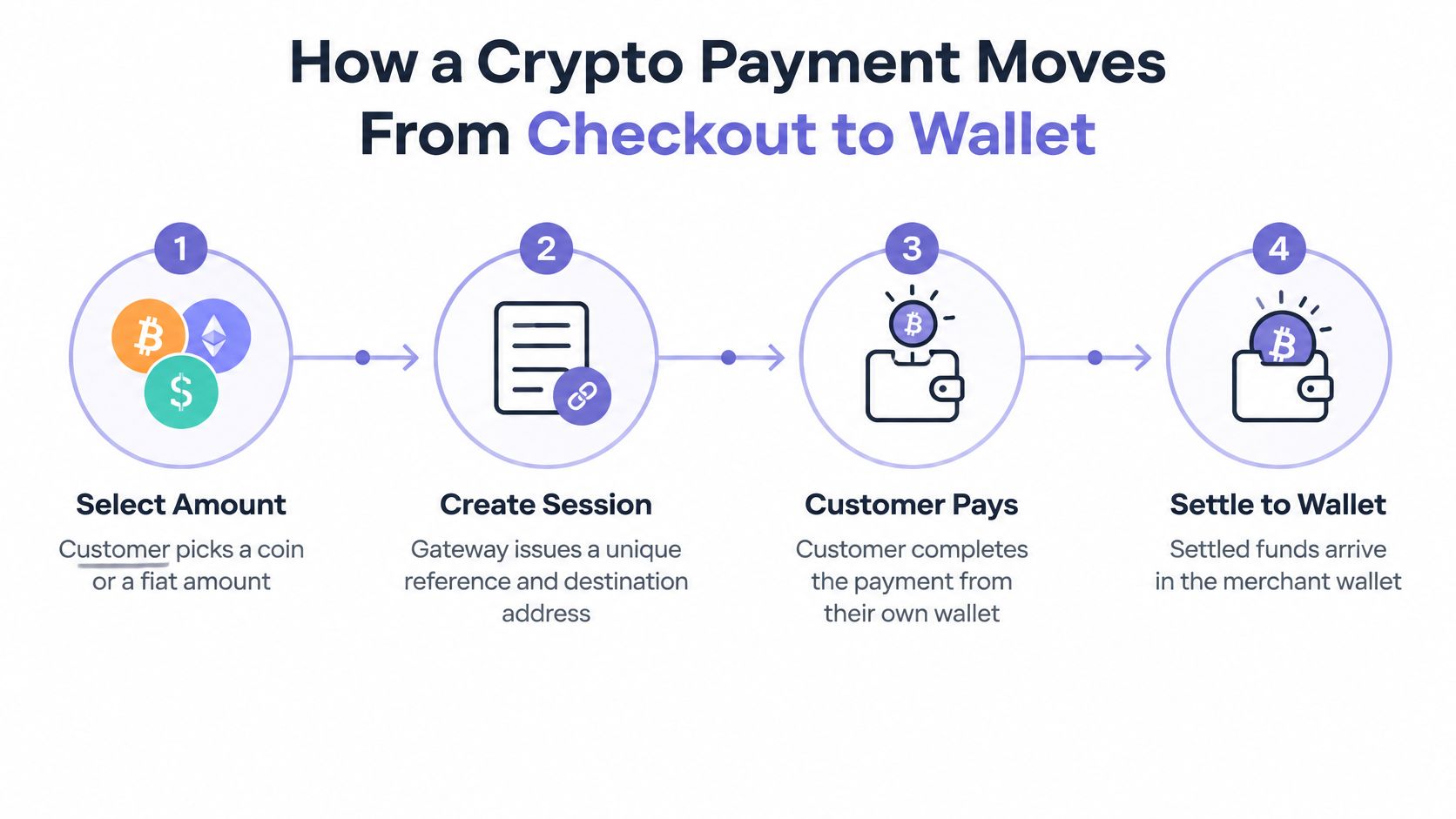
First, the buyer selects a coin or a fiat order amount on your storefront. Second, the gateway creates a payment session tied to a unique reference ID and generates a dedicated destination address so incoming funds can't collide with another customer's order. Third, the customer completes payment through the provider-hosted checkout using a card, mobile wallet, or personal crypto wallet. Finally, once the provider authorizes the payment, the gateway records the payer's asset, network, exact amount, and block height, then initiates settlement to your merchant wallet.
Why Card Authorization Is Not Blockchain Finality
A card payment is a promise a bank can reverse; a blockchain transaction is a receipt a network can't un-write. Your gateway's real job is to bridge those two systems without pretending they behave the same way.
Card networks return an authorization response in seconds, yet the issuing bank can pull those funds back weeks later through a dispute. Distributed ledgers work in reverse. As the Bank for International Settlements (BIS) working paper on stablecoins explains, permissionless distributed-ledger systems can face limited scalability and high costs when achieving payment finality, while multiple synchronized ledgers and processing nodes can restrict real-time processing during volume spikes. Even when you settle in stablecoins to cut exchange-rate swings, the BIS notes that stablecoin transfers don't settle on a central-bank balance sheet and still carry issuer, reserve, liquidity, operational, and de-pegging risks.
Because on-chain settlement is subject to chain reorganizations (reorgs), transaction replacements, and stuck mempool transfers, a production gateway must run chain-specific monitoring and apply configurable confirmation policies. For a low-value digital download, accepting a transaction on early observation may make commercial sense. For a high-value invoice or irreversible software license, your system should wait for additional block confirmations or a provider-specific finality signal before releasing the goods.
Never build your order fulfillment around a binary paid/unpaid flag. If your gateway can't expose granular payment states, your support team will spend its week untangling expired sessions and stuck transfers manually.
A well-designed merchant interface exposes a full state machine with explicit statuses:
- Created: The session exists and awaits customer action before its quote expires.
- Payment detected: Funds appeared in the mempool or card authorization succeeded, but finality isn't met yet.
- Provisionally accepted: Risk thresholds are satisfied for low-value release while final confirmations finish.
- Finalized: Required confirmations cleared and settlement is complete under your treasury rules.
- Expired, refunded, or under review: The payment missed its window, was returned, or triggered compliance or anomaly checks.
Choosing Settlement Assets and Networks
"Accepting crypto" sounds like toggling a single switch in your store settings. In production, it's three separate decisions: what asset your customer pays with, what asset lands in your treasury, and which blockchain network carries the transfer.

Data from Visa's stablecoin report illustrates why asset and network selection can't be an afterthought. Retail-sized stablecoin volume for USDC, USDT, and PYUSD grew from approximately $0.5 billion in 2019 to $69.8 billion in 2025, with retail transactions representing 57% of transaction count yet only about 0.6% of adjusted stablecoin volume. That ratio reveals a long tail of small consumer purchases where network fees, confirmation delays, wrong-chain wallet errors, and minimum payout thresholds can wipe out your margin. The same report found B2B payments leading at an annualized run rate of $36 billion, card-linked payments reaching $13.2 billion, and Tron, Ethereum, Polygon, and Binance Smart Chain ranking among the top settlement networks.
Your customers' geography shapes the right network choice just as much as fee tables do. A buyer in the United States often holds USDC on Ethereum or Polygon, while a buyer in Southeast Asia or Latin America may rely heavily on USDT over Tron, and a European merchant has to weigh regional stablecoin compliance frameworks. Asking "Can this gateway accept USDC?" isn't enough. You need to ask whether the gateway can route stablecoins by customer region, wallet compatibility, and fee conditions while settling into the exact asset your finance team can account for.
Matching Your Treasury to a Settlement Policy
Use this lookup table to align your business operations with the right settlement configuration before you configure wallet addresses.
| Merchant situation | Settlement choice | Reason |
|---|---|---|
| Treasury stability across customers | Stablecoin settlement (USDC or USDT) | Reduces exchange-rate exposure versus BTC or ETH |
| Hold or convert immediately | Volatile coin settlement | Only if the merchant converts at once |
| Accounting or payroll needs fiat | Fiat settlement | Matches books and payroll cash |
| Fragmented customer regions | Multi-chain routing | Fits wallet, fee and compliance conditions per region |
Settling in stablecoins removes Bitcoin or Ether price swings, yet it introduces operational risks your accounting team must track. A stablecoin can temporarily lose its dollar peg during market stress (depeg exposure), and centralized issuers retain the technical ability to freeze specific addresses during compliance investigations. Running multiple networks also means reconciling chain-specific compliance screening, different block explorers, and separate gas tokens across every ledger you enable.
For a deeper walkthrough of how enterprise payment flows connect stablecoin liquidity and network choices in practice, watch this overview.
Before going live, document four parameters in your internal treasury policy for every settlement path you activate: the exact asset, the network, the fee basis (who pays incoming and outgoing gas), and the conversion timing that dictates when received crypto turns into operating cash.
Integrating a Gateway and Securing the Money Path
From an engineering standpoint, getting a hosted crypto checkout running is straightforward. Platforms running standard e-commerce stacks such as WooCommerce can often connect through an official plugin in minutes, while custom web apps wire directly into the gateway's REST API.
Regardless of your stack, the standard integration path follows five steps:
- Create an account and generate API keys. Keep test and production credentials strictly isolated in your secrets manager.
- Set your destination crypto wallet address in Settings. Double-check both the wallet address and the exact network assigned to it, since funds sent on the wrong chain are often unrecoverable.
- Create a payment session via the API. Send the order amount, currency, and unique internal reference ID; the gateway responds with a hosted
checkout_url. - Redirect the customer to the hosted checkout page. The buyer completes card, wallet, or crypto payment inside the provider's secured environment.
- Receive crypto when payment completes. Once confirmation rules pass, settlement transfers directly to your configured wallet and triggers your fulfillment logic.
Security Boundaries and Custody Controls
Getting the checkout redirect working takes an afternoon. Securing the money path takes deliberate architecture. Smart-contract interactions and wallet custody aren't minor implementation details; they're your primary attack surface.
According to the NIST stablecoin security report, oracle manipulation, smart-contract bugs, and transaction-ordering attacks can lead to fraudulent transfers, lost tokens, governance manipulation, or frozen protocol components. NIST recommends formal security analysis, reputable third-party audits, formal verification where appropriate, and public bug-bounty programs. The same analysis emphasizes that two stablecoins serving identical market roles can carry sharply different risk profiles depending on their code complexity, administrative controls, and trust assumptions.
Before handling production volume, enforce these operational controls across your gateway integration and treasury wallets:
- Strict asset-and-network allowlists: Validate chain identifiers and exact token contract addresses on every transaction, and reject unsupported fee-on-transfer or rebasing tokens unless your accounting logic explicitly models them.
- Pre-sign verification: Run destination-address compliance screening and transaction simulation before signing or broadcasting any outgoing payout or refund.
- Key custody discipline: Protect treasury balances with hardware-backed custody or multi-party computation (MPC) rather than single-key hot wallets, and evaluate whether a custodial or non-custodial wallet setup matches your internal security team's capacity.
- Treasury guardrails: Enforce hot-wallet spending limits, require dual approval for treasury sweeps, maintain immutable audit logs, and build a kill switch for rapid token or network disablement if an asset depegs or a bridge breaks.
Treat incoming webhooks with the same rigor. Every callback must be cryptographically authenticated, processed through an idempotent handler so duplicate deliveries don't double-ship orders, and guarded against replay attacks. As a final check, reconcile every settlement webhook against independently queried blockchain data. A provider callback alone should never act as your sole source of settlement truth.
Go-live verification rule: Before opening checkout to customers, run a small live transaction end to end, confirm every state machine transition in your logs, and deliberately simulate a delayed or duplicated webhook to verify your fulfillment system stays consistent.
Fee Structure Beyond the Headline Rate
A gateway quotes a low headline processing fee on its pricing page. Six weeks later, your finance team reconciles the bank account and wallet balances, and the net amount received doesn't match the order totals. Nothing was necessarily hidden. Total payment cost is built from five distinct layers, and the headline rate only describes the first one.
The headline commission sits at the top of the invoice. Confirm in writing whether that percentage applies to the gross order amount or to the net balance left after currency conversion. Right beside it sit provider fees: card-acquiring surcharges, account onboarding charges, monthly platform minimums, or bank wire withdrawal charges when moving fiat out of a custodial balance.
Next come network fees paid directly to blockchain validators. Because a chain fee is priced per transaction rather than as a percentage of cart value, a fixed gas cost that looks trivial on an enterprise invoice can devour the margin on a small consumer purchase. In high-volume retail checkouts, enabling a congested network without an affordable alternative turns small orders unprofitable overnight.
The fourth layer is the conversion spread, meaning the gap between the mid-market exchange rate and the rate applied when fiat turns into crypto or crypto converts back into fiat. Your treasury timing dictates how much spread you pay: automatic checkout conversion locks a rate immediately, whereas holding volatile crypto and converting manually in batches exposes you to market slippage plus separate exchange fees.
Finally, factor in minimum payout thresholds and operational friction. Funds trapped below a minimum withdrawal threshold tie up working capital, while customer underpayments, wrong-network deposits, and stuck transactions create support overhead that never shows up on a vendor's fee schedule.
How to Measure Real Net Cost
Don't compare gateways using marketing tables. Pick one realistic order size from your store and request a written breakdown of all five fee layers from two providers across two settlement networks, alongside their refund and dispute fees.
Once you narrow your shortlist, execute one small live payment on each platform. Subtract the exact value that reaches your usable wallet or bank account from the gross checkout total. That delta is your true effective rate.
Merchant Checklist for Refunds, Disputes and Liability
Most comparisons of crypto gateways obsess over speed and low fees while glossing over the ugliest edge case in hybrid payments: what happens when a card-funded purchase triggers a refund, fraud investigation, or chargeback after crypto has already settled to your wallet?
Blockchain transfers are irreversible, yet the card networks feeding those checkouts aren't. A cardholder can dispute a charge with their issuing bank weeks after your gateway delivered digital assets to your wallet. Unless your merchant agreement assigns that loss explicitly, you face a brutal mismatch where you can lose both the delivered product and the payment proceeds. This exposure hits digital goods, SaaS subscriptions, iGaming, adult content, and other high-risk sectors hardest.
As highlighted in the Capgemini World Payments Report 2026, merchants are willing to pay a premium for fraud prevention and chargeback automation, underscoring that raw settlement speed isn't the sole criterion buyers care about. Card-network rules, local consumer protection laws, and provider underwriting can override the apparent finality of an on-chain transfer in any fiat-to-crypto payment gateway setup.
Before you sign an agreement, walk every shortlisted provider through these five core operational areas.
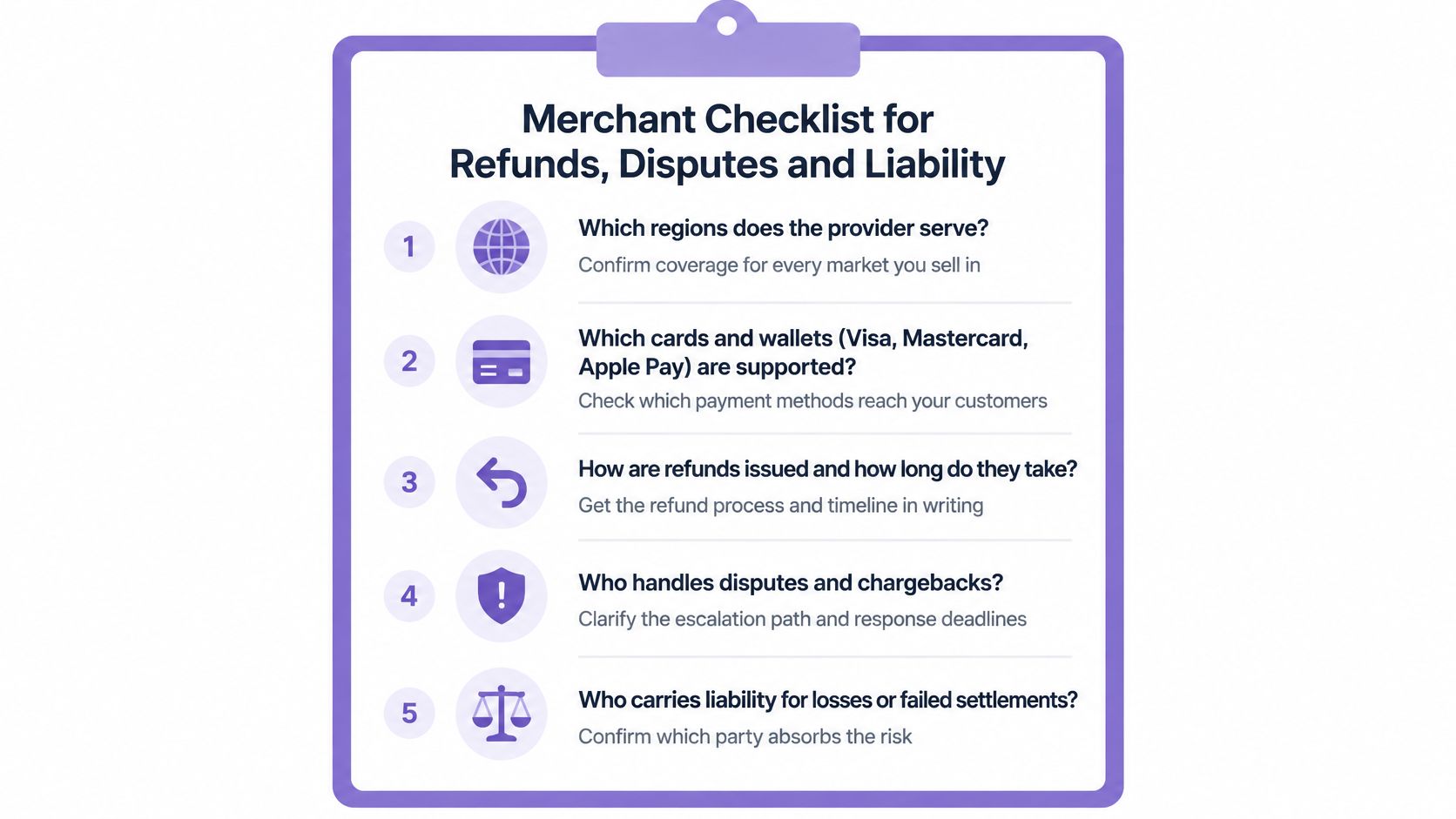
Six Questions to Put in Writing
Take these six questions into your vendor evaluation and insist on documented answers rather than verbal assurances on a sales call.
- Which regions, cards, and wallets are live for our merchant category? Don't settle for a global country count. Confirm coverage for Visa, Mastercard, Apple Pay, Google Pay, and local payment methods in your top buyer markets, filtered specifically for your industry risk tier.
- Who handles customer verification, and what friction hits the buyer? Ask which identity documents trigger at checkout and at what ticket thresholds, because surprise KYC pop-ups mid-purchase tank conversion rates.
- Which settlement assets and confirmation policies apply by order size? Confirm support for BTC, ETH, USDT, USDC, or SOL, check whether fiat settlement is available, and verify whether low-value and high-value orders can follow different block-confirmation rules.
- How does the refund workflow operate end to end? Pin down the refund currency (fiat back to the card or crypto to a customer wallet), which exchange rate applies when asset prices moved since purchase, how partial refunds work, and how the provider verifies the buyer's return wallet address.
- Who absorbs a card chargeback after on-chain settlement? Get the exact contractual clause covering post-settlement card disputes, fraud evidence submission timelines, reserve holds, and whether funds can be clawed back from future payouts.
- What do the API, webhooks, and reconciliation exports provide? Inspect the developer documentation before signing. Look for signed webhooks, idempotency keys, replay protection, and downloadable transaction logs showing order ID, gross amount, exchange rate, fees, and on-chain transaction hash.
Mapping Chargeback Liability by Gateway Model
Use this reference table during contract review to verify how liability and delivery timing shift across architectures.
| Model | Who absorbs the card chargeback | Refund currency | Delivery guidance |
|---|---|---|---|
| Hosted checkout with crypto settlement | Gateway or processor per contract; merchant if not specified | Crypto or fiat per contract | Delay fulfillment for higher-value orders until finality policy is met |
| Processor-hosted fiat-to-crypto | Merchant in most setups unless contract states otherwise | Fiat card reversal plus merchant crypto recovery | Hold high-value deliveries until dispute window risk is assessed |
| Embedded API with provider fallbacks | Split by provider terms; merchant must verify each | Provider-defined | Confirm liability per provider before enabling high-risk categories |
A provider that can't answer your refund-currency and chargeback-liability questions in writing isn't ready for high-risk volume.
Worked Example Mapped to the Model Table
Applying this framework to a live provider keeps vendor selection objective. Consider how NexaPay maps onto the model table and checklist above.
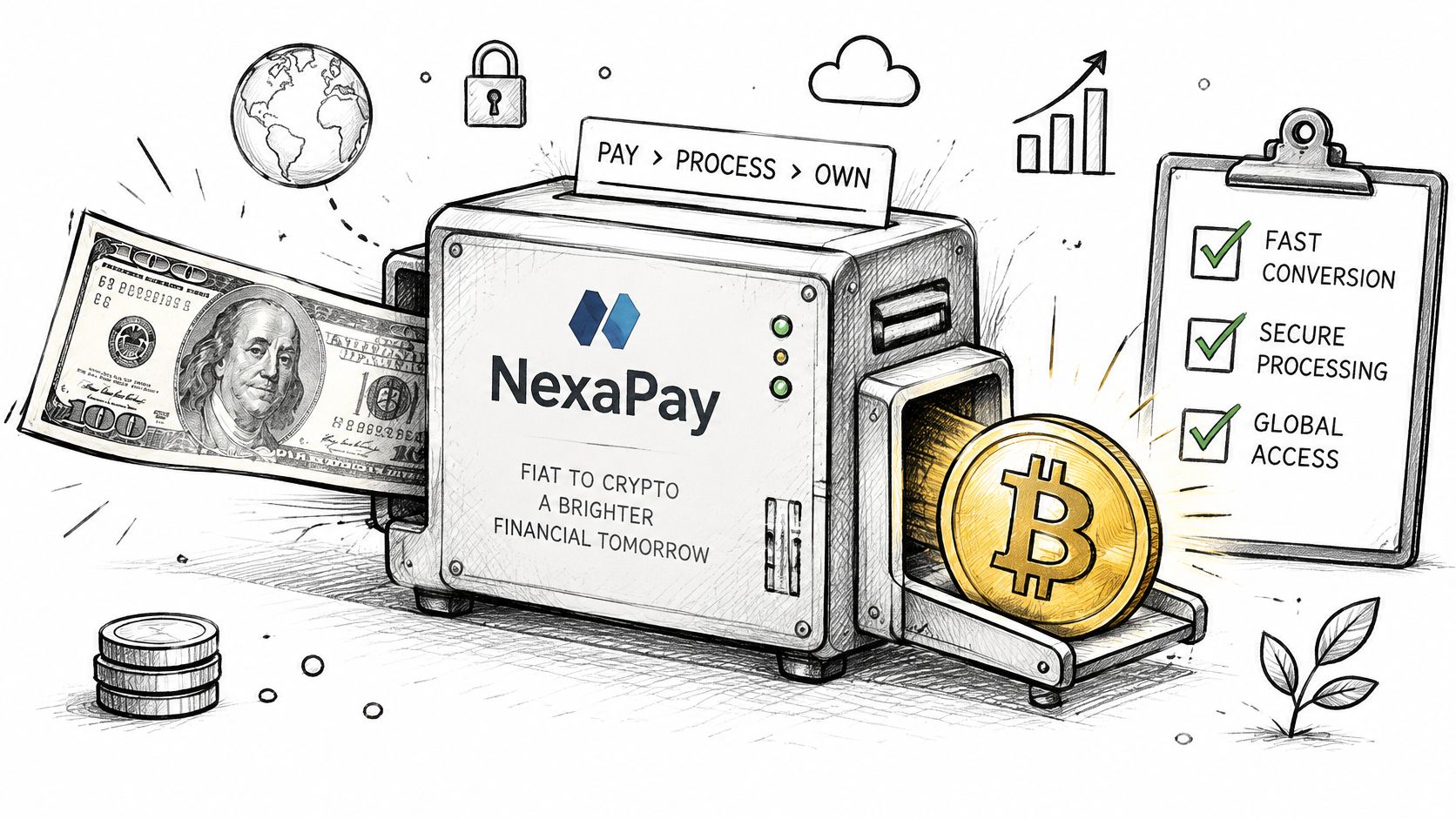
On architecture, NexaPay fits the processor-hosted fiat-to-crypto pattern. NexaPay describes itself as a no-KYC fiat-to-crypto payment gateway where merchants accept cards, Apple Pay, and Google Pay and get paid in crypto instantly. Under the hood, card processing and buyer verification run through licensed third-party providers at hosted checkout, while crypto settlement pays merchants directly to their own wallet.
Because you never assume a marketing claim applies universally to your jurisdiction, treat every attribute as a live verification item. Confirm in writing how merchant onboarding rules apply to your business entity and which identity checks the underlying payment providers trigger for buyers in your target countries.
On integration, the path matches the two common tiers: store owners can connect through a WooCommerce plugin in minutes, or engineering teams can link any custom site through the NexaPay API. Once connected, you still run the exact same written checklist you'd run on any competing gateway: confirm the refund currency policy, verify how card disputes and chargeback liability are handled across your product categories, and document which settlement assets and networks are available per region.
Finally, separate shipped features from upcoming releases when building your launch plan. NexaPay Flow, which is coming soon, is slated to add native checkout, fiat-to-crypto payments across 600+ providers, automatic fallbacks, smart routing, and high-risk support. Ask for a written roadmap and release timeline, yet build today's production workflows strictly around capabilities that are live and testable right now. Scoring every shortlisted provider against identical table rows and written questions keeps your evaluation fair and your risk documented.
Your Next Step Before You Integrate
Moving from research to live transactions goes smoothly when you follow a strict sequence instead of rushing straight into API keys:
- Pick your operating model first based on whether your finance team needs fiat bank deposits, direct wallet settlement in crypto, or both.
- Shortlist two or three gateways and send the six checklist questions to each in writing.
- Lock down refund currency and chargeback liability in your contract before enabling card-funded checkouts.
- Run one small live payment end to end to inspect net receipts, webhook reliability, and every state machine transition.
- Document your asset, network, and conversion policy with your accountant so monthly reconciliation doesn't turn into manual spreadsheet triage.
- Scale volume gradually once your test orders reconcile cleanly against independent chain data.
Keep one operational distinction front and center during rollout: crypto transfers are typically initiated within one to two minutes after payment confirmation at many gateways, yet transfer speed shouldn't dictate when you ship goods. Your documented confirmation policy and dispute-window assessment set your fulfillment rule.
I'd start with a hosted checkout model paired with a stablecoin settlement policy unless your treasury or customer base specifically requires volatile assets or direct fiat payouts. It keeps your PCI scope minimal, insulates your margins from price swings, and gets you live cleanly.
The best crypto payment gateway isn't the one with the loudest headline fee; it's the one whose refund and liability terms you can put in writing.
If you want to evaluate a fiat-to-crypto setup that lets customers pay by card, Apple Pay, or Google Pay while settling directly to your own wallet, you can run our written checklist directly against NexaPay. Review the supported checkout providers, test the WooCommerce plugin or API with a small live transaction, and confirm how the settlement assets and regional coverage match your store before scaling volume.