What Is a Payment Facilitator and How It Works
What is a payment facilitator? Learn how PayFacs onboard sub-merchants, settle funds, manage risk, and differ from gateways and processors.
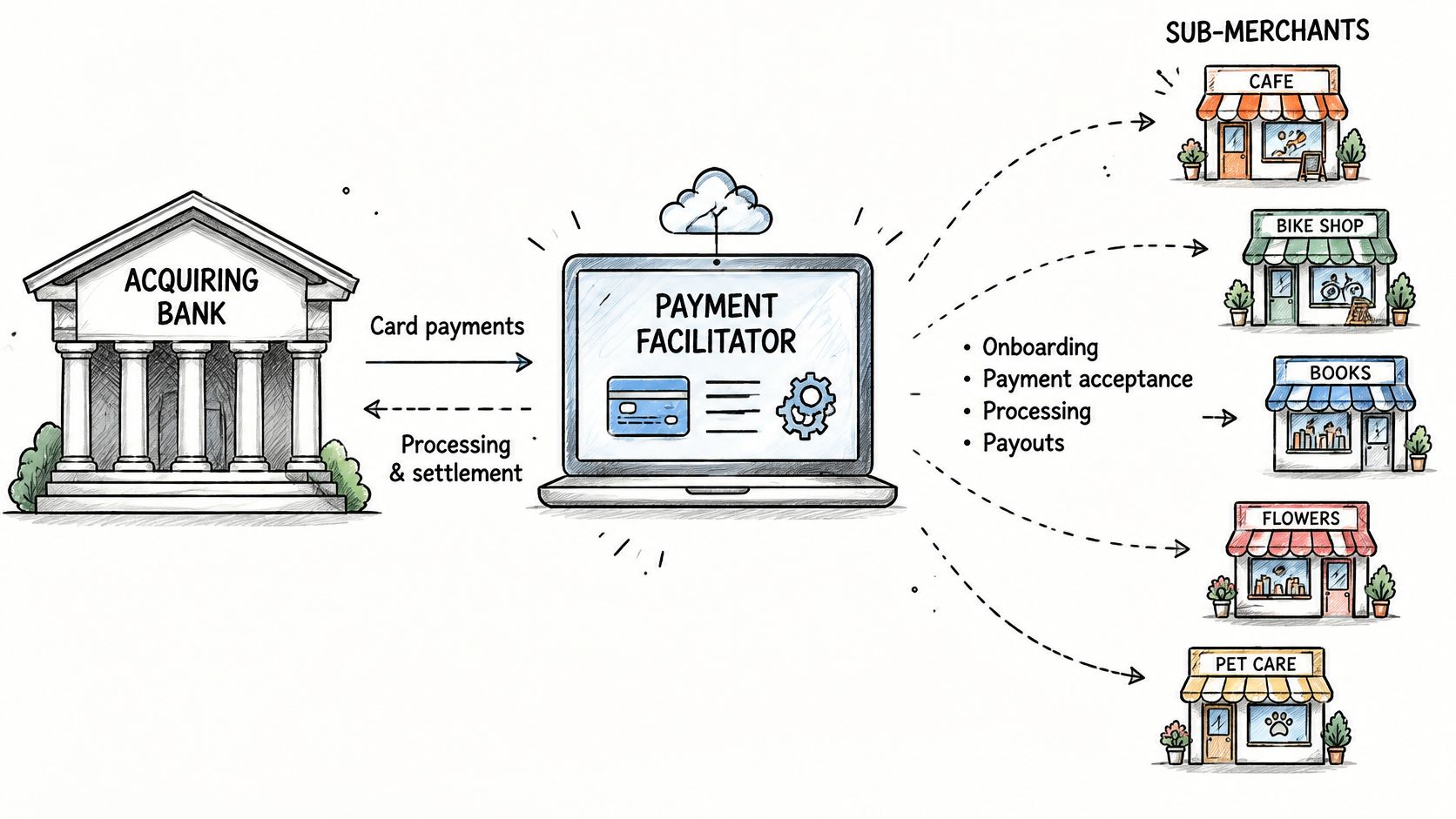
A payment facilitator is an intermediary registered by an acquiring bank that accepts and processes card payments for many businesses, called sub-merchants, under its own acquiring relationship and merchant ID. That structure is why a small shop can start taking cards in an afternoon without ever speaking to a bank.
So why does that same shop still see its payouts held three months later? Most introductions stop at the fast onboarding and never explain the trade behind it. The speed isn't free. It's paid for by pushing underwriting, monitoring and a share of the liability upstream to the facilitator, which now answers to its acquirer for everything you and every other sub-merchant do. Understanding that shift is the difference between picking a payment provider well and discovering the arrangement when a payout doesn't arrive.
What a Payment Facilitator Does in Plain Terms
PayFac is shorthand for payment facilitator. The term describes an intermediary registered by an acquiring bank that accepts and processes card payments for many businesses, called sub-merchants, under its own acquiring relationship and merchant identification number. The OCC's Comptroller's Handbook on merchant processing sets out the mechanics plainly: instead of every business establishing a direct relationship with an acquirer, the facilitator onboards sub-merchants, provides payment acceptance and takes part in settlement itself.
The closest everyday comparison is a shared office building. The building operator signs the master lease with the landlord, then lets fifty small firms use desks inside. No tenant negotiates with the landlord, and no tenant gets a key to the plant room.
What the tenant gets and what the operator takes on
Tenants get a desk, a working internet line and someone at reception on day one. In payments, that's a live checkout, one integration, one dashboard and one place to ask questions.
The operator takes on screening each tenant, meeting the landlord's terms, collecting rent and answering when a tenant damages the lobby. In payments, that's underwriting every business, watching transactions, handling disputes and carrying the acquirer's expectations across the whole portfolio. Sub-merchant and acquirer are the two words worth keeping: the sub-merchant is the business accepting money, the acquirer is the bank that holds the card-network relationship and moves the funds.
The mismatch to watch for: the merchant experiences a signup form. The facilitator experiences an underwriting decision with money attached. Those two things take very different amounts of time, which is why a "five minute" signup can still end in a week of review.
This structure is what let software companies and marketplaces embed payments inside their own products rather than handing customers off to a bank. A booking platform could take a deposit without sending the hotel to a branch.
A practical test separates the roles. If a provider approves your business, sets your payout schedule and moves money to you, it's probably acting as a facilitator. If it only carries transaction data to a processor that does those things, it's more likely a gateway. The contract settles the question, not the marketing page.
How a PayFac Differs From Gateways and Acquirers
Four job titles get used interchangeably in sales conversations and mean different things. Here's the split.
| Role | Relationship to Merchant | Acquiring Relationship Used | Role in Settlement |
|---|---|---|---|
| Payment gateway | Connects the merchant's checkout to a processor | Uses the merchant's existing processor | Passes transaction data; does not usually hold funds |
| Payment processor | Routes authorisations and clearing for the merchant | Works through an acquirer on the merchant's behalf | Moves transaction messages; funds follow the acquirer |
| Acquirer | Holds the merchant account with card networks | Its own relationship with the card schemes | Settles funds and carries network obligations |
| Payment facilitator | Onboards many sub-merchants under one agreement | Its own acquiring relationship and merchant ID | Participates directly in settlement and payouts |
The gateway row is where many readers stop reading too early. A gateway is plumbing between your checkout page and a processor. It encrypts, tokenises and forwards, and it can be excellent at that job, which is why a careful look at what separates a good payment gateway from a weak one is worth an afternoon. But a gateway normally doesn't decide whether your business is acceptable, and it normally doesn't hold your money.
A processor routes the authorisation request and later the clearing message. It works on behalf of a merchant the acquirer has already agreed to serve. The acquirer sits above both: it holds the merchant account with the card networks, settles the funds and wears the network's rules when something goes wrong.
A facilitator bundles the whole stack for a crowd. It has its own acquiring relationship and merchant ID, then lets hundreds or thousands of businesses operate underneath it. That bundling is the product. It's also the risk.
One company can wear several of these hats at once. A single brand may be a gateway in one country, a facilitator in another and a reseller of someone else's acquiring in a third, depending on licensing and contracts.
Three questions that settle it
Marketing labels can't answer this for you. Ask instead:
- Whose merchant identifier appears on my statements? If it's the provider's, you're a sub-merchant, not a direct merchant.
- Who underwrites my business? The entity that approves you is the entity that carries you in its portfolio.
- Who settles my funds, and on what schedule? Settlement is the clearest signal of who is in the money flow.
If the answers don't line up with the sales pitch, trust the answers. A provider that can't name its acquirer relationship in writing is telling you something.
How Sub-Merchants Are Onboarded Step by Step
Onboarding looks like a signup form. Underneath, it's a compact underwriting file. Mastercard's guidance for payment facilitators frames the model as a contractual relationship in which a provider registered by an acquirer extends payment services to sponsored merchants. That's why the platform's merchant identifier, not yours, sits behind the account.
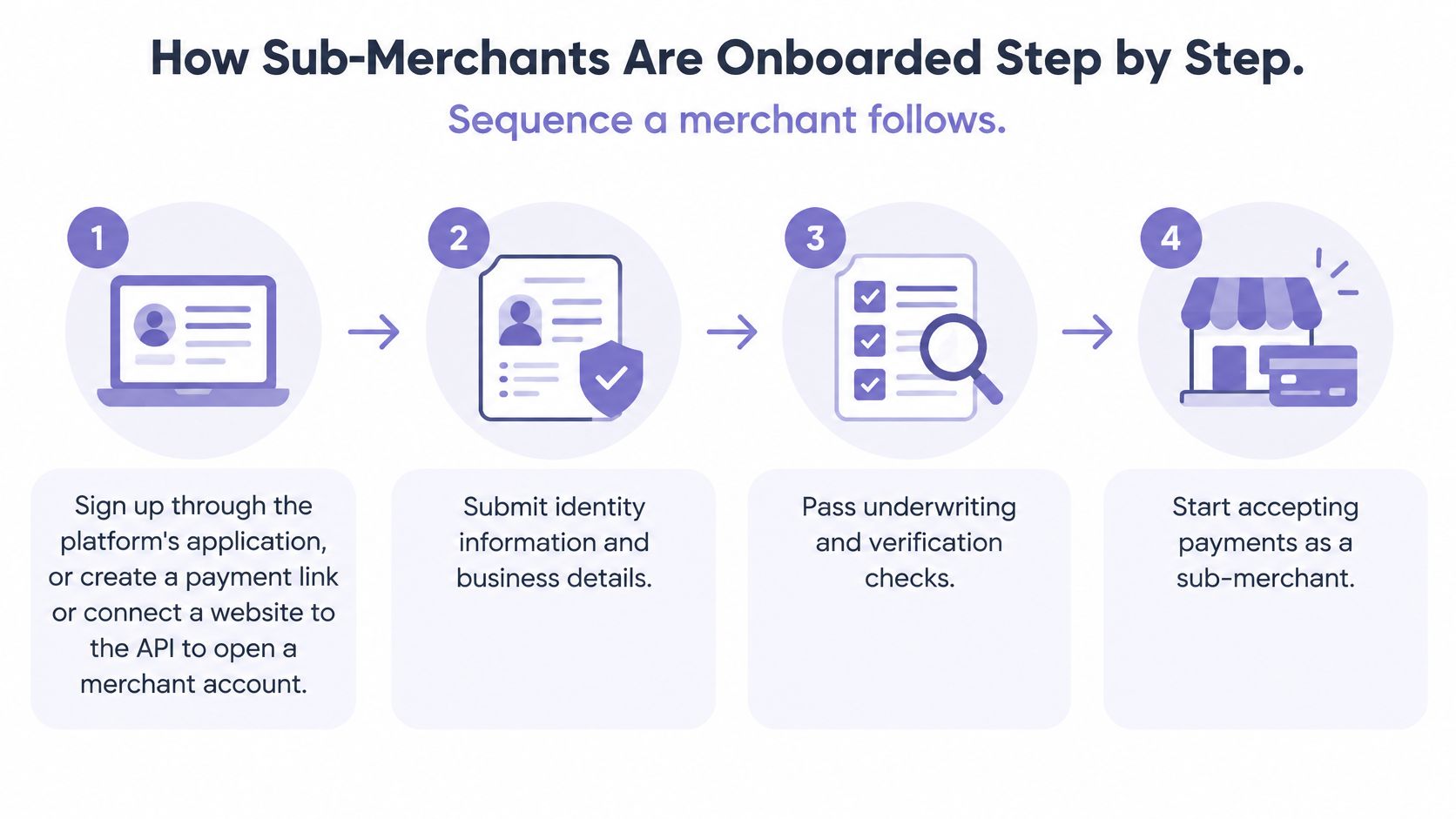
- Open the account inside the platform. A merchant is the person or business that opens an account to accept payments, and here that account starts inside the provider's system rather than at a bank branch. Many platforms let you create a payment link from a dashboard or connect a website to an API, which is why the first step feels less like a bank application than a software signup. Usual hold-up: a half-finished application that feels live but can't yet process anything.
- Submit identity and business details. The facilitator needs to know who owns the business, what it sells, where it operates and how it wants to be paid. Usual hold-up: a trading name that doesn't match the registration, an address that doesn't match public records, or a website with no clear description of the product.
- Pass screening. Sanctions lists, adverse media, prohibited-business rules and jurisdiction checks run next. Usual hold-up: a merchant category that sits near a restricted one, or an owner whose name triggers a false positive that needs documented human resolution.
- Get approved under the facilitator's identifier. Approval means the business is now sponsored under someone else's acquiring relationship, with a merchant-level record in the platform's ledger. Usual hold-up: conditional approval with a transaction cap or a delayed payout schedule, which the merchant often doesn't read.
- Agree payout rules. Settlement timing, currency conversion, refund handling and any reserve get fixed here. Settlement times depend on the payment provider and the network, so treat any promise of instant money as a question rather than a feature. Usual hold-up: a rolling reserve the merchant discovers only after the first busy month.
- Take a first live payment. The checkout completes, the transaction posts to the ledger and the payout schedule starts running. Usual hold-up: a payment that authorises but doesn't capture because the merchant never tested a refund path.
The speed of all this depends almost entirely on screening depth. A provider that verifies owners against corporate registries and screens against watchlists will take longer than one that waves applicants through and audits later.
Your own customers may also hit a verification step at checkout, depending on the transaction, the region and the provider handling it. Warning buyers in advance saves abandoned carts.
Practical rule: before you sign, ask what triggers a payout hold and get the answer in writing. Fraud review, reserve changes and category reviews are the three reasons funds stall, and each has a different remedy.
Risk Controls a Payment Facilitator Must Run
The defining obligation of a facilitator is continuous risk management, not a one-time identity check. Visa's payment facilitator risk guide requires underwriting consistent with the network rules and the acquirer's policy, plus ongoing monitoring for increased risk and controls capable of detecting and blocking transaction laundering.
| Control | What It Catches | Example |
|---|---|---|
| Identity and business verification | Fake or prohibited businesses | Checking registration details against public records |
| Sanctions and adverse-list screening | Sanctioned owners or entities | Screening directors and owners against watchlists |
| Device fingerprinting and geolocation | Account takeover and mismatched origin | Flagging logins from an unexpected country |
| Velocity checks | Card testing and laundering bursts | Limiting transactions per hour for a new merchant |
| Chargeback and refund monitoring | Abnormal dispute or refund rates | Alerting when disputes exceed an agreed threshold |
| Exception queue | Cases needing human judgement | Manual review before a payout hold is released |
Visa's guide names third-party validation, negative databases, device fingerprinting, geolocation checks, velocity checks and exception reports as useful controls. The list isn't decorative. Each item maps to a loss.
Take chargeback monitoring. A merchant selling a product that never ships generates disputes, and disputes above the network's threshold pull the facilitator into a monitoring programme. That's a direct cost to the facilitator, which is why your payout gets held before the threshold is breached, not after.
Now trace the chain in the other direction. Weak onboarding lets a prohibited business or a laundering operation into the acquiring system. That exposure turns into chargebacks, scheme penalties, withheld settlement or, in the worst case, the acquirer ending the relationship. When that happens, every sub-merchant on the portfolio feels it, not just the offender.
What good looks like: a named control for each risk, a documented review process, and published criteria for when a payout is held and how it's released. Vague reassurance about "advanced fraud protection" is not a control.
Why one global threshold fails
Risk rules have to flex by country, payment method, merchant category, asset type and settlement route. A card payment from a returning customer in one market and a cross-border digital-goods order from a new device in another shouldn't trip the same rule.
Traceability matters as much as detection. A defensible programme records the reason for every approval, review, decline, suspension and payout hold, at both the sub-merchant level and the transaction level, so a decision can be explained months later.
For merchants in categories the networks treat cautiously, the controls themselves become the product. That's the territory covered by high-risk merchant account services, where the question shifts from "can I get approved" to "what evidence will keep me approved".
Who Carries the Risk and How to Vet a Provider
A facilitator can approve an account in minutes. So who pays when fraud, chargebacks, sanctions exposure or provider insolvency lands?
The risk does not disappear. It moves upstream.
The facilitator carries the portfolio risk, standing behind every sub-merchant it onboards much the way a guarantor stands behind each loan it co-signs. The acquirer performs the heavier due diligence and stays inside the network framework. You keep responsibility for your own products, refunds and representations. Reduced integration friction does not mean reduced underwriting friction. The work moved upstream, and it keeps running through transaction monitoring while you process.
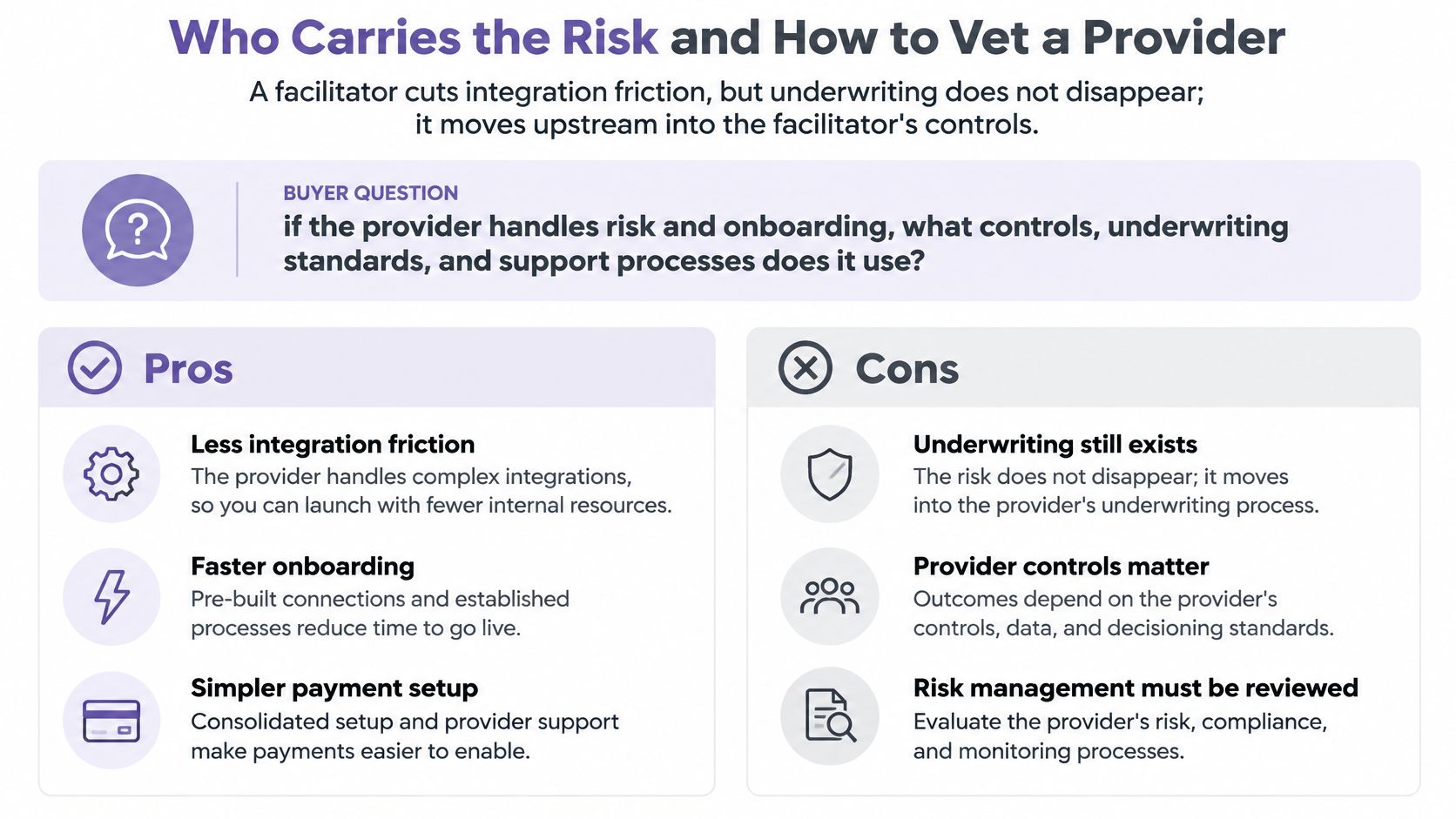
That split is also why approval never stays a bilateral technology decision for long. A facilitator is registered by an acquirer and operates under the card networks' rulebook, the structure described in Visa's payment facilitator model documentation. Regulation has been pushing liability in the same direction, toward the payment service provider rather than the individual seller. How far that reaches depends on the service, the licence structure, the contract and local law. Either way, the liability clauses deserve a careful read before signing.
The trade, written out
What you gain:
- Less integration work: one checkout, one API, one set of credentials to maintain.
- Faster activation: days rather than a bank's onboarding cycle.
- Unified reporting: transactions, refunds and payouts land in one ledger, so reconciliation stays in one place.
What you accept:
- Reserves and rolling holds: a percentage of volume can be held back for a period you do not control, typically to cover disputes and chargebacks that surface after the payout.
- Termination risk: your ability to take payments depends on one provider's decisions, and a single compliance review can switch the checkout off.
- Concentration: a portfolio-wide event at the provider reaches your account even when your own record is clean.
None of that is a reason to avoid the model. It is a reason to vet it. For merchants in categories the networks treat cautiously, the same questions carry more weight, and what a high-risk merchant account actually involves explains how the underwriting conversation changes.
The four questions to ask before signing
- Is the provider licensed, or acting through a licensed partner? Ask for the name of the entity that holds the acquiring relationship.
- Are reserves or rolling holds possible, and on what terms? Get the percentage, the trigger and the release conditions in writing.
- What happens if the account is terminated? You want a migration path and a copy of your transaction history.
- Who handles refunds, disputes, sanctions screening and wallet-address risk? With NexaPay, questions about a specific payment, including disputes, chargebacks or verification, go to the licensed provider that handled that transaction.
Pricing belongs at the end of this list, not the start. Compare all-in rates, reserve terms, payout fees and conversion costs. A headline rate tells you almost nothing about the total.
Building the controls behind a compliant programme is not cheap either. One industry estimate of the payment facilitation market puts initial spend on anti-money-laundering controls, sanctions screening, business compliance and PCI DSS Level 1 readiness at roughly USD 100,000 to USD 500,000 before variable transaction-monitoring costs. Someone funds that, and it surfaces in your rate.
The verdict pattern: if you sell one product under one brand and just need to take cards, a direct merchant account or a gateway may suit you better. If you pay many sellers or embed payments inside software, facilitation is usually the only realistic route.
One action this week: before comparing any pricing, request the provider's written description of its acquirer relationship and its risk policy. Read it before the rate card.
Where Payment Facilitators Show Up in Practice
Three scenarios cover most of the market, and each has a different trade at its centre.
Start with the marketplace. A platform lists independent sellers, collects the buyer's money once and pays each seller afterwards. Onboarding every seller as a sub-merchant under one agreement, and settling funds from a single master account, is exactly what the model was built for. The trade: the platform now owns seller-level risk, so one bad seller can affect its own processing. Ask: how are payouts handled to a seller I've suspended, and who bears the loss if that seller's funds have already gone out?
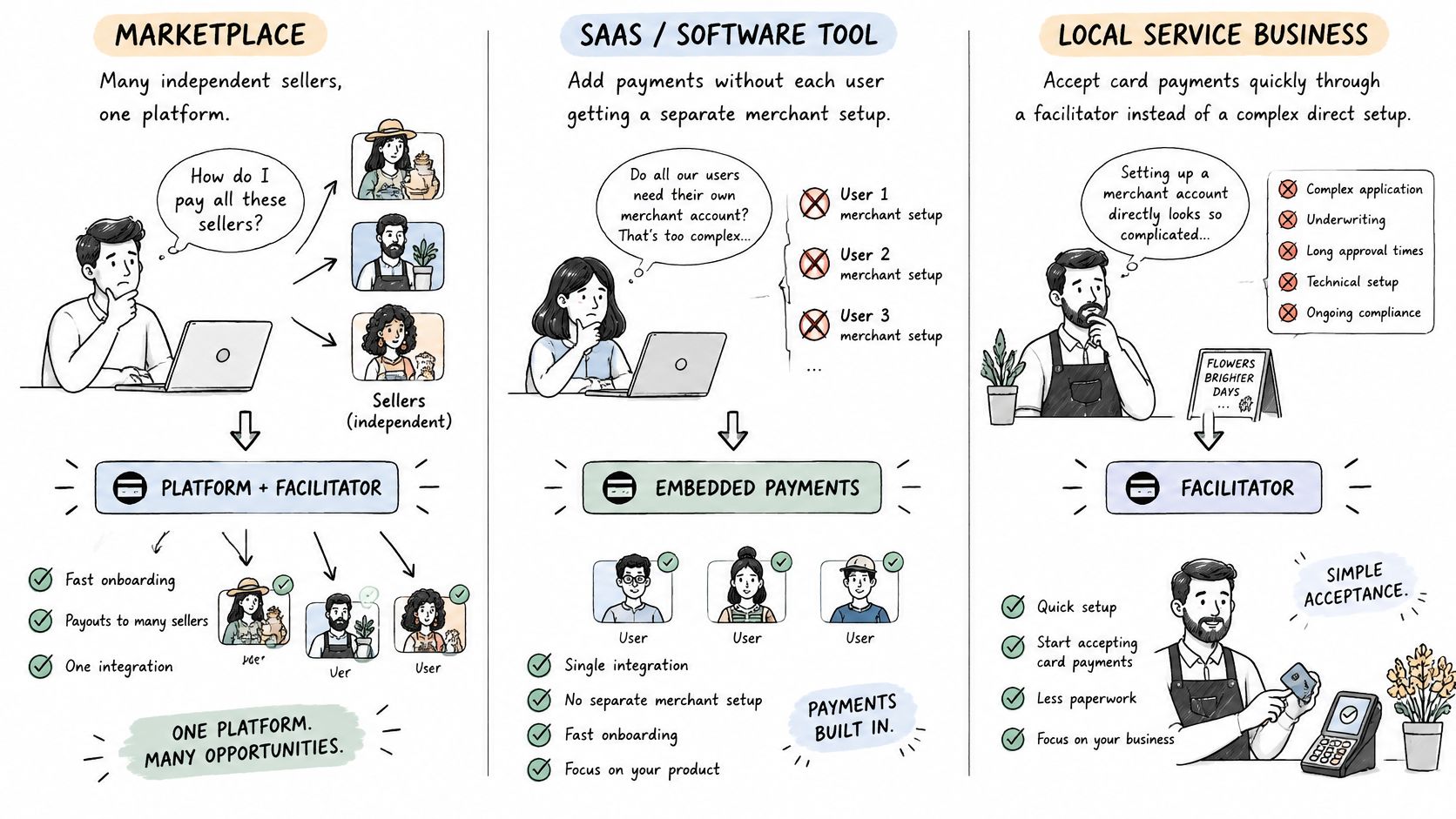
Then the software company. A SaaS vendor wants payment acceptance inside its own product, so customers never leave for a bank form and never see a third-party brand interrupt the workflow. Facilitation delivers that through one integration. The trade appears at scale, when reserves and rolling holds start eating into cash flow precisely because volume grew. The seller got easy onboarding; the facilitator inherited the monitoring and the liability. Ask: what reserve policy applies at my projected volume, and what triggers a change?
The third case is the awkward one. A digital goods seller, or a business in a category conventional processors decline, keeps getting rejected, and a facilitator willing to serve it becomes the only viable route. Screening and reserves are the price of admission here. Ask: which merchant categories are restricted, and who reviews a borderline case?
What the growth tells you
Payment facilitation has grown significantly in recent years, and what began as a workaround for small sellers is now a standard arrangement across marketplaces and software platforms.
Read that as a buyer, not an investor. When facilitation is common, a provider that can't explain its acquirer relationship, its screening and its reserve rules is behind the market rather than ahead of it. Growth doesn't reduce the need for due diligence. It concentrates the differences between providers in exactly the terms you should be reading.
If you'd rather see how the merchant-side flow works before you read another contract, this short walkthrough is a useful primer.
The pattern across all three cases is the same one from the first paragraph: somebody upstream is doing the underwriting. Your job is to know who, and on what terms.
NexaPay connects merchants' websites with independent, licensed payment and cryptocurrency providers, so you can accept card, Apple Pay and Google Pay payments through provider checkouts and settle directly to your own wallet. If you're weighing up a payment facilitator for your business, visit NexaPay to create a payment link from your dashboard or connect your site through the API, then follow every payment from a single workspace.