What Is a High Risk Merchant Account in 2026
What is a high risk merchant account? See how banks classify risk, set reserves and fees, and decide approval in this 2026 guide.
A high-risk merchant account is a card-acquiring account priced for above-average fraud, chargeback, refund, or regulatory loss, not a verdict that the business is illegitimate.
You might be reading this after a bank declined your application even though your business is registered, your products are lawful, and customers want to pay. The useful question isn't whether your business deserves that label. It's what the acquiring bank expects could go wrong, and which account terms make that exposure acceptable.
Why a Lawful Business Still Gets Declined
Say you run a subscription business selling a legal digital service. Your website works, your refund policy is published, and you've supplied your company documents. A mainstream bank still declines your application.
The bank isn't grading your character. It's considering whether customers might dispute recurring charges after you've received and spent the proceeds. A legitimate business can create a difficult recovery problem without doing anything dishonest.
Why the bank sees a different transaction
You see a completed sale. The acquirer, the financial institution supporting your card acceptance, also sees a possible future obligation to return that payment.
Think of everyday motor insurance compared with the same cover on a road with more accidents. Cover may still be available, but the insurer asks more questions and changes the premium and deductible. High-risk acquiring follows a similar commercial logic.
Common patterns that attract additional scrutiny include:
- Remote checkout: Customers pay without presenting a physical card.
- Delayed delivery: The merchant takes payment before supplying the service or goods.
- Repeat billing: Customers may forget renewals or misunderstand cancellation terms.
- Specialist categories: Gambling, adult content, travel, nutraceuticals, forex, and cryptocurrency introduce different combinations of licensing, fulfillment, and dispute exposure.
A lawful business can be outside a bank's risk appetite without being prohibited from accepting payments elsewhere.
Your volume, customer geography, and processing history also affect the decision. A decline is therefore a reason to examine the application and proposed account terms, not to keep submitting an unchanged file.
The practical differences show up in underwriting, accessible cash, fees, and exit rights. The comparison below separates those commercial changes from the emotional weight of the label.
What a High Risk Merchant Account Actually Means
The repeatable definition is straightforward: a high-risk merchant account supports card payments for a business whose operating profile creates above-average potential losses for the acquirer.
It isn't a special business bank account for everyday expenses. It's an acquiring arrangement that lets a merchant accept card payments under terms designed around its expected exposure.
Standard account versus high-risk account
These are typical commercial differences, not promises that every standard account avoids reserves or detailed checks.
| Account term | Standard merchant account | High-risk merchant account |
|---|---|---|
| Underwriting | Incorporation and basic history | Owners, licenses, website, fulfillment, and volume model |
| Reserves | Uncommon or small | Rolling or delayed reserve is common |
| Settlement | Standard batch payout | Delayed settlement and tighter caps |
| Fees | Interchange plus a normal markup | Higher processing and risk fees |
| Monitoring | Routine reviews | Monthly ratio and absolute chargeback count |
| Visa early scrutiny | Below applicable program thresholds | Historical count-and-ratio scrutiny |
| Visa severe band | Not in a severe program | Historical higher-count, higher-ratio band |
| Exit rights | Standard termination terms | Faster termination if disputes spike |
The distinction is between legitimacy and loss probability. A merchant can sell a lawful product while facing expensive refunds, disputed renewals, late fulfillment, or a sudden surge in orders it can't fulfill.
The acquirer also considers severity. A dispute pattern involving expensive transactions can create a different financial exposure from the same pattern involving inexpensive purchases.
Why percentages and counts both matter
For a historical reference, the Moneris fraud and chargeback threshold guide describes traditional Visa monitoring levels using at least 100 chargebacks and a 1% chargeback-to-transaction ratio monthly, with more severe levels involving 500 chargebacks and a 2% ratio.
Those historical figures illustrate the mechanism, not a universal current approval rule. Obtain the applicable network program, region, calculation method, and contractual triggers in writing before relying on a threshold.
A small seller can develop a concerning ratio from relatively few disputes, even without meeting a formal program's count requirement. A large seller can generate substantial absolute losses at a lower ratio, prompting an acquirer's own review. Crossing a ratio alone isn't necessarily the same as meeting every condition for network monitoring.
For a cryptocurrency-related merchant, direct wallet settlement can reduce conventional payout delays, but the underlying card-funded purchase still faces fraud screening, dispute procedures, consumer-protection obligations, and provider controls.
Place your actual transaction pattern against the high-risk column. Strong sales alone don't establish that a standard acquiring account will fit.
Why One Processor Approves and Another Refuses
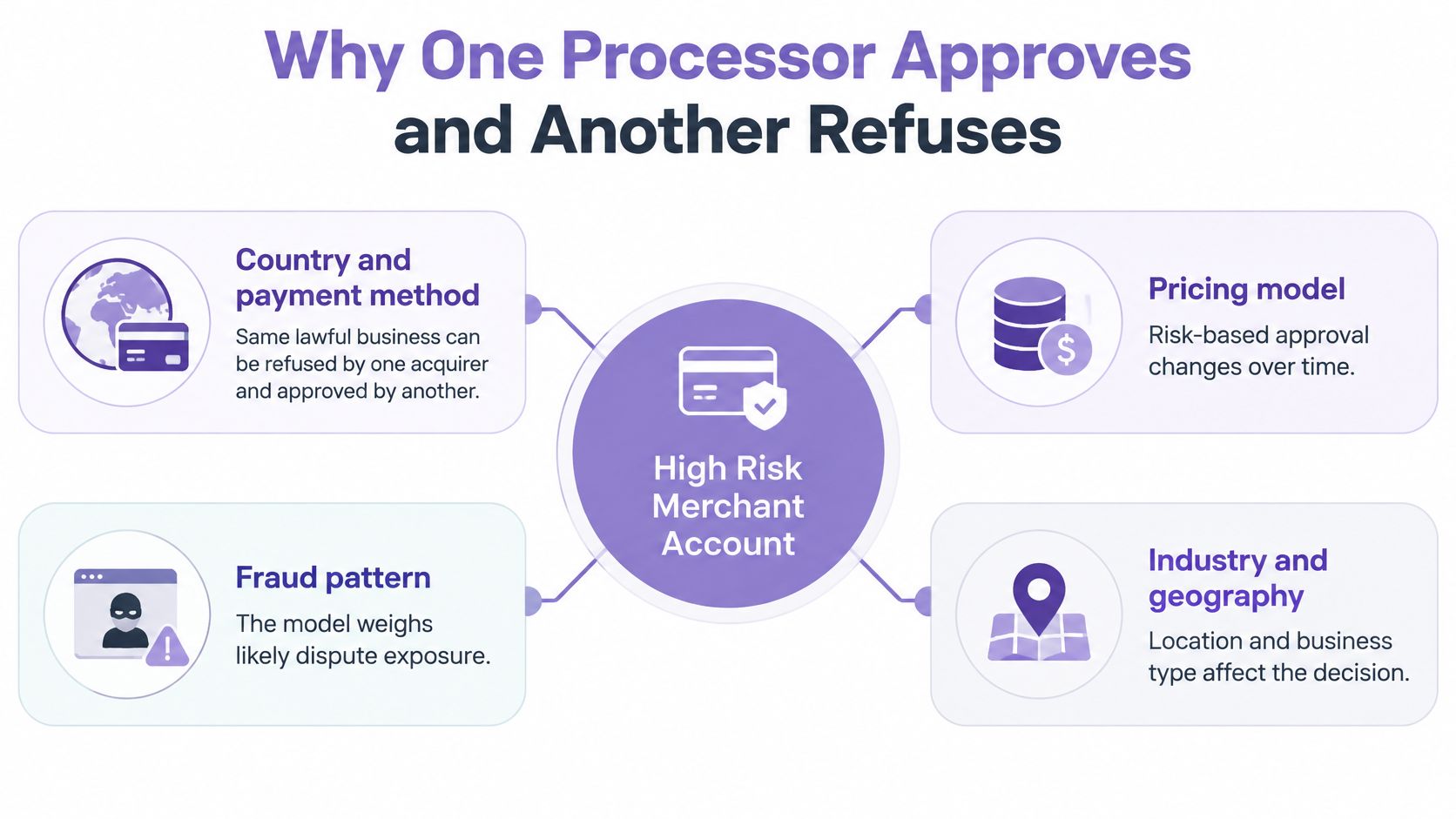
A high-risk classification is an acquirer's risk decision, not a single permanent status shared identically across the payments industry. Different institutions can reach different conclusions about the same lawful merchant.
One acquirer may support your category but not your customer countries. Another may accept your geographic mix but require a longer operating history. A specialist may understand your fulfillment evidence well enough to offer terms a generalist won't consider.
The approval decision combines several inputs rather than relying on the industry name alone.
Why common business models get flagged
| Business model | Feature that raises loss | What the acquirer worries about |
|---|---|---|
| Online gambling | Licensed wagering and card-not-present play | Regulatory breach and dispute spikes |
| Adult content | Brand-sensitive digital delivery | Chargebacks and reputational risk |
| Travel | Payment long before the trip | Inability to recover funds after a cancellation |
| Subscriptions | Recurring bills the customer forgets | Renewal disputes and unclear consent |
| Nutraceuticals | Continuity offers and refund friction | Policy abuse and fulfillment complaints |
| Forex and financial products | Complex regulation and large tickets | Licensing gaps and sudden volume |
| Cryptocurrency | Fast or irreversible digital delivery | A later card dispute after the asset moved |
| Ordinary ecommerce | Late shipping or recurring digital goods | The same loss pattern without a famous high-risk label |
These categories identify questions an underwriter needs answered. They don't establish that every merchant within a category has identical risks.
Travel illustrates the difference. A business taking payment close to delivery presents a different settlement exposure from one collecting funds well before it must fulfill its obligations. The industry label stays the same, but the operating facts change.
A moving price rather than a permanent ban
The scale of disputes helps explain why acquirers scrutinize these differences: Sift's disputes report projects global chargeback losses rising from $33.79 billion in 2025 to $41.69 billion in 2028.
An ordinary online shop can also attract specialist underwriting when it introduces recurring digital products or starts shipping far later than advertised. Conversely, an established merchant may support a request for better terms with consistent fulfillment, clear billing, and stable processing performance. Improvement doesn't guarantee reclassification, particularly where category restrictions remain.
When comparing decisions, examine beneficial ownership, website disclosures, refund terms, fulfillment evidence, projected volume, customer geography, and compliance controls. A processor's approval is useful only if the approved activity matches what you sell.
If providers disagree, identify which variable caused the difference. Changing your operating evidence is more productive than treating the first refusal as an industry-wide ban or the next approval as unconditional permission.
What Underwriters Score Before They Say Yes
An underwriting file should tell a coherent story from ownership through delivery. The analyst needs to establish who operates the business, what customers buy, how charges appear, and what happens when a sale goes wrong.
Start with consistency. Your legal entity, website, product description, settlement details, and processing history should describe the same business. Unexplained mismatches make it harder to assess the account accurately.
The analyst's starting checks are practical rather than mysterious.
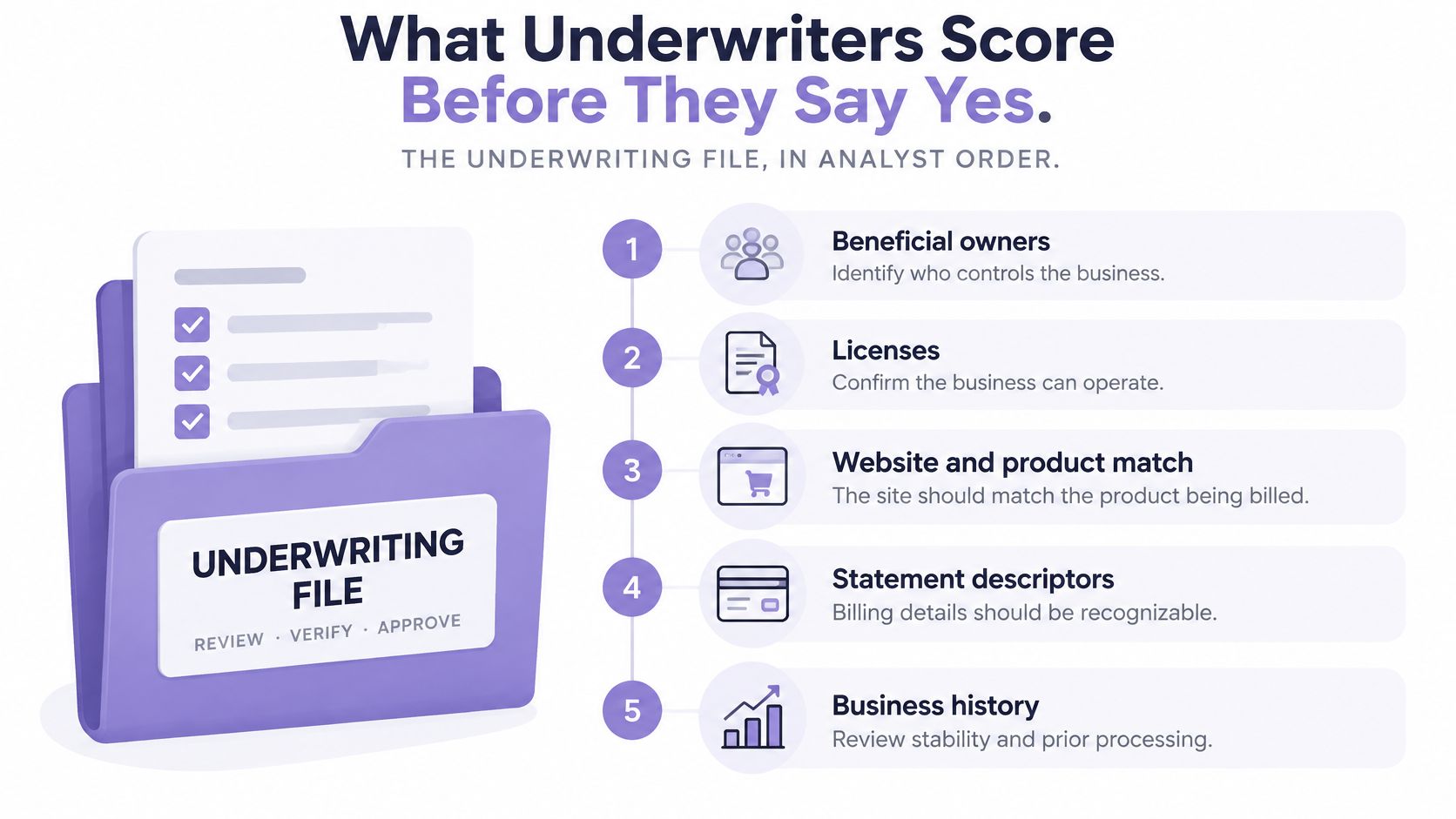
Build the file in analyst order
- Ownership and permissions: Supply corporate records, beneficial-owner information, and licenses relevant to the activity and markets served.
- Customer-facing material: Capture product pages, checkout disclosures, terms, refund instructions, and the statement descriptor customers will see.
- Fulfillment evidence: Explain delivery timing and provide records showing how you establish that the customer received the purchase.
- Billing exposure: Describe recurring charges, cancellation handling, average ticket, projected volume, and customer geography.
- Processing history: Include available statements, refund and dispute records, and explanations for unusual changes.
- Recovery capacity: Explain how refunds, disputes, and any required reserve would be funded.
The point isn't to assemble the biggest folder. It's to make each material claim easy to verify.
Explain the gap between payment and liability
When an acquirer pays you before the dispute window has run its course, it has released money while a possible repayment obligation remains. It's like returning a security deposit before the final inspection: the party releasing the cash needs confidence it can recover a later loss.
The Federal Reserve's merchant payments analysis notes that merchants with high chargeback rates may be classified as high risk, face stricter compliance requirements, or have processing terminated.
Preparation rule: Explain how you'll prevent and fund losses, not just how much revenue you expect to generate.
For cryptocurrency and other rapid digital delivery, document source-of-funds controls, sanctions screening, wallet-risk checks, customer-verification triggers, and refund mechanics where relevant. Show exactly when card authorization occurs and when the asset is released. Authorization isn't proof that no later dispute can arise.
Keep those documents current after acceptance. A new product, market, delivery promise, or billing model can change the file the acquirer originally approved. Approval starts an ongoing compliance relationship; it doesn't replace one.
How Reserves Fees and Thresholds Change Cash Flow
A profitable sales month can still leave you short of spendable cash. Processing fees reduce revenue, while reserves and settlement delays restrict when you can use it.
A rolling reserve holds a portion of card volume and releases it later under an agreed schedule. Delayed settlement postpones payout after the sale. An upfront reserve, where required, funds the buffer before normal processing proceeds.
There isn't a universal reserve percentage or processing rate. Your contract must state the actual arrangement.
Cash controls and the rule that tightens them
| Control | What it does | Figure or rule to confirm |
|---|---|---|
| Rolling reserve | Holds a slice of volume and releases it later | Reserve percentage, hold length, and release calendar |
| Delayed settlement | Pauses payout after the sale | Days before funds move |
| Volume or ticket cap | Limits how large the exposure can get | Monthly cap and maximum ticket |
| Higher processing fee | Prices expected fraud and disputes | Written rate card; no single market rate |
| Mastercard newer-merchant review | Requires investigation of refund and chargeback load | Combined refund-and-chargeback trigger described below |
| Termination right | Allows processing to stop under specified conditions | Whether unsettled funds can be held and when they're released |
The cash-flow mechanisms are easier to compare when separated from the headline processing rate.
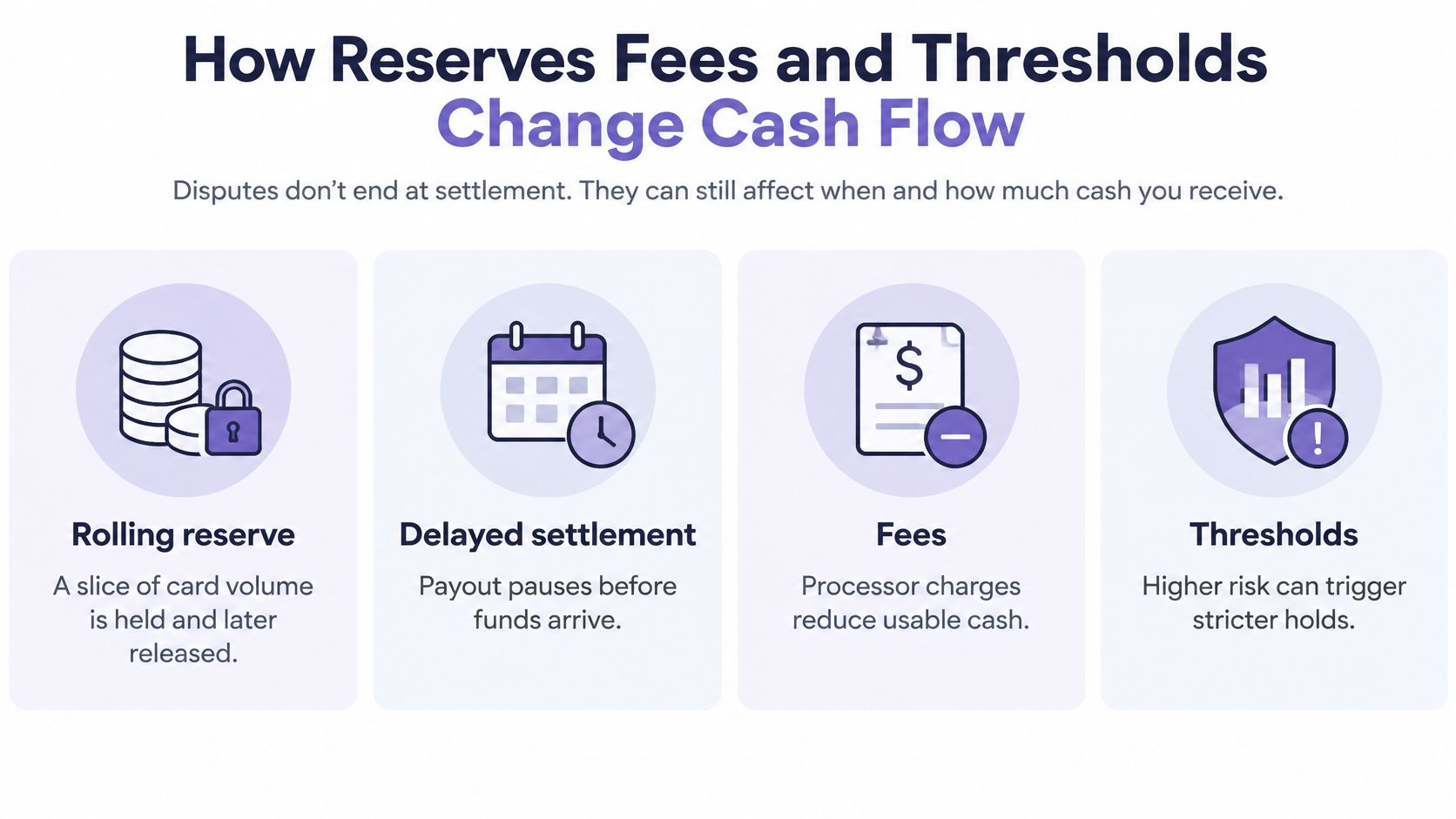
Read the monitoring rule accurately
The Mastercard Security Rules and Procedures manual requires acquirers to investigate a newer merchant when more than 5% of purchase transactions involve refunds, chargebacks, or both during a rolling 30-day period, provided the merchant conducts at least 500 purchase transactions.
That isn't just a chargeback-only ratio. Refund activity also matters under this rule, so a merchant watching only lost disputes could miss an important warning.
A dispute ratio uses disputed transactions divided by the network-defined transaction or sales base for the monitoring period. Don't substitute your own convenient denominator. Reconcile your dashboard with the acquirer's calculation.
Model usable cash rather than gross sales
A dispute spike can prompt manual reviews, a larger reserve, or tighter processing capacity. Rapid sales growth can produce similar scrutiny because the amount potentially repayable grows even if the dispute percentage doesn't.
Review the operational signals regularly:
- Acceptance performance: Authorization rate and fraud rate.
- Customer friction: Refund rate and disputes grouped by reason code.
- Exposure: Dispute-to-sale ratio, average ticket, geographic concentration, and funds already settled.
- Evidence readiness: Delivery records, authentication details, lawful device signals, consent logs, and wallet-delivery timestamps.
For each quote, record the percentage processing rate, per-transaction fee, account or gateway charges, dispute fees, and any risk-related charges. Mark missing information as not disclosed, rather than assuming it's free.
Then model a difficult month: reduced sales, continued operating costs, increased refunds, and cash still held in reserve. Confirm that you can fulfill existing orders without relying on funds the processor hasn't released.
A reserve isn't necessarily a permanent expense, but unavailable money can't pay today's suppliers.
How Real Disputes Play Out After Approval
A subscription customer forgets a renewal and disputes the charge. The merchant's useful evidence is the recognizable descriptor, stored recurring-payment consent, renewal communications, and cancellation timestamp. An account approval email proves none of those things.
The subscription evidence trail should be retrievable as a single case file.
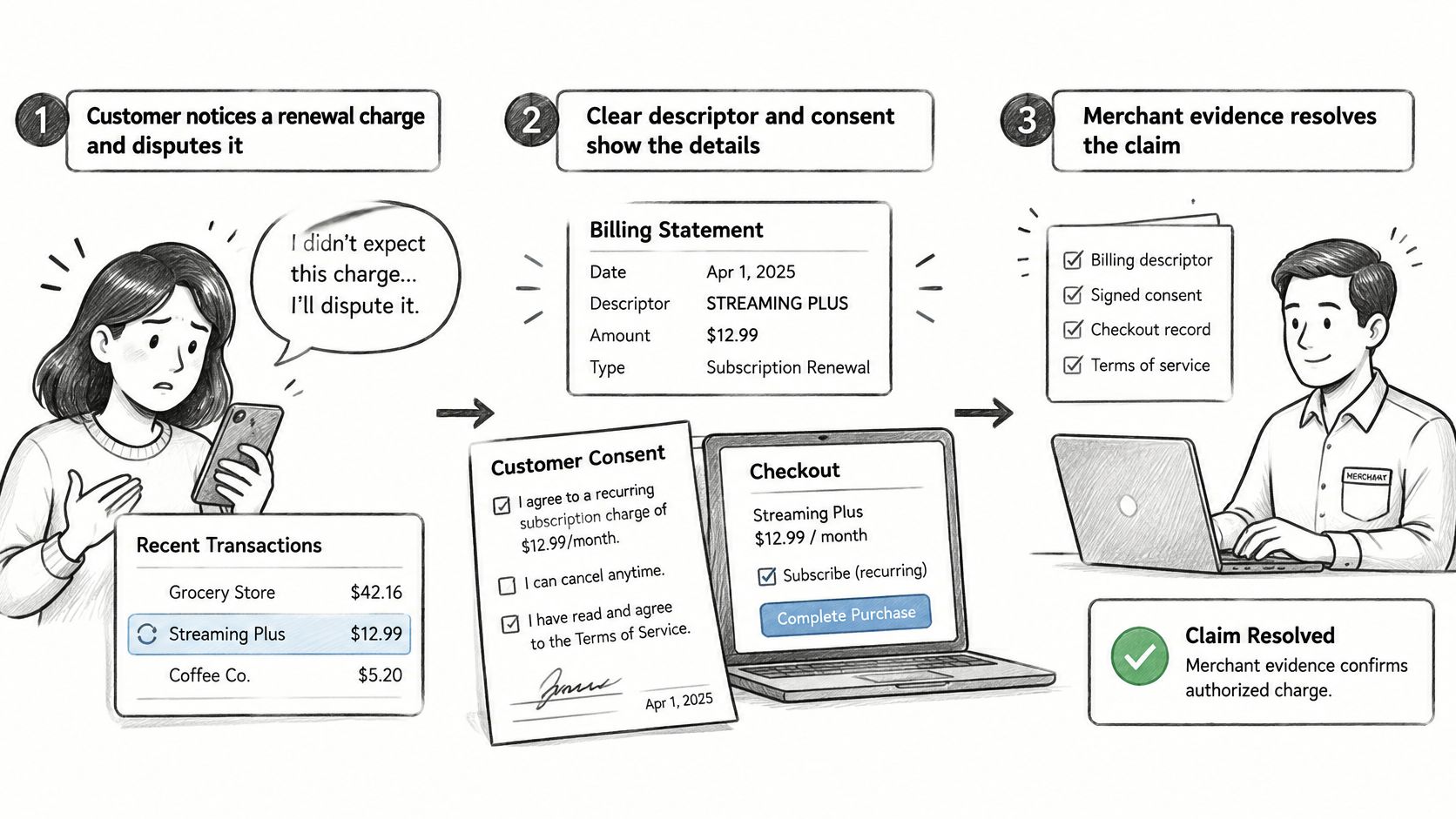
A travel merchant faces a different problem. It receives payment well before departure, then cancellations arrive when the seller has already committed funds elsewhere. Its ability to repay matters as much as whether the original booking was genuine.
At a gaming or cryptocurrency checkout, delivery may happen quickly while the card dispute arrives later. A wallet transaction or account-access log can help establish fulfillment, but it doesn't automatically resolve every dispute reason.
Does approval protect you from friendly fraud?
No. A conventional high-risk merchant account doesn't absorb friendly-fraud liability merely because it approved the business. First-party misuse involves a real customer disputing a purchase they made or received, rather than a stranger using stolen payment credentials.
Mastercard's global chargebacks outlook indicates that fraudulent chargebacks account for roughly 45% of global merchant dispute volume, and projects chargeback volume reaching 324 million transactions by 2028.
Don't assume every mistaken or dissatisfied customer is acting fraudulently. Match your response to the dispute reason, the customer communications, and the transaction evidence.
- Unrecognized billing: Provide a clear connection between the descriptor and the business.
- Recurring-payment complaints: Preserve consent, billing terms, and cancellation records.
- Delivery challenges: Retrieve fulfillment proof and relevant access or wallet records.
- Refund disagreements: Show the disclosed policy, request history, and any refund already issued.
Keep the operational sequence clear when reviewing a disputed transaction.
Balance fraud control with legitimate acceptance
Declining too aggressively blocks genuine customers. Accepting too freely can create losses and lead the acquirer to tighten account terms. Review false declines alongside fraud and dispute outcomes rather than optimizing either side alone.
The cost extends beyond individual chargeback cases: the Merchant Risk Council's 2025 report, based on a survey fielded in late 2024, reported that global ecommerce merchants lost 3.2% of annual revenue to payment fraud.
A workable process gives support staff a documented refund path and makes transaction evidence retrievable before response deadlines. Buying specialist acquiring without fixing those workflows leaves the underlying problem in place.
Choose the Account That Matches Your Risk
Choose the arrangement around your actual operation, not the account label you'd prefer. A shop that ships promptly, bills once, and maintains low disputes has a reasonable basis to pursue standard acquiring. A lawful business with complex licensing, recurring billing, long delivery times, or difficult dispute history should evaluate specialist arrangements.
Compare obligations before convenience
Use a short decision checklist when reviewing offers:
- Activity fit: Confirm that the accepted category describes what you sell and where you sell it.
- Cash access: Record reserve terms, release dates, payout timing, and any processing caps.
- Liability: Identify who handles disputes and who bears losses for the relevant transaction types.
- Exit exposure: Read the termination provisions and treatment of funds already in transit.
- Total cost: Apply the written fee schedule to your projected volume and transaction mix.
- Setup requirements: Separate account creation from any customer checks or provider-specific transaction requirements.
Prepare a consistent underwriting file for conventional acquiring applications so you can compare decisions on the same facts. Don't conceal a category or soften its description to obtain acceptance. Proceed only where the activity is lawful in the markets you serve.
Distinguish acquiring from provider-managed crypto settlement
We welcome lawful high-risk businesses when they use the plan intended for their business category. Merchants can start taking payments once their account is set up, with no approval queue.
NexaPay Instant has no merchant chargebacks, and merchant revenue is protected through cryptocurrency settlement to the merchant's wallet. Licensed payment providers handle card disputes rather than passing them back to the merchant's account. That is a different operating model from a conventional high-risk acquiring account, not evidence that ordinary account approval eliminates liability; providers may still verify customers at checkout.
If wallet delivery is unfamiliar, our guide to buying Ethereum provides useful context for the purchasing side. Understand the payment journey and settlement asset before choosing how your business gets paid.
NexaPay connects lawful merchants with licensed payment providers and cryptocurrency settlement to their wallets. Visit NexaPay to review the option intended for your business category and determine whether provider-managed checkout and wallet settlement fit your payment workflow.
Composed with Outrank tool