High Risk Merchant Account Services Explained for 2026
High risk merchant account services cover underwriting, processing, fraud controls and support, with the thresholds to plan for in 2026.
Your checkout is ready, customers want to buy, and a payment provider has just called your business high risk. The next offer promises approval, but the contract mentions reserves, processing limits and dispute fees. You need to know whether you're buying reliable payment access or postponing another account review.
High risk merchant account services make more sense when you follow a sale from approval to payout, then through any refund or dispute. Each service responds to a particular exposure. The useful question isn't just whether a provider accepts your industry, but whether its controls and contract fit how your customers pay.
The Services Inside a High Risk Merchant Account
| Service | What It Covers | What to Ask Before Signing |
|---|---|---|
| Underwriting | Reviews the business model, owners, products, refund policy and expected chargeback exposure before approval | Which documents are required, and does a rolling reserve apply? |
| Payment processing and acquiring | Routes card transactions through a licensed provider or acquiring bank for authorisation | Which card networks and payment methods are supported in my market? |
| Settlement and reserves | Sets when funds reach your wallet or bank account and whether part is held back | What are the reserve percentage, holding period and release conditions? |
| Fraud screening | Scores transactions for risk and flags or blocks suspicious orders | How does screening affect approval rates, and how are false declines handled? |
| Chargeback and dispute handling | Manages evidence submission, representment and dispute deadlines | Who submits evidence, and what deadline applies to each stage? |
| Payment security | Covers tokenization, hosted payment fields and 3-D Secure authentication | Who handles PCI DSS responsibilities, and which systems remain in scope? |
| Account support and monitoring | Covers ongoing reviews, network alerts and escalations | What are the support hours, account-management arrangements and escalation path? |
Think of the account like a courier service that insures high-value parcels. The courier checks the sender, scans parcels, may require a deposit against losses and has a process for handling claims. A payment provider uses similar layers because accepting a sale and resolving its eventual liabilities are different jobs.
Follow the transaction's journey
Underwriting comes before the sale. It determines whether the business fits the provider's acceptance policy and which conditions apply. Processing then carries the payment request to the relevant parties, while the card issuer decides whether to authorise it.
Settlement determines when you can use the proceeds. Fraud screening operates around checkout, dispute handling becomes important if a cardholder challenges the purchase, and payment security governs how card information moves through the system. Account support coordinates reviews when something needs human attention.
Providers don't necessarily bundle these responsibilities under one contract. A gateway may supply the checkout while another company processes payments, holds funds or answers disputes.
Practical rule: A feature listed on a sales page isn't a complete service until you know who delivers it and which written terms govern it.
Check every row against the provider's contract. Mark any unanswered row as a gap before signing, especially when the answer concerns access to money or responsibility for a missed deadline.
How Underwriting Sets Your Risk Level
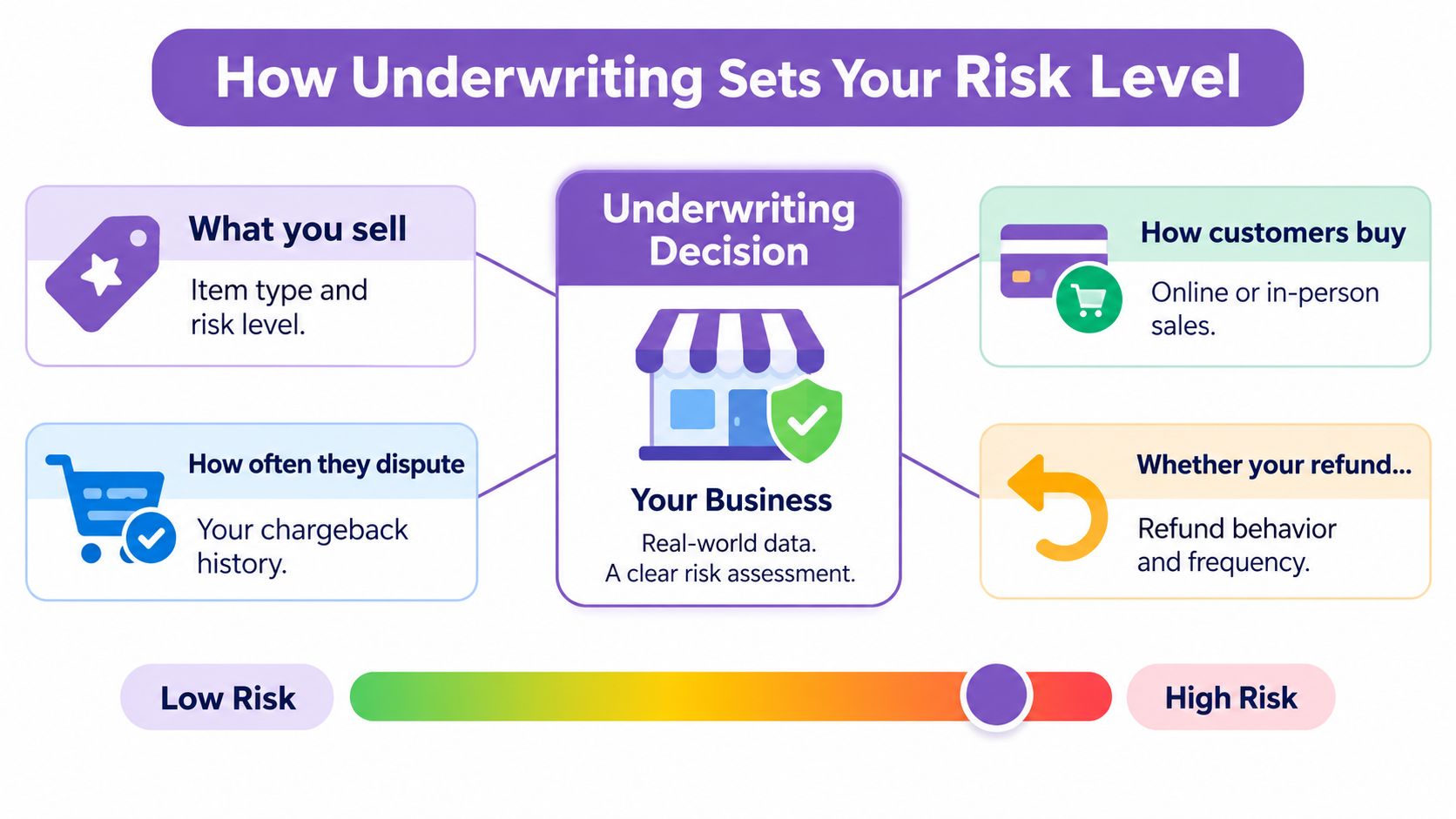
Start with your own business: what do you sell, how do customers buy, how often do they dispute purchases, and can they understand your refund terms? Those answers give an underwriter more useful information than the label on your industry alone.
High risk isn't a finding of wrongdoing. A lawful subscription business can generate disputes because customers don't recognise renewal charges. A digital-goods seller can attract stolen-card purchases despite delivering exactly what it advertises. Industry classification matters, but measurable payment behaviour also affects the decision.
The main assessment factors fit together like this:
Read monitoring thresholds carefully
A chargeback begins when a cardholder disputes a transaction with their issuing bank. It can lead to a payment reversal, fees and further monitoring, even when the merchant believes the sale was legitimate.
The following historical triggers are described in the FTC's Nuvei complaint, not presented as universal current entry rules:
| Network | Monitoring Trigger | Notes |
|---|---|---|
| Visa | At least 100 disputes in one month with a ratio above 1% | Some periods used a 0.9% threshold |
| Mastercard | At least 100 chargebacks with a monthly ratio above 1% | Comparable framework; program definitions and calculation periods can differ |
Treat these as historical context, not operating targets. Ask the acquiring provider to identify the current program, calculation method and escalation rules that apply to your account. A ratio without its denominator, measurement period and minimum count can mislead you.
What the underwriter changes
An underwriter can respond to exposure with enhanced documentation, a rolling reserve, delayed settlement, transaction caps or ongoing review. These measures address different problems: ownership records establish who operates the business, while a reserve provides funds against potential losses.
Suppose you sell access to an online course. Your application should explain when access starts, what proves delivery, how cancellation works and who answers complaints. A vague description such as digital services leaves the reviewer unable to judge fulfilment risk.
At NexaPay, merchants can accept payments whatever their risk profile, provided their business is lawful. We welcome lawful high-risk businesses on the plan intended for their category. That acceptance policy doesn't mean payment behaviour stops mattering after signup.
For the underlying distinction between the account and its risk classification, our guide to what a high-risk merchant account is provides additional context. Approval establishes access; maintaining accurate records and workable customer-service procedures supports continued use.
How Processing, Settlement and Payment Security Work
Say a customer buys a digital product through a provider-hosted checkout. The customer enters payment details into the provider's environment, the processor routes the authorisation request, and the issuer approves or declines it. Authorisation isn't the same as payout: it confirms the payment decision, not that spendable funds have reached you.
In our operating model, card and other payments are handled solely by licensed third-party payment providers. Your integration needs to send the customer to the correct checkout and preserve the transaction reference returned by the provider. Don't mark an order paid solely because the customer lands on a success page; use the provider's verified payment status.
Separate the money path from the data path
After confirmation, the settlement arrangement determines where proceeds go. A traditional acquiring arrangement may pay a bank account on a schedule, with deductions or reserves applied under its contract. A rolling reserve holds a portion of successive settlements until the agreed release conditions are met.
Our Instant product uses a different destination: Crypto Settlement sends USDC on the Polygon network to the merchant. Record the payment reference, settlement asset, network and destination wallet so your bookkeeping can match the customer purchase to the wallet receipt. Don't confuse the customer's payment method with the asset you receive.
Payment-data design deserves the same attention. The PCI Security Standards Council's standards guidance places PCI DSS responsibilities around environments that store, process or transmit payment-account data, including relevant connected systems.
Tokenization replaces a card number with a payment identifier. That reduces where the underlying number must be protected, but it doesn't automatically remove connected systems from scope. Assess the token provider's access controls, cryptography, retention, monitoring and incident-response arrangements.
Keep the integration narrow
- Use hosted collection: Prefer hosted payment fields or a validated provider-hosted checkout rather than collecting raw card numbers yourself.
- Protect connected systems: Segment payment-related systems, restrict administrator access and keep secrets out of browser code.
- Retain useful references: Store the identifiers needed for reconciliation, refunds and disputes, not raw card numbers in databases or logs.
Before committing, get written answers to these settlement questions:
- Availability: What event starts the settlement clock, and when can you spend the proceeds?
- Deductions: Which fees, reserves or holds are applied before payout?
- Release: What conditions govern held funds, and who can explain a delayed release?
Fraud Controls That Keep Card Acceptance Open
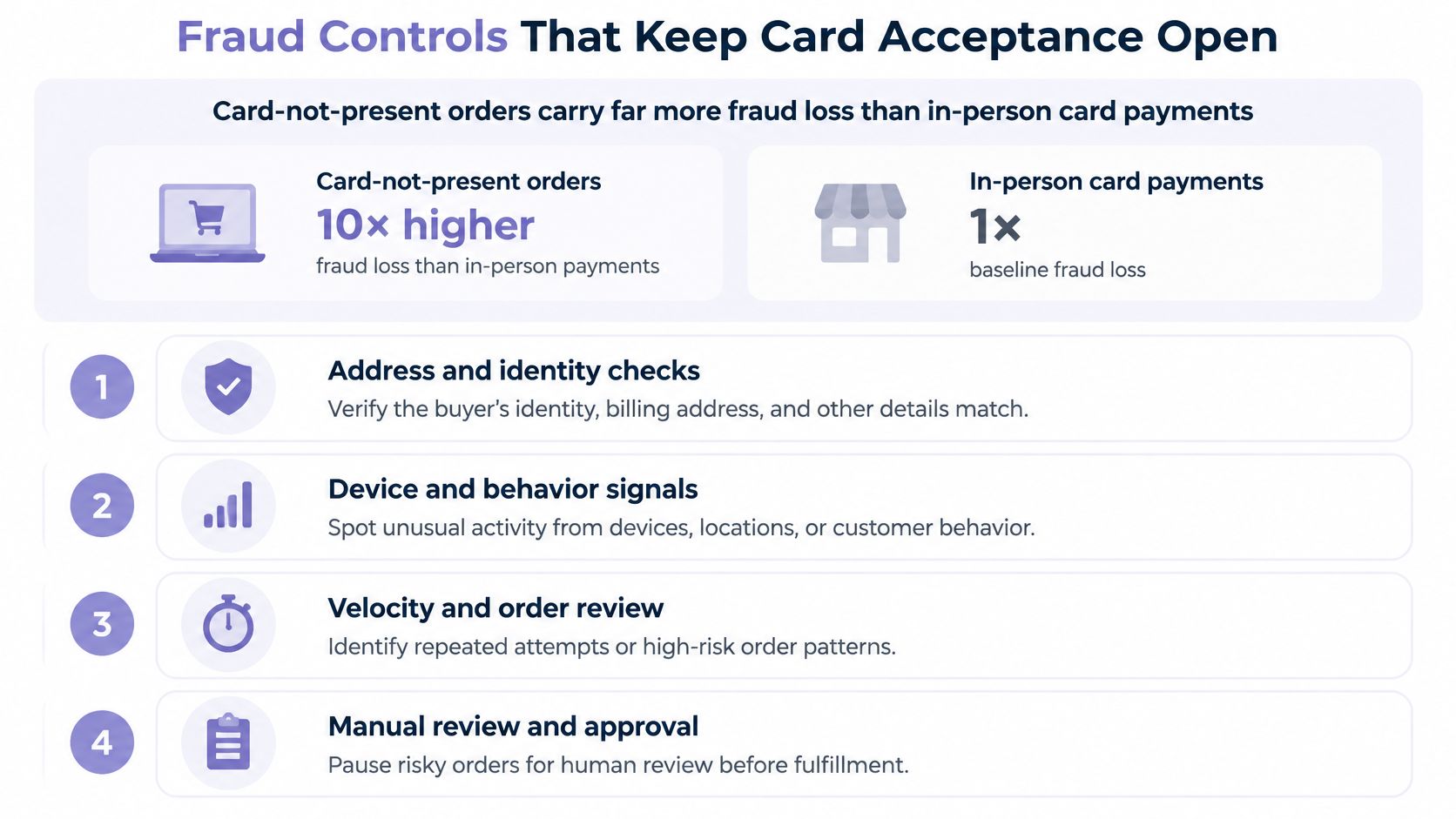
Online orders expose merchants to risks that an in-person card interaction doesn't present in the same way. In processor data analysed by the Federal Reserve Bank of Kansas City, the measured merchant fraud-loss rate was 14.17 basis points for card-not-present transactions versus 1.02 basis points for card-present transactions. That historical comparison explains the scrutiny, but it isn't a forecast of your store's loss rate.
The control stack should distinguish suspicious purchases from legitimate ones, not reject more orders. These checks address different parts of that decision:
Match each check to a specific threat
EMV 3-D Secure lets the issuer authenticate an e-commerce buyer. It can add a challenge at checkout, so use the supported risk-based flow rather than assuming every customer needs the same interruption.
Device and behavioural signals help identify unusual access patterns or related attempts. They need context: a returning customer using a new phone isn't automatically an attacker. AVS and CVV signals add useful checks, but address mismatches can also reflect legitimate billing differences.
Velocity limits constrain repeated attempts by card, email address or device. Set them to catch rapid testing without trapping customers who retry after an ordinary error. Use sanctions and identity screening where relevant, and define a manual-review path for ambiguous cases.
Risk-tiered settlement can limit financial exposure after acceptance. It isn't a substitute for deciding whether a suspicious transaction should proceed.
Measure the customer cost too
Keep delivery records, account or wallet ownership information, customer communications and authentication results connected to the transaction. A fraud score alone won't explain what the customer received.
Your operational dashboard should include:
- Fraud and disputes: CNP fraud rate and chargeback rate by payment method and country.
- Acceptance: Authorisation approval rate, reviewed orders and confirmed false declines.
- After-sale outcomes: Refund velocity and representment success, meaning the outcome of evidence submitted to contest disputes.
For a complementary walkthrough of the payment-risk topic, use the video below.
More screening isn't automatically safer. A rule that blocks good buyers while leaving the cause of later disputes untouched can damage acceptance without fixing the problem.
Review rule changes against both losses and legitimate approvals. Otherwise, a lower fraud total may mean you stopped accepting customers.
Chargebacks, Disputes and First-Party Fraud
Treating every dispute as customer abuse leads to the wrong response. A stolen-card purchase, a forgotten subscription and an undelivered order can all produce a chargeback, but they require different evidence and different operational fixes.
First-party fraud represented 38% of reported fraud globally in 2025, up from 15% in 2023, according to LexisNexis Risk Solutions figures cited by Marsh's merchant chargeback fraud analysis. That makes it an important category to investigate, not permission to assume every unhappy customer is dishonest.
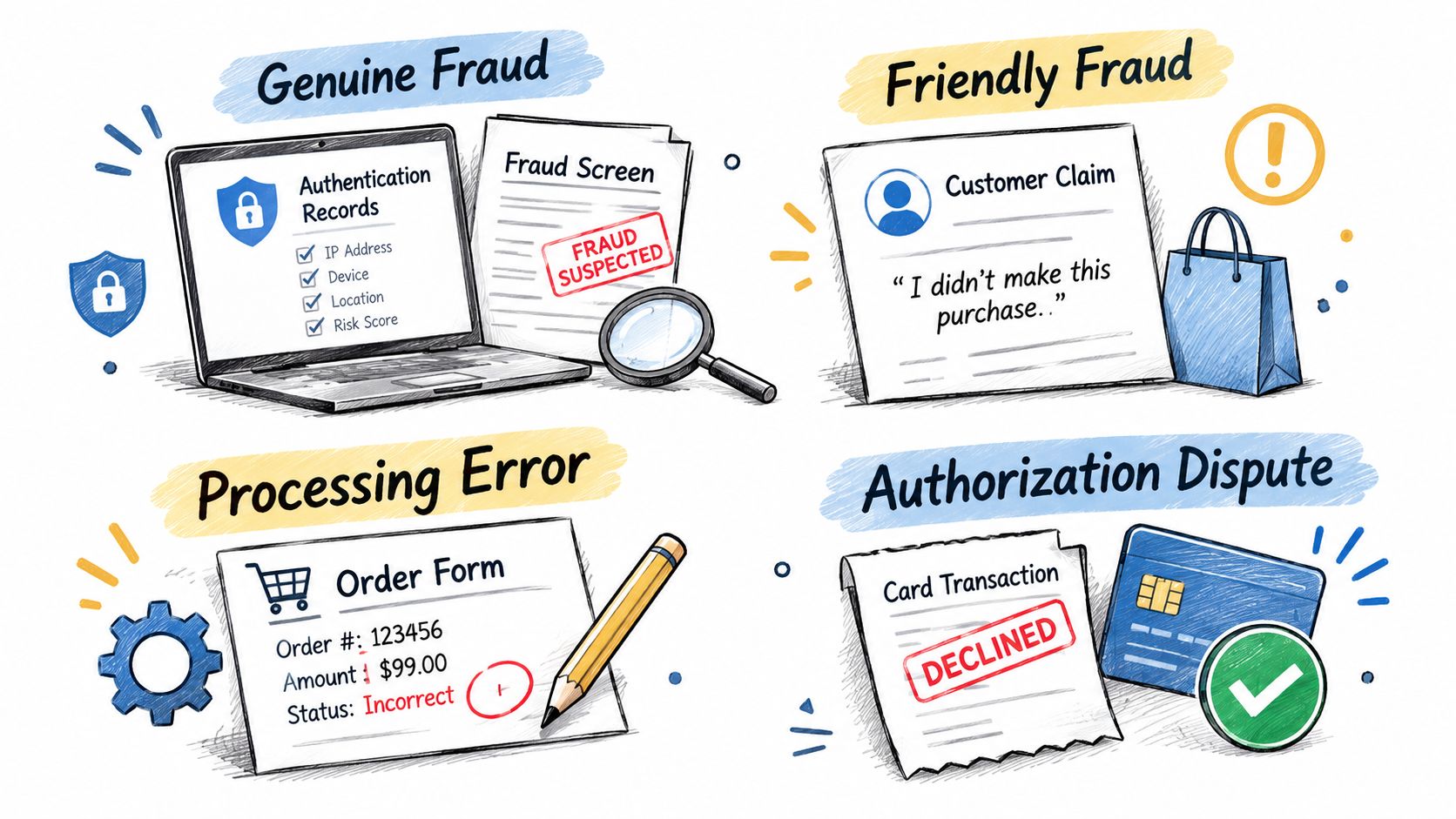
The diagram highlights several dispute classifications you may encounter; your response must still follow the actual reason for the claim.
Build evidence around the customer's claim
| Dispute situation | Useful records | Operational response |
|---|---|---|
| Genuine fraud | Authentication results and fraud-screen records | Investigate unauthorised use and follow the provider's instructions |
| Friendly fraud or first-party misuse | Delivery proof, access logs and order history | Establish whether the buyer received or used the purchase |
| Subscription confusion | Checkout disclosures, signup record and cancellation history | Make renewal and cancellation terms easier to understand |
| Fulfilment dispute | Tracking, service-completion records and communications | Resolve missing, delayed or incomplete delivery |
For digital goods, record the entitlement granted, access time and relevant account identifier. For wallet transfers, preserve the transaction reference and destination information. Collect only what you can lawfully retain and secure.
Evidence requirements differ by network and market. An access log that helps answer one claim may not establish the facts required for another. Send a concise, relevant file rather than an indiscriminate export of customer information.
Know who handles the dispute
In our model, the licensed provider that processed the payment handles card disputes, not the merchant directly. Questions about a specific payment, including chargebacks or verification, must go to that provider. You can still need to supply records or resolve the underlying customer complaint.
Our blockchain payouts are final once confirmed, so chargebacks don't come back to the merchant's account. That distinction concerns the payout mechanism; it doesn't make misleading billing or failed fulfilment acceptable.
Representment, the submission of evidence to contest a dispute, shouldn't be automatic. Fighting weak cases can consume resources and increase network risk without resolving the cause. Match the response to the merits, deadlines and provider instructions.
Before onboarding, finalise refund and cancellation terms, complete any customer identity checks the payment provider requires, and log every delivery. A new processing relationship won't repair an unclear renewal policy or an undocumented fulfilment process.
Comparing Providers on Service Criteria
Start your comparison sheet with expected monthly volume, the number of payment routes you need and the markets you sell into. A route means a usable payment path for your customers, not merely an integration logo. Confirm availability for the customer's location, payment method and business category.
A processing ceiling is an operating constraint. If a campaign succeeds but your account can't accept the resulting volume, the plan no longer fits. Ask how capacity changes before you need it, not while customers are receiving declines.
Apply the same tests to every offer
- Market coverage: Confirm supported networks and payment methods for your actual selling locations.
- Capacity: Record the monthly ceiling and the procedure for increasing it.
- Support: Identify contact hours, account ownership and escalation contacts.
- Service commitments: Check whether a written SLA specifies response times, covered incidents and remedies.
- Reporting: Look for transaction-level exports and usable refund, dispute and settlement records.
Our plans illustrate why these criteria need separate columns rather than a single feature score.
| Plan | Processing and provider access | Support and operational tools |
|---|---|---|
| Starter | Up to $10,000/month; 4 integrations, Transak, Banxa, Binance Pay and Ramp; live mode and card payments on providers' checkouts | Email support and basic analytics |
| Professional | Up to $75,000/month; 15 available payment providers, with 2 coming soon | Priority 24/7 support, 5 team members, advanced analytics and webhook notifications |
| Enterprise | Unlimited processing and high-risk industry support | Unlimited team members, dedicated account manager, SLA guarantee and priority onboarding |
Choose category fit before feature count
Our Enterprise plan is the intended option for supported high-risk businesses. A lower-volume business in that category shouldn't assume that the smallest processing allowance makes Starter the appropriate contract.
Likewise, providers marked coming soon aren't available payment routes. Count only the routes you can use today, and verify that the chosen licensed provider supports the required customer journey.
Contract check: An SLA guarantee needs readable terms. Establish what triggers escalation, who responds and what the guarantee actually covers.
Compare the full cost schedule separately from subscription features. Record processing charges, dispute-related charges, reserve requirements and termination provisions wherever they apply. Treat any criterion a provider won't answer in writing as an unresolved gap, not an implied inclusion.
Termination Response and Records Before You Sign
Before signing, confirm the service scope and build the records you'd need during a review or termination. Use this routine while the account is functioning, when statements and contacts are easiest to obtain.
- Document responsibility. Identify the contractual provider for each service in the opening table, including who controls holds and escalation decisions.
- Preserve records. Export processing statements, fulfilment evidence and refund logs into secure storage you control.
- Reconcile monthly. Match refunds and disputes to transactions, and investigate unresolved balances.
- Separate signup from processing checks. We open merchant accounts with an email address and payout wallet, plus an optional business name, without requiring uploaded KYB documents. That's our account-opening process, not a promise about every third party's checks.
- Confirm customer verification. Our payment providers may verify customers at checkout; make that possibility clear in your customer journey.
- Get release terms. Obtain written conditions governing how long funds can remain unavailable after termination and how release is decided.
- Correct inaccurate information. Request the reporting party's correction process and keep evidence supporting your request.
Respond to the reason, not just the closure
If an account is terminated, obtain the precise contractual reason and establish whether the decision concerns processing, settlement, an industry warning-list entry or several issues. Don't assume every termination produces the same consequences.
The Clearly Payments merchant compliance guide highlights termination and warning-list exposure as issues merchants need to prepare for. Separate the available remedies: a legal adviser can assess contractual rights, a compliance team can review inaccurate information, and an acquirer decides whether it can support a new processing relationship.
Maintain a reserve-funded continuity plan for obligations that continue during an interruption, including customer refunds and fulfilment. Don't move unresolved problems to another provider or conceal the previous closure. Clear records help explain both what happened and what you changed.
This week, score your shortlisted providers against the service table and comparison criteria. Bring the completed sheet to each call, and leave with written answers for every unresolved item.
NexaPay offers provider-hosted payments with cryptocurrency settlement, alongside an Enterprise plan for lawful businesses in supported high-risk categories. Visit NexaPay to compare the available plans, then match your payment routes, processing needs and support requirements to the appropriate option.
Enhanced by the Outrank app