Can I Buy Bitcoin with Credit Card in 2026?
Can I buy Bitcoin with credit card in 2026? Often yes, but issuer rules, cash-advance fees and irreversible transfers change the answer. Check these first.
Yes, you can buy Bitcoin with a credit card through some providers, but I recommend it only when your issuer treats the payment as a normal purchase rather than a cash advance. Check your issuer before paying, because an accepted card can still be an expensive card.
Why ask only whether the checkout accepts your card when your bank decides how to charge you? The same card can produce a normal purchase, a cash advance or a blocked transaction. The useful answer comes from a pre-payment check, not a Visa or Mastercard logo.
Which Cards and Payment Methods Work for Bitcoin
A provider must accept your payment method, and your issuer must allow the transaction. Those are separate approvals. A checkout showing a credit-card option doesn't guarantee that your bank will approve it or apply ordinary purchase terms.
Start with a provider licensed to serve customers where you live. Then confirm that your issuer allows cryptocurrency purchases in that country. Comparing exchange rates before checking eligibility wastes time and can leave you choosing a route you can't use.
Compare the funding routes
Funding routes for buying Bitcoin and how each is coded
| Funding route | How it is usually coded | What to expect | Check before paying |
|---|---|---|---|
| Debit card | Usually a normal purchase | Provider fees can apply; no credit-card borrowing interest | Daily purchase limit and whether the issuer blocks crypto merchants |
| Credit card | Purchase or cash-like, according to issuer rules | Cash-like treatment can trigger immediate interest and an additional fee | Whether this transaction will be a purchase or cash advance |
| Apple Pay or Google Pay linked to a credit card | Based on the underlying card and transaction classification | Using a digital wallet doesn't remove issuer charges | Wallet support in your country and the underlying card's crypto policy |
| Bank transfer | Not a card payment | Often a lower-cost option without card cash-advance treatment, but settlement can take longer | When the provider releases Bitcoin after receiving funds |
Debit cards are the more straightforward card option when you already have the money available. You still need to review provider charges and transaction limits, but you're not borrowing to buy a volatile asset.
Apple Pay and Google Pay are checkout methods, not exemptions from bank policy. Linking a credit card to a digital wallet doesn't turn it into a debit card or guarantee ordinary purchase treatment.
Ask about your specific card
In 2024, 14% of UK cryptoasset users said they paid for cryptoassets with a credit card or existing credit facility, up from 6% in 2022, according to the Financial Conduct Authority's cryptoassets consumer research. That establishes that people use this route, not that every UK card supports it.
Ask your issuer how a cryptocurrency purchase from your intended provider will be classified on your specific card. Give the provider's name, payment currency and your country of residence. A general answer about online shopping isn't enough.
Practical rule: A card logo tells you which network the checkout supports. Only your issuer can confirm the borrowing terms on your account.
If the representative can't confirm the classification, request the relevant card terms or a written response through secure messaging. Don't use a large purchase to discover the answer.
What a Credit Card Purchase Really Costs
Compare the Bitcoin you receive against your entire cash outlay, not just the advertised exchange rate. A provider can display an attractive price while separate processing and issuer charges make the purchase poor value.
Investopedia's guide to buying Bitcoin describes the cost issues buyers need to examine, including platform fees, spreads, card-processing charges and potential cash-advance treatment. Some issuers classify cryptocurrency purchases as cash-like, which can mean a fee and interest without a grace period.
Build your cost calculation
The table uses an illustrative USD 500 budget, not a claim about current fees. There's no reliable universal fee range to insert: use the checkout quote and your card agreement.
Cost layers on an illustrative USD 500 Bitcoin card purchase
| Cost layer | Where it shows up | Typical range | On a USD 500 purchase |
|---|---|---|---|
| Provider price spread | Built into the quoted Bitcoin price | Provider's quoted rate determines it | Compare the quoted Bitcoin quantity with an independent market reference |
| Provider service fee | Quote before payment | Provider's disclosed fee schedule | Record the displayed amount |
| Card processing charge | Provider checkout | Checkout's disclosed fixed or percentage charge | Include it unless already included in the total |
| Cash-advance fee | Card account | Issuer's cash-like transaction terms | Add the applicable issuer charge |
| Foreign-exchange markup | Card account when currencies differ | Card's currency-conversion terms | Add the applicable conversion cost |
| Break-even price move | Calculated from total cost and Bitcoin received | Your completed calculation | Bitcoin proceeds must cover all purchase and sale costs |
Don't add a fee twice when the provider has already deducted it from the Bitcoin delivered.
Use this calculation:
Break-even Bitcoin sale price = total acquisition cost ÷ Bitcoin received
For a realistic exit target, include selling and withdrawal costs too. Compare that result with the market reference price at purchase, rather than assuming the checkout price is the market price.
International buyers should be particularly strict: currency-conversion costs and cash-advance charges can apply together. If any cost remains unknown, pause the payment. An incomplete calculation isn't evidence that the card route is affordable.
How to Buy Bitcoin with a Credit Card Step by Step
Choose your wallet and establish your spending limit before opening checkout. Our purchasing interface lets you enter an amount, choose your cryptocurrency and pay by card; supported provider checkouts accept Visa and Mastercard.
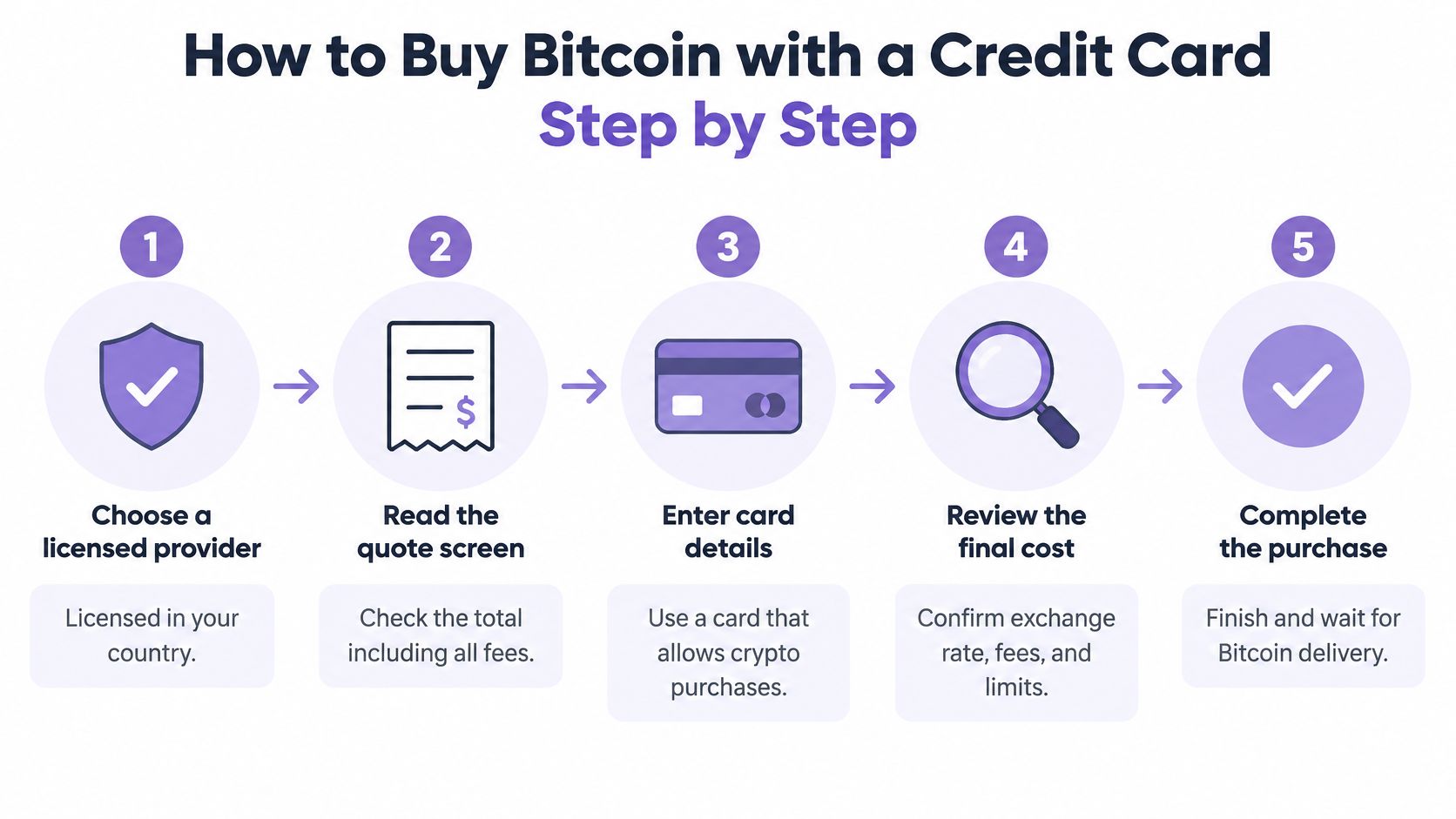
Use this visual overview alongside the checks below.
Complete the purchase deliberately
Confirm eligibility and read the quote. Use a licensed provider serving your country. Review the total payment and Bitcoin delivery amount before entering card details.
Enter your spending amount in the checkout currency and select Bitcoin. Check that the final quantity reflects the disclosed charges.
Choose custody. A self-custody wallet gives you control of the private keys; an exchange holds the keys and can restrict withdrawals. Select the arrangement you understand and can secure.
Copy a Bitcoin receiving address from your wallet. Check the full address on your trusted device, including its beginning and end, and consider a small test purchase before committing more.
Select an available payment method. Enter card details only on the legitimate provider checkout. Availability of cards and digital wallets follows provider and regional rules.
Complete any 3-D Secure authentication in your banking app or issuer's verification screen. An unfinished approval can leave the order pending.
Track payment and delivery separately. Card authorization isn't proof of blockchain delivery. Wait for the provider's status update and the required network confirmations.
Save the receipt, authorization email and transaction ID. Match the delivered Bitcoin against the final quote.
No account is required for our basic purchases: enter the amount, supply your wallet address and complete payment. Payment providers may still require identity verification.
For a video walkthrough, use the player below.
If you're comparing assets, our guide to buying Ethereum covers that purchase route. Don't reuse a receiving address without confirming that it supports the selected asset and network.
Declines, Cash Advances and Other Blocks
A decline at checkout doesn't necessarily mean your card details are wrong. Your issuer may prohibit cryptocurrency merchants, reject the transaction's classification or flag an unfamiliar payment. Repeated attempts won't resolve a policy block.
Identify the failed stage before trying again. A rejected authorization, unfinished banking-app approval and delayed Bitcoin transfer require different actions.
Credit card purchase symptoms, causes and fixes
| Symptom | Likely cause | Fix |
|---|---|---|
| Card declined at checkout | Issuer blocks the crypto merchant category or flags the payment | Call the issuer; if crypto purchases aren't permitted, choose an allowed debit-card or bank-transfer route |
| Purchase posted as a cash advance | Issuer classifies crypto as cash-like | Ask the issuer to review the classification; fees and interest may remain payable |
| Order stalls at approval | Banking-app authentication wasn't completed | Open the app and complete the active request; confirm order status before restarting |
| Limit exceeded | Daily, per-transaction or available-credit limit reached | Request an approved limit change or reduce the order within permitted limits |
| Works in one country, fails in another | Issuer, currency or provider eligibility rules differ | Use an eligible provider licensed for your residence and confirm cross-border card permissions |
| Card charged but no Bitcoin arrives | Pending authorization, provider review, network delay or address error | Check payment status and transaction ID; contact the provider before paying again |
What you can fix yourself
An unfinished authentication prompt may be straightforward to resolve while the session remains active. Open your banking app directly rather than following an unexpected message, approve the correct transaction and return to checkout.
A limit issue needs more care. Reduce the purchase only when the smaller amount complies with the issuer's and provider's rules. Don't split orders to evade verification, monitoring or restrictions.
If money appears to have left your account, establish whether the entry is a pending authorization or a posted charge. Give support the order reference, time, amount and transaction ID where available. Never send your full card number or security code in a support message.
What needs the issuer
Ask for a classification review if the transaction posted differently from the issuer's earlier guidance. Keep that guidance and your receipt, but don't assume the bank will recode a correctly classified cash advance or refund its charges.
Merchant-side acceptance also affects authorization. Our explanation of high-risk merchant accounts helps distinguish a seller's processing arrangements from your personal card permissions.
A failed payment is a reason to investigate the payment route, not a reason to disguise the transaction.
Use another method only after confirming the original order won't complete. That prevents a troubleshooting attempt from becoming an accidental duplicate purchase.
Fraud Risk and Why Bitcoin Transfers Cannot Be Reversed
Consumers reported more than USD 12.5 billion lost to fraud in 2024, a 25% increase from 2023, according to the U.S. Federal Trade Commission's fraud summary. Cryptocurrency-related payments accounted for approximately USD 1.4 billion of reported losses.
These figures describe reported fraud, not the likelihood that your legitimate card purchase will be fraudulent. The important distinction is between purchasing Bitcoin for yourself through a verified service and following a stranger's instructions to send it elsewhere.
Keep that distinction in mind whenever someone pressures you to complete a payment.
Card protection isn't blockchain reversal
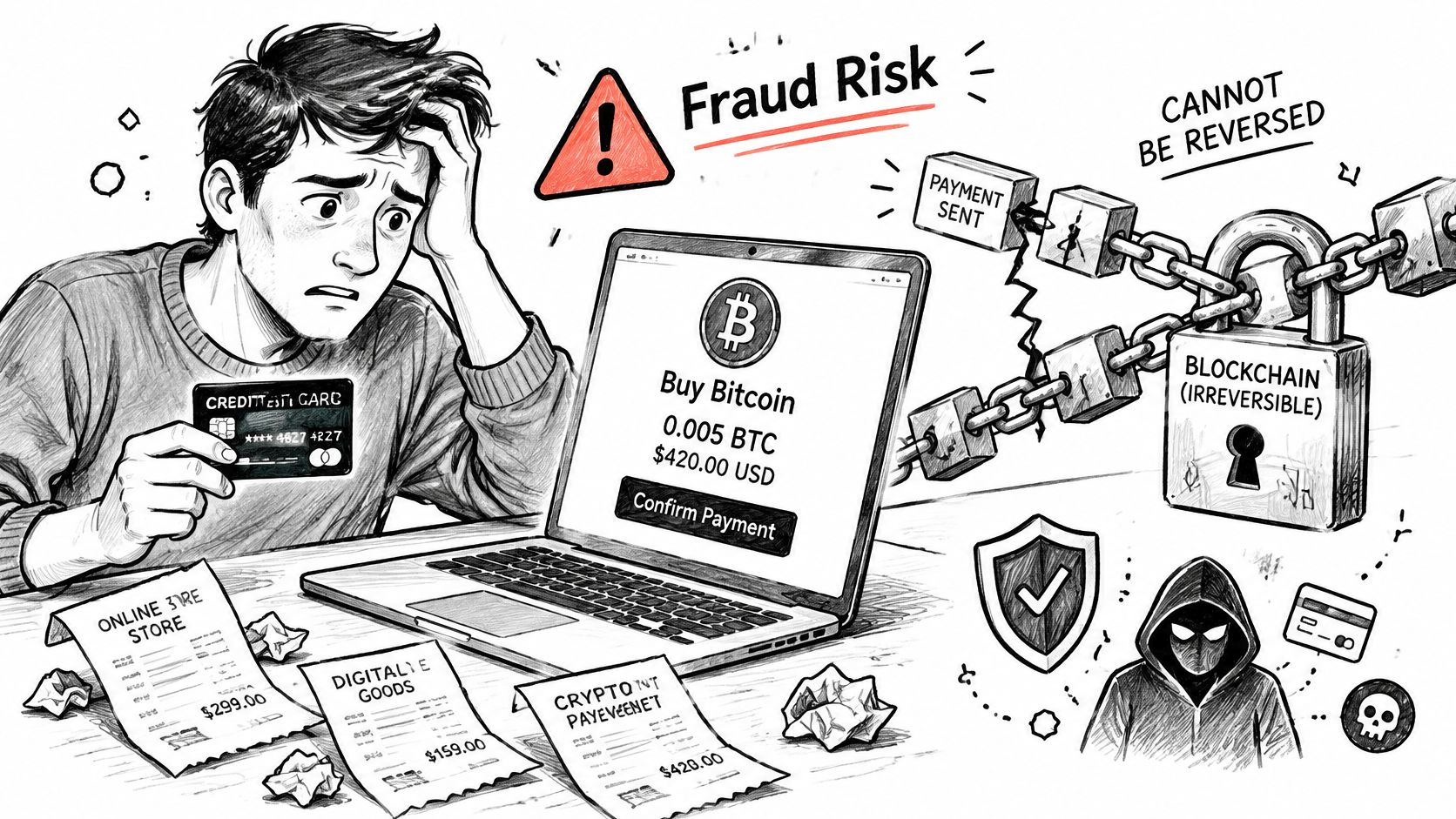
Your card issuer controls the card account. The payment provider processes the purchase and investigates delivery. Neither can recall a confirmed Bitcoin transfer from the blockchain.
A genuine unauthorized card charge is different from a purchase you approved before sending Bitcoin to a scammer. Both deserve prompt reporting, but the available remedies aren't interchangeable. A fall in Bitcoin's price also doesn't turn an authorized purchase into unauthorized card use.
Card disputes and blockchain settlement operate on different timelines. An industry review of crypto payment disputes describes typical dispute windows of 120 days, while noting that some categories can extend longer. Your issuer's applicable rules determine your deadline, so report a problem immediately rather than relying on a general window.
Safety boundary: Paying by credit card doesn't make a confirmed Bitcoin transfer reversible.
Preserve evidence and report promptly
If you don't recognize a transaction, lock the card through your banking app and contact the issuer using its official contact details. Notify the payment provider as well, and request preservation of the order and delivery records.
Useful evidence includes:
- Authentication records: Approval messages, banking-app notifications and whether you authorized them.
- Wallet-delivery logs: Destination address, transaction ID and the provider's delivery status.
- Device information: Unfamiliar sign-ins, security alerts and relevant account-access records.
- Provider correspondence: Receipts, support conversations and the sequence of events.
Let the issuer and provider obtain sensitive technical records through their investigation. Don't give a supposed recovery agent remote access to your phone or wallet.
Reject unsolicited investment instructions, guaranteed-return promises and demands to pay exclusively in cryptocurrency. Never disclose your wallet recovery phrase or give a caller your card details or one-time verification code. Independently open the provider's official service instead of following payment instructions sent through social media.
For our service, card and other payments are handled solely by licensed third-party payment providers. That operating model doesn't remove your responsibility to verify the recipient or protect your wallet credentials.
Confirm Your Card Route Before You Pay
Already have the money available? Prefer a debit card or compare the bank-transfer quote. There's little reason to add borrowing costs just to acquire Bitcoin.
Only have a credit card? Get written confirmation of ordinary purchase treatment and plan to repay the balance in full. Skip the route if your issuer confirms cash-advance treatment.
Buying across currencies? Check the issuer's conversion terms before accepting the checkout total. A quote in a familiar currency doesn't automatically establish how your issuer will process it.
Hoping a price rise will absorb the fees? Don't use that hope as your affordability test. Choose the lower-cost eligible route, and buy only an amount you can afford to lose.
Your pre-payment checklist
- Confirm classification: Save the issuer's response about the intended provider and card.
- Calculate the full cost: Include checkout charges, issuer charges and your eventual exit costs.
- Test cautiously: Use a small initial purchase when practical, remembering that another order can incur additional fees.
- Verify the destination: Use a Bitcoin address you control and check it on a trusted device.
- Keep the records: Retain the quote, receipt, authorization message and delivery transaction ID.
Our purchasing service delivers cryptocurrency to external wallets, so your coins don't need to remain on a platform. Merchants evaluating acceptance rather than making a personal purchase should review our high-risk merchant account services guide for the business-side considerations.
My recommendation is simple: choose a payment method whose terms you understand before committing funds. Then give the wallet-address check your full attention. A card dispute cannot undo a confirmed Bitcoin transfer.
NexaPay lets you choose Bitcoin, enter your spending amount and purchase through supported card-provider checkouts for delivery to your external wallet. Visit our purchasing interface to review the available payment route, then confirm your issuer's classification and final costs before paying.
Drafted with the Outrank app