Gateway in USA Methods and How to Choose
A gateway in USA is not one national checkout. Compare methods, settlement speed, fraud loss and stablecoin rules before you choose.

A customer in Ohio taps Apple Pay on your checkout page at 9:40 on a Monday. The authorization comes back before you finish reading the order email. The question that shapes the rest of your week isn't whether the payment worked. It's where the money sits at 9:41, and who can pull it back at 9:42.
Most merchants learn the answer the hard way, usually when a payout doesn't arrive or a settlement lands in an asset nobody on the team knows how to convert. The integration was never the hard part. Settlement design is.
What a Gateway in the United States Actually Connects
Say a shopper pays by card on a US storefront and the founder wants proceeds in a wallet before the day ends, not a bank deposit that shows up on Thursday. That gap between the moment of payment and the moment of usable funds is where nearly every misunderstanding about a gateway in USA setups begins.
A payment gateway does one job: it records and routes. It takes the payment request, hands it to an independent payment provider, receives a status back, and shows the customer a result. The provider carries the heavier load. It runs customer checks, talks to the card or wallet network, and holds the merchant relationship that determines whether the charge gets approved at all.
Settlement is a third event, and it happens later. The gateway keeps the status. The provider authorizes and holds the relationship. Funds or crypto move afterwards, on a different clock, sometimes through a different company entirely.
The practical split: if you can't name which of those three parties has your money at a given hour, you don't yet know your own cash position.
"Available in the USA" reads like one national switch. It isn't. Every method your customer sees at checkout, whether that's a Visa card, Apple Pay, Google Pay or a bank transfer, exists only where the provider behind your account supports that method in that state. Customer verification can still apply even when you were never asked for identity documents up front.
The cleanest way to untangle the roles is to understand what a payment facilitator does differently from a gateway and an acquirer, because the three often appear as a single logo on a pricing page and behave nothing alike when a payment goes sideways.
What's left is one question worth settling before any integration work: which method the customer uses, where the money lands, how fast, and who can reverse it.
Payment Methods and Where the Money Lands
Read the rows before the feature list. Most gateway comparisons argue about integration effort; the rows below decide your cash position, your reserve exposure and your fraud liability.
| Route | Customer pays with | Settlement destination | Typical timing | Reversal exposure |
|---|---|---|---|---|
| Card checkout | Visa or Mastercard | Bank payout or crypto wallet | Card auth in minutes; bank payout 1 to 3 business days; crypto after confirmation | Card chargeback possible before irreversible crypto settlement |
| Apple Pay | Card via Apple Pay | Same as the underlying card route | Same as card checkout | Same card-dispute rules as the funding card |
| Google Pay | Card via Google Pay | Same as the underlying card route | Same as card checkout | Same card-dispute rules as the funding card |
| Pay by bank or ACH | US bank account | Bank account | Often same day to several business days | Fewer consumer chargebacks; larger loss amounts when fraud succeeds |
| Customer crypto payment | Customer's own wallet | Merchant crypto wallet | Network confirmation, often minutes | Generally irreversible once confirmed |
| Card-to-crypto settlement | Card or wallet at checkout | Merchant crypto wallet such as USDC | Crypto send often within minutes after provider confirmation | Card dispute may remain with the provider while the on-chain send is hard to undo |
Wallets ride on the card rails, not beside them
Apple Pay and Google Pay are not separate settlement products. They're checkout wrappers around a funding card, which means the money arrives wherever that card's route sends it and the dispute rules follow the same card. If your provider supports the card, it probably supports the wallet. If it doesn't support the card in that state, the wallet button is decoration.
Availability is the constraint people underestimate. Our gateway and fiat onramp share the same regional availability, and we support 53 US regions, with individual providers adding their own method and customer-check rules on top of that.
Where the reversal risk actually sits
The bottom two rows get confused constantly. A customer paying from their own crypto wallet is a different product from a merchant receiving crypto after a card payment. The first barely involves you. The second is a card transaction with a crypto delivery attached, and that's where the liability math gets interesting.
For the card-funded version, the customer's experience mirrors any other crypto purchase with a card, including the authorization step and any verification the provider runs, which is why the process of buying bitcoin with a credit card is the closest mental model for what your buyer goes through.
Pick the row that matches how you want to hold proceeds. Then look at the handoff, because that's where the timing and the loss get decided.
How a Card Payment Becomes Wallet Settlement
A completed purchase looks instantaneous from the storefront. Behind it, six things happen in order, and each one has a different owner.
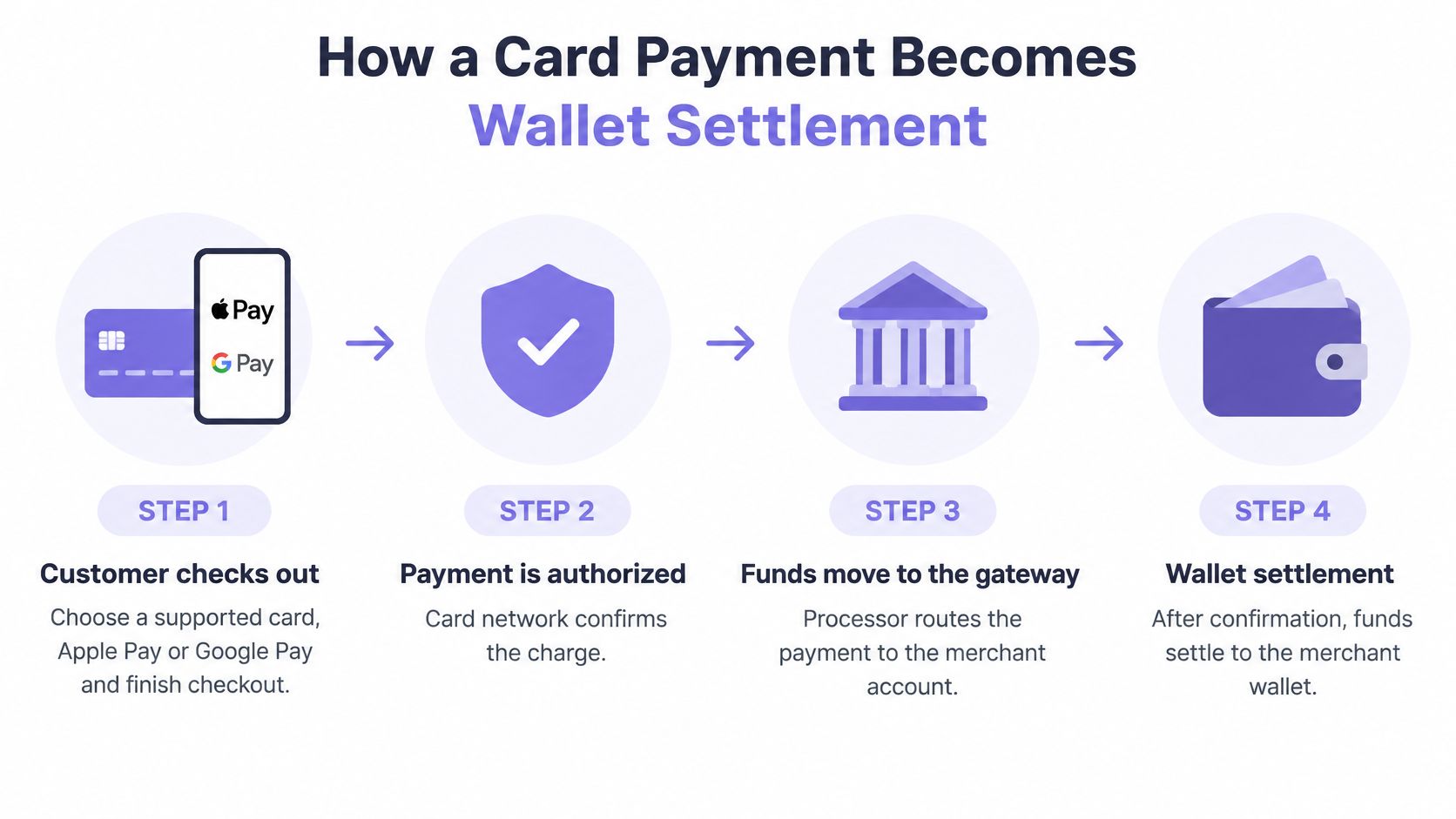
Six handoffs, in order
- The customer checks out. They pick a supported card, Apple Pay or Google Pay and finish on the independent provider's hosted page. The provider controls that page, not the gateway.
- The provider authorizes the payment and runs whatever customer checks that transaction, region and provider require. Approval is a provider decision.
- The gateway records the payment state so your support team and your reconciliation have a status to query, not just a wallet balance to squint at.
- Crypto settlement starts after the provider confirms. Confirmation is the trigger, not the checkout click.
- The transfer goes out. On an instant route we send USDC directly to the merchant's Polygon wallet within minutes, while the exact asset, amount, network and timing still depend on the payment route and the provider.
- You see the credit in the configured wallet and treat that balance as proceeds, not as a rolling reserve parked at the gateway waiting for a release date.
The distinction that matters operationally is that confirmation is a provider event and the blockchain transfer is a later event. One can be held, reviewed or declined. The other, once broadcast and confirmed, is effectively final.
Settlement times are not a single service level across every provider and network. They depend on the payment provider and the network, which is why a merchant who moves from one route to another often finds the same checkout feeling different on the payout side.
Here's the same flow as a walkthrough, for anyone who wants to see the routing in motion.
Two questions stay open after the transfer lands. What happens if the card payment wasn't legitimate, and whether that USDC route stays available to US customers at all.
Which Payments Create the Costliest Losses
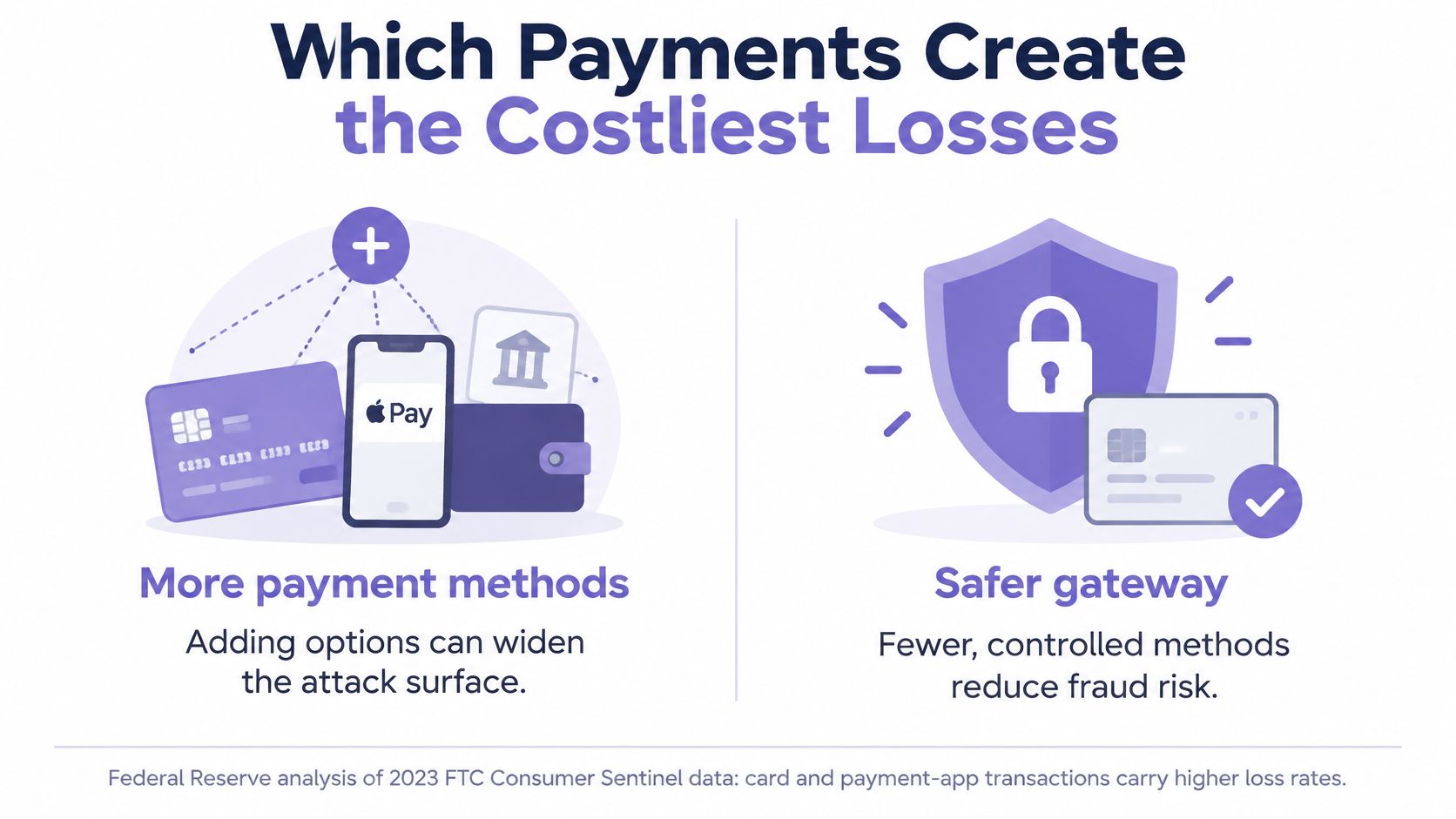
More payment methods is usually pitched as growth. It's also a decision about who absorbs a loss, and the two aren't correlated the way most merchants assume.
Federal Reserve analysis of the merchant payments use case, citing 2023 FTC Consumer Sentinel data, found that card and payment-app transactions generated the highest number of fraud reports, while bank transfers and cryptocurrency payments produced the highest loss amounts. Frequency and severity pull in opposite directions.
Who eats the loss before and after confirmation
Cards generate volume and complaints in equal measure, but they come with a well-worn path: the customer disputes, the issuer reviews, the merchant responds with evidence, and the money moves back if the evidence doesn't hold. It's slow and annoying. It's also survivable.
Bank transfers and crypto are the opposite profile. Fewer people complain, because there's often no complaints mechanism. When a loss does occur, it's larger and it's final. A wallet address typed with one wrong character has no chargeback department.
Map a bad card-funded crypto purchase across the parties and the sequencing becomes obvious. Before confirmation, the provider and the card issuer can decline, hold or reverse under card rules, and you can still choose not to release goods or coins. After blockchain settlement, the recipient wallet generally cannot be unwound by the gateway, the provider or the network. If the customer sent funds to an external wallet they mistyped, nobody in that chain can fetch the coins back.
The operating rule I'd apply: never add a row to your checkout until you can name the party that eats the loss on that row. If the answer is you, price it in.
That's why merchants who accept crypto alongside cards end up building controls that card-only merchants never need: wallet allow-lists, per-transaction amount limits, transaction monitoring, and a written refund policy that pays out as a fresh transfer rather than a reversed crypto send. The provider keeps its own customer-verification duties for its service. The gateway's job is status and routing, and it should never be sold as a fraud guarantee.
If your category is one mainstream acquirers decline, the loss math shifts again, because high-risk merchant account services come with their own reserve and review terms before you ever reach the fraud question.
Stablecoin Settlement Rules That Can Change Access
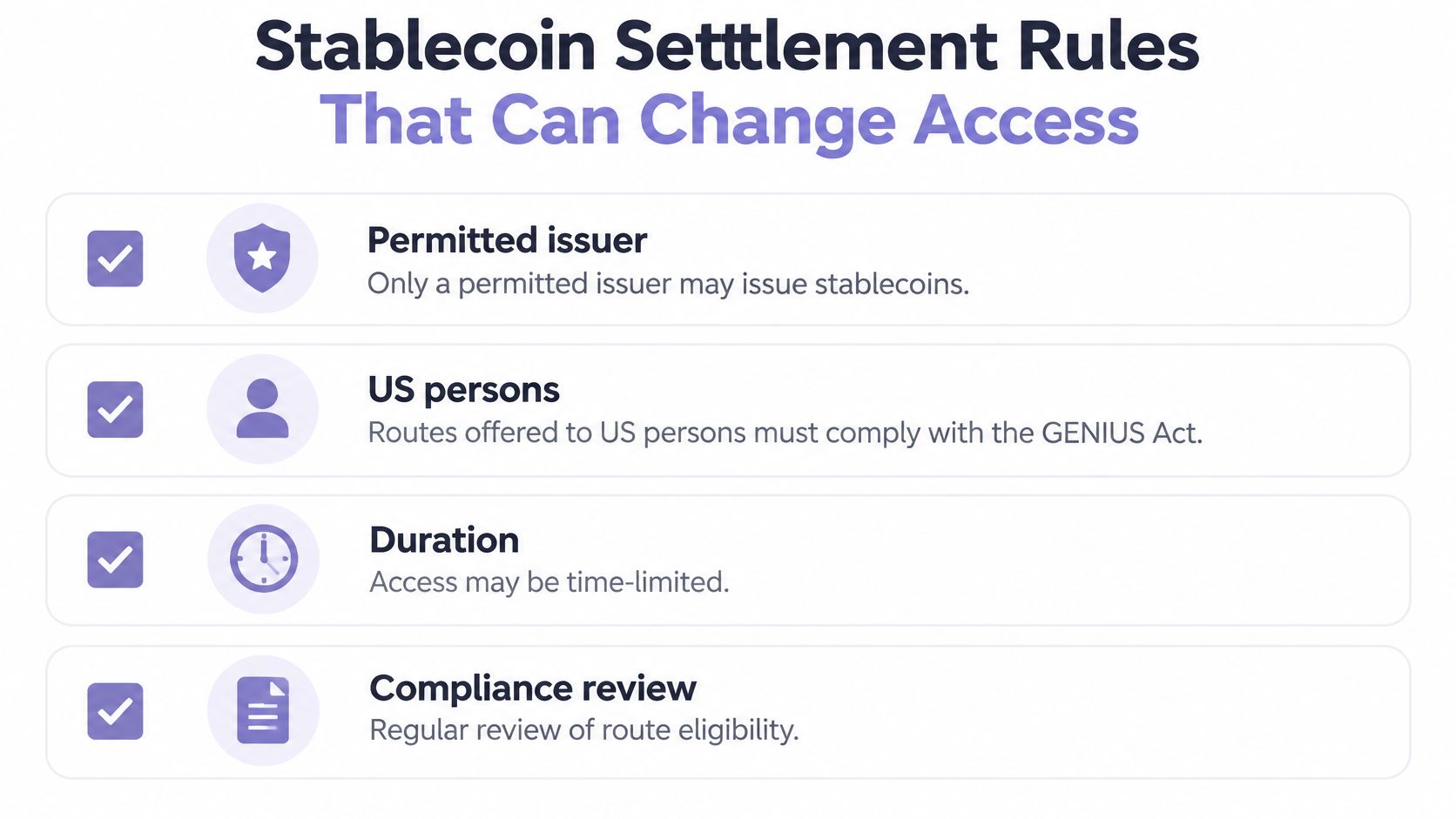
A pricing page that says "USDC settlement" only tells you what the API can send. The live question is whether that route may be offered to US persons, and for how long the offer can stand.
The GENIUS Act as enacted in Title 12, signed July 18, 2025, generally prohibits anyone other than a permitted issuer from issuing a payment stablecoin in the United States, and it restricts digital-asset service providers from offering or selling non-compliant payment stablecoins to US persons. That offering restriction phases in over a transition window rather than taking effect overnight, with exceptions written into the statute. In practice, a settlement route can be lawful today and still carry an expiry date that neither the gateway's marketing page nor its checkout flow will warn you about.
Three questions that decide whether USDC stays available
Seeing "USDC settlement" on a pricing page proves nothing about regulatory status. Run this list instead.
- Is the asset a payment stablecoin under the statutory definition, and who issued it?
- Is the provider a permitted party to offer or sell it to US persons, or is it relying on an exception?
- How are reserves and customer assets held, and does state or federal oversight apply to that issuer?
That third question creates real variation. Smaller issuers can remain under state oversight where the state framework is judged substantially similar to federal standards, so availability can differ by issuer and by state even when the checkout looks identical from the customer's side.
Ask in writing which asset and which chain settle today, whether the offer is limited by customer location, and what happens to in-flight checkouts if a route is withdrawn. The answer you get becomes a contract term, not a support ticket.
Continuity of USDC payout belongs on the same vendor-risk sheet as price and speed. A merchant whose settlement asset could change by jurisdiction needs a fallback asset and a documented conversion path, not just a promise that it will probably be fine. If the route disappears between authorization and settlement, the merchant holds the gap.
Checkout Setups US Merchants Actually Run
Three configurations cover most of what US-facing merchants are trying to do right now, and the customer's view is nearly identical in all of them.
A digital goods seller who wants USDC on Polygon
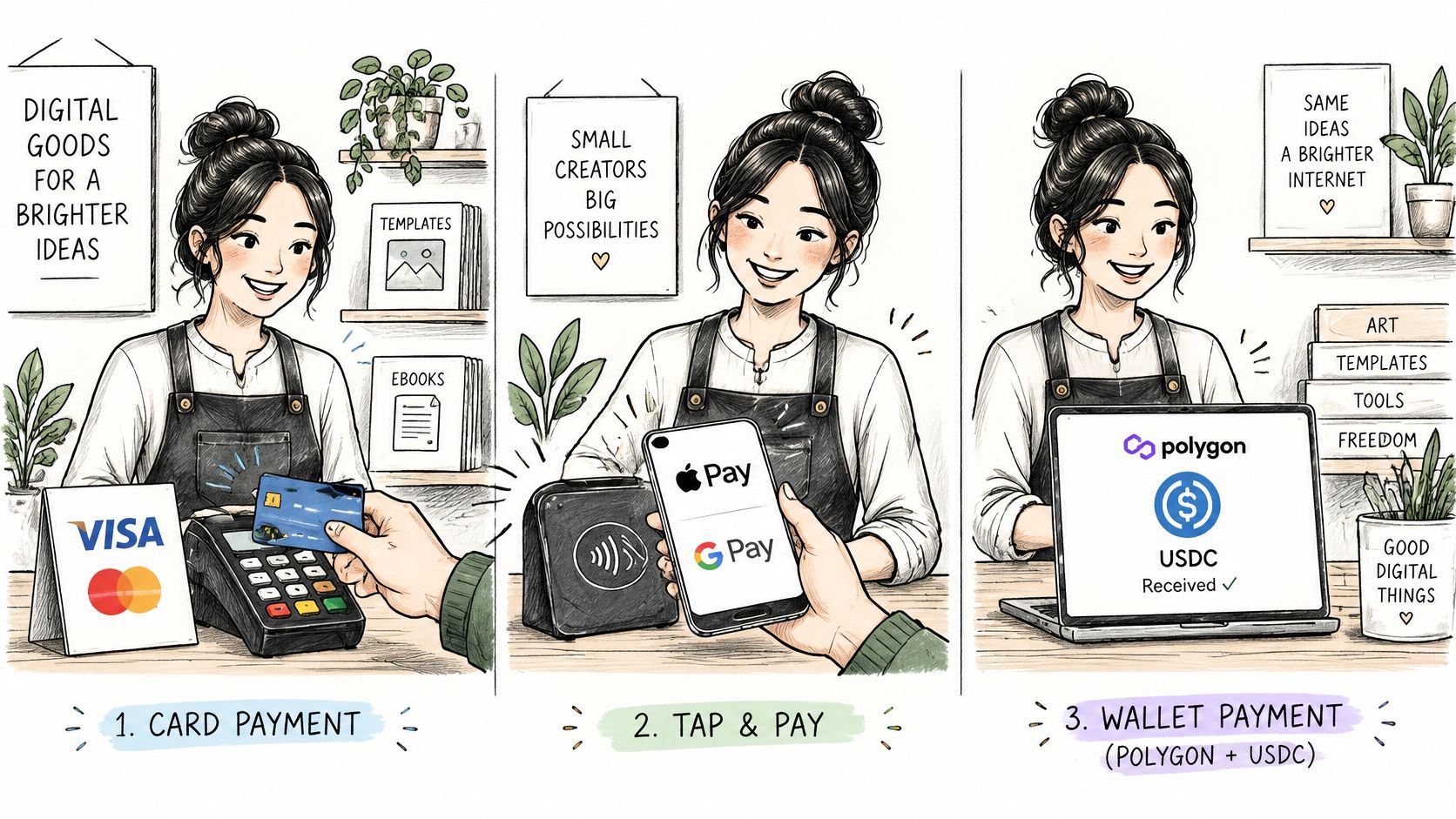
This operator sells templates and licenses, wants Visa, Mastercard, Apple Pay and Google Pay at checkout, and wants proceeds in a Polygon wallet rather than a bank account tied up by a gateway reserve. The setup is a plugin on WooCommerce or a direct API call, and reconciliation runs on two records: the payment status from the gateway and the wallet receipt from Polygon. Neither alone tells the full story.
A SaaS team whose real problem is webhooks
Subscription billing cares more about retries and status events than about underwriting. Their integration detail: private or internal addresses are rejected for webhooks, each delivery times out after 15 seconds, and failed deliveries are retried automatically. That means the billing system should treat a status webhook as a signal to verify, and the wallet credit as the cash event. A merchant who treats a webhook as proof of payment will eventually provision an account for a charge that never settled.
A high-risk merchant with a provider-hosted checkout
A licensed iGaming operator or an eligible research-use supplier gets the same card checkout page as everyone else, but should expect customer checks, plan limits and a human review instead of instant approval of every product. Nothing about the storefront signals the difference. The reserve terms and the reversal exposure do.
In all three, the customer experience looks interchangeable while settlement, reserves and reversal rights are not. The mistake is copying another company's stack because the checkout looked the same in a screenshot.
Choose the Gateway That Matches Your Settlement
Strip out the feature comparison and the decision comes down to two paths.
Path one. Customers pay by Visa, Mastercard, Apple Pay or Google Pay, and the business wants a dollar bank payout with ordinary card chargebacks. Use a conventional US acquirer, keep crypto optional, and don't overthink it.
Path two. That same card checkout should land in a merchant wallet. Shortlist a card-to-crypto gateway only after you've chosen the row from the methods table. Then confirm three things in writing: that the provider supports the method in your US region, that the settlement asset and network are named explicitly, and that the payout arrives shortly after provider confirmation rather than sitting in a reserve.
Get the liability answer too, for both failure modes. Who bears a fraudulent card payment that has already left as crypto, and who bears coins sent to the wrong external wallet? If the answer is "the merchant" in both cases, your monitoring budget just became part of the cost of the route.
Pick the settlement asset your operations team can actually hold and account for. A wallet full of a token your bookkeeper can't price is not proceeds.
For Polygon-based settlement, we let merchants choose USDC, POL, LINK or UNI as the settlement currency, each on the Polygon network, so the wallet matches what finance will custody. Merchants can add the gateway in minutes through a WooCommerce plugin or connect any site through the API, and the Enterprise plan covers unlimited processing, unlimited team members, high-risk industry support, a dedicated account manager, an SLA guarantee and priority onboarding for operators who need contracted response times.
Next step: pick the asset, run one test checkout, and confirm a small live payment in the configured wallet before you enable the method for real customers.
NexaPay gives eligible US-facing merchants a card-in, crypto-out setup: customers pay by Visa, Mastercard, Apple Pay or Google Pay through provider-hosted checkout, and settlement arrives in a Polygon wallet in USDC, POL, LINK or UNI, with no merchant identity verification required to begin even though providers still run their own customer checks. If you've read this far and you already know which row of the methods table you want, visit NexaPay and run the test checkout before you commit a live catalog to it.