How to Buy Cryptocurrency Safely: Steps, Fees and Wallets
Learn how to buy cryptocurrency with a card or bank transfer, compare real fees, verify wallet addresses and avoid costly first-time mistakes.
You've got your card ready, a free evening, and a purchase screen asking for a wallet address. Buying Bitcoin looked straightforward until you had to choose a network, understand the fees, and decide where the coins should go.
The purchase itself is usually the easy part. The decisions around delivery deserve more attention because a completed blockchain transfer generally can't be undone. Learning how to buy cryptocurrency safely starts with deciding where you'll keep it, before you pay.
The Five Steps to Buy Crypto at a Glance
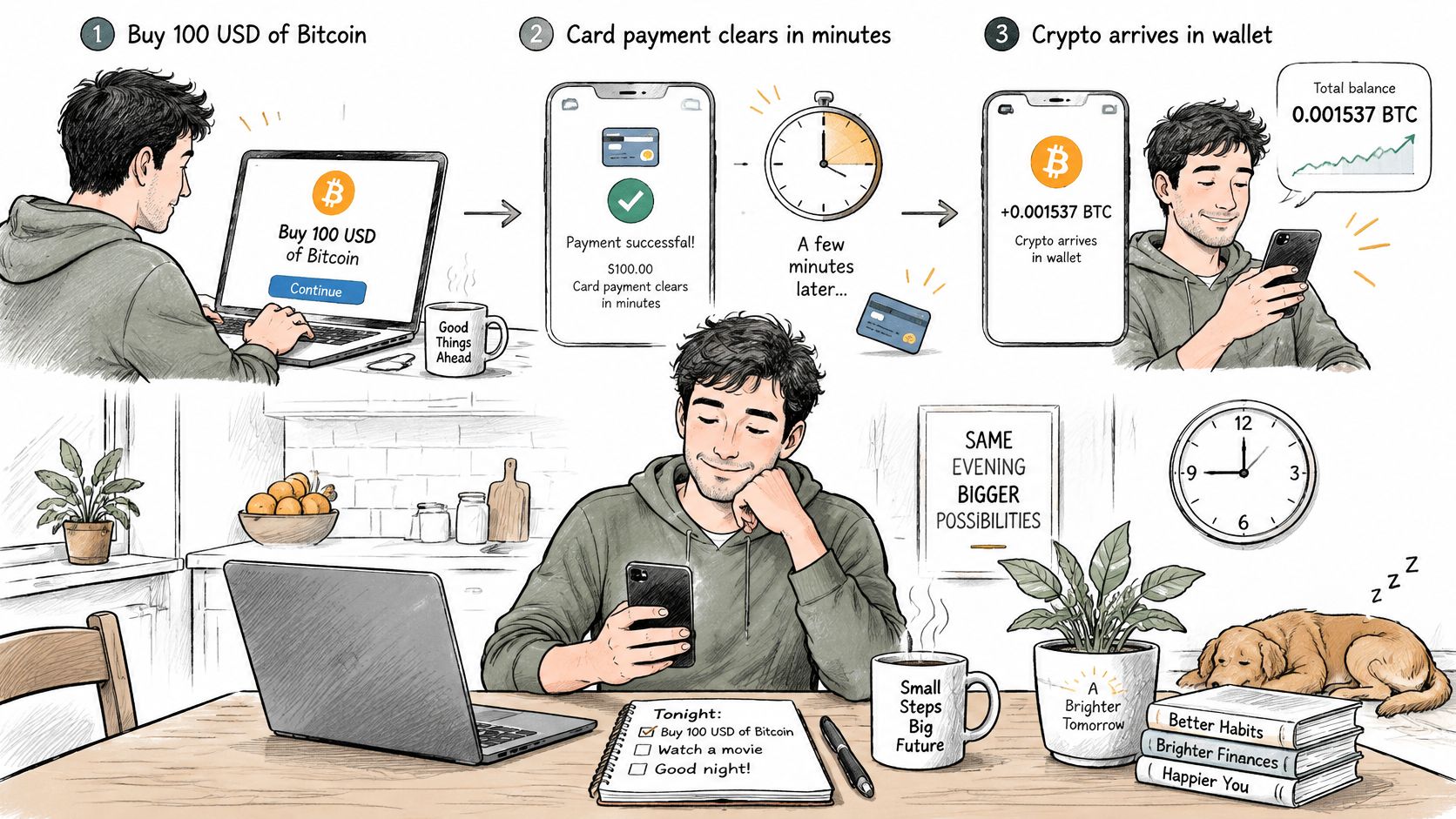
Say you want a small amount of Bitcoin and enough time to understand the process without rushing. You choose a purchase service, enter your spending amount, and reach checkout. Your card payment might be approved promptly, but that doesn't mean the Bitcoin has arrived or that it's ready to move again.
Between payment and receipt, the provider processes the order and sends the cryptocurrency to its destination. An incorrect but valid destination can turn a successful payment into a transfer you can't recover. That's why the wallet decision belongs before checkout, even though receiving the crypto comes last.
The purchase sequence
- Choose the amount and asset. Set a spending limit and select the cryptocurrency you intend to buy.
- Pick a route. Compare a card purchase, a bank-funded exchange account, and trading with an already funded account.
- Complete verification and payment. Supply identity information when required and authorize the payment.
- Wait for settlement. Allow the provider and blockchain to process the transaction.
- Receive and check your crypto. Confirm it arrived in your personal wallet or provider account.
Have a government-issued ID available, a payment card or bank account in your name, and a secure, updated device. Use money you can afford to lose, not money reserved for rent, bills, or emergencies.
Before checkout: Know both what you're buying and where it will arrive. A familiar payment screen doesn't validate the destination.
Your first practical choice is the purchase route. It determines how you fund the order, which charges you'll encounter, and how much account setup you'll need.
Card, Bank and Exchange Routes Compared
Purchase routes by speed, cost and fit
| Route | Typical speed | Main costs | Best fit |
|---|---|---|---|
| Card purchase through a broker or payment-based service | Payment approval can be quick; delivery follows processing | Card or processor fee, spread, and possible delivery charge | Small first purchase without an exchange account |
| Bank transfer to an exchange | Purchase follows bank clearance and account crediting | Bank charges, trading fee or spread, and withdrawal costs | Larger amounts and recurring buys |
| Exchange trading with a funded account | Trading can begin once funds are available | Trading fee, spread, and withdrawal fee | Frequent buyers who manage their own orders |
| Crypto ATM | Purchase follows machine verification and payment | Operator markup, transaction charges, and network costs | Avoid for a first purchase, especially under someone else's instructions |
Compare the received amount, not the headline fee
A spread is the difference between the reference market price and the price you're offered. A service can advertise a low transaction fee while quoting a less favorable purchase price. Compare quotes for the same spending amount and asset, looking at the net cryptocurrency delivered.
Card purchases simplify the funding process. With our purchase interface, you enter an amount, choose your crypto, and pay with a card. Available assets include Bitcoin, Ethereum, USDT, USDC, Solana, and additional cryptocurrencies, but the asset name alone isn't enough to identify the right delivery network.
If you plan to use borrowed funds, review the practical considerations in our guide to buying Bitcoin with a credit card. Your card issuer's treatment of the transaction matters separately from the purchase service's quote.
Bank funding separates depositing money from buying cryptocurrency. That gives you an opportunity to compare trading options, but you must wait until the exchange credits the deposit. A funded exchange account adds order controls, while also requiring you to understand withdrawals and any associated charges.
Choose for the purchase you actually intend to make
Use these decision criteria rather than assuming one route always wins:
- For a small, occasional purchase: A card route may justify its convenience if the delivered amount is acceptable.
- For larger or repeated purchases: Compare bank funding and exchange costs before committing.
- For an already funded account: Check the trading quote and withdrawal charge together.
- For an ATM purchase: Stop if anyone directed you to the machine or supplied the receiving address.
Don't assume a bank route is automatically cheapest or a card route automatically fastest. The useful comparison is the complete quote, the funding requirements, and the destination, not the payment method in isolation.
Spot Scam Pressure Before You Pay
Urgent instructions from a romantic contact, an employer, a supposed government official, or an online investment adviser should make you stop. The warning sign is often who is directing the purchase and why, rather than which payment button you use.
Pressure can look ordinary on a phone screen:
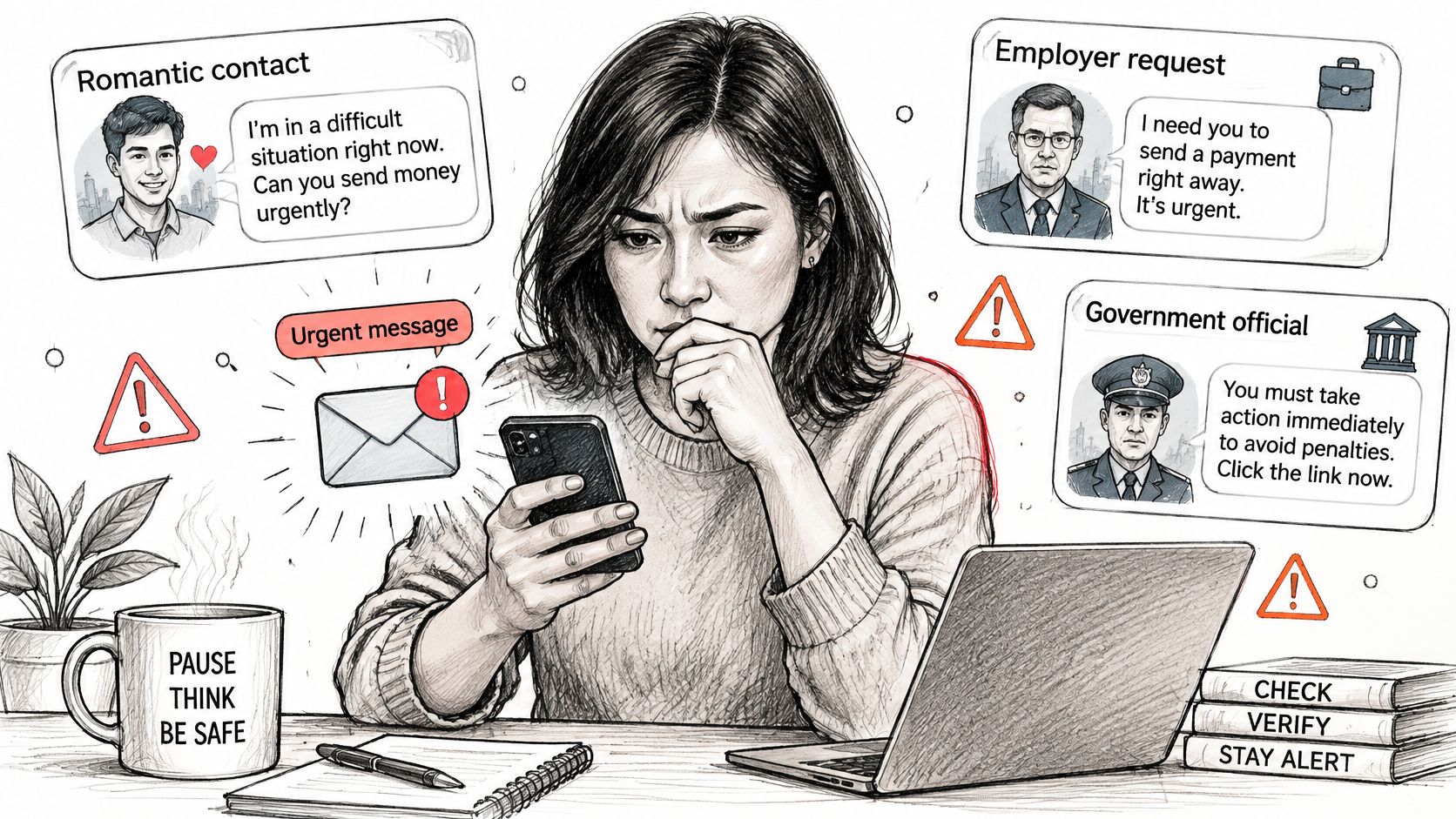
The FBI's 2025 Internet Crime Report recorded 181,565 cryptocurrency-related complaints and $11.366 billion in reported losses. Those figures make independent verification more than a technical precaution.
Recognize the instruction behind the payment
Watch for combinations of these behaviors:
- Guaranteed returns: Someone promises profits without acknowledging the possibility of loss.
- Withdrawal obstacles: A website demands another crypto payment to release an apparent balance or settle an alleged tax.
- An unfamiliar recipient: An adviser supplies an address and tells you not to change it.
- Device access: Someone asks you to install remote-control software or share your screen during payment.
- Secrecy or urgency: You're told not to involve your bank, family, or anyone who might question the instructions.
A card purchase isn't necessarily safer than buying through an exchange. A familiar checkout can make a fraudulent instruction feel routine, while the cryptocurrency still goes to a wallet controlled by the scammer.
Promises about avoiding identity checks can also distract from the recipient question. Our explanation of buying Bitcoin without ID is useful context, but an easy purchase process isn't evidence that an investment is legitimate.
Use a deliberate pause
Leave the checkout before responding to pressure. Contact the person or organization through contact details you find independently, not the phone number, message, or website they supplied.
Ask who owns the destination wallet, why cryptocurrency is necessary, and what the payment accomplishes. Refusal to answer plainly is a reason not to proceed. Don't let someone who claims to be helping you perform the verification on your behalf.
Use the accompanying video as another opportunity to pause before authorizing payment.
A demand to send cryptocurrency to unlock your own money is a stop signal, not a routine checkout step.
Real services can charge disclosed transaction or withdrawal fees. That's different from an unexpected demand to send fresh cryptocurrency to a separate wallet before you can access an alleged investment balance.
Choose Where Coins Sit and Verify the Address
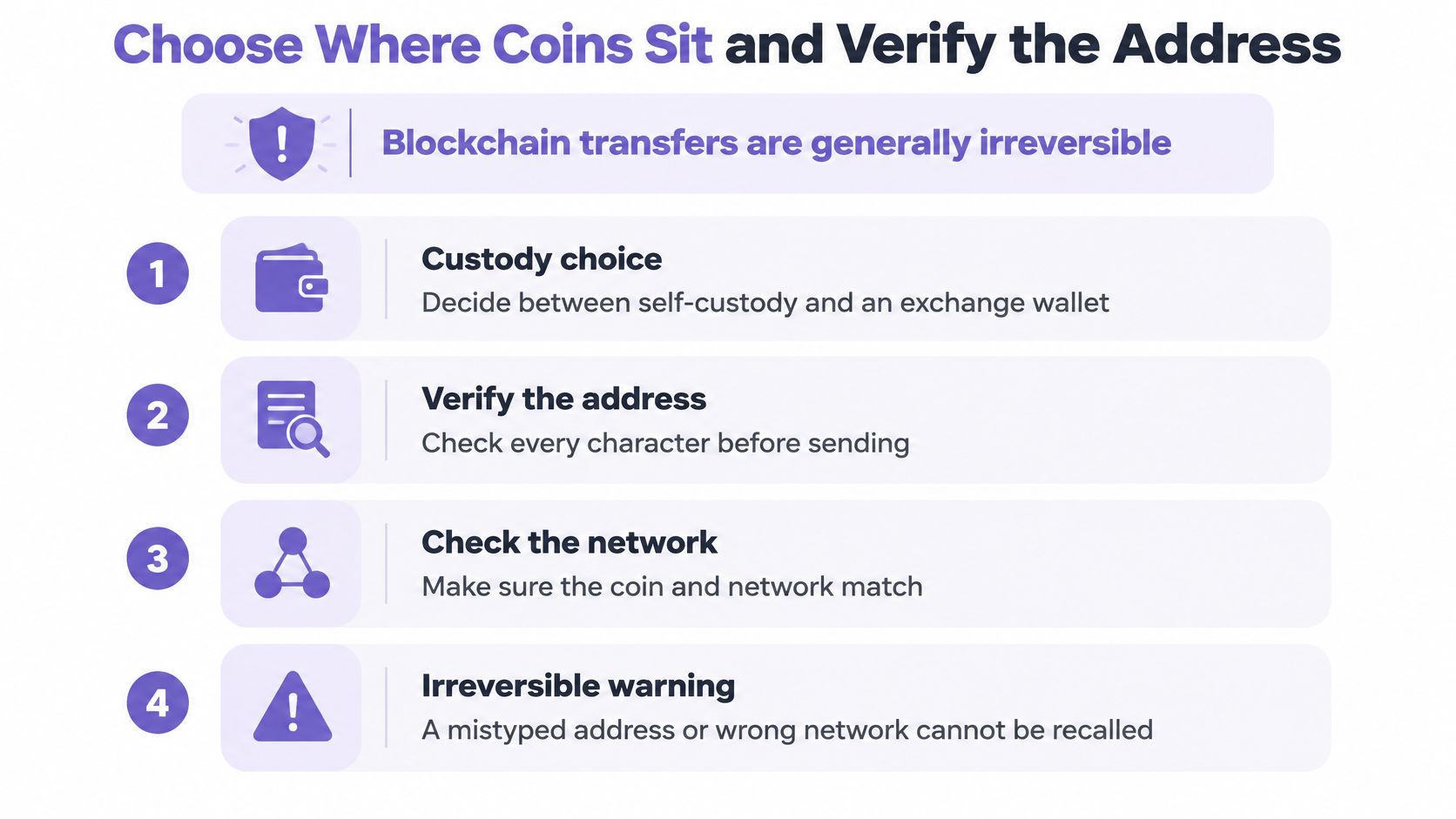
Blockchain transfers are generally irreversible. You can't ordinarily recall a transfer because you selected the wrong network or sent funds to the wrong valid address. Some invalid addresses are rejected before sending, but you shouldn't rely on that safeguard.
Choose a regulated or well-established provider available in your jurisdiction, then decide who will control the cryptocurrency after purchase. Those are separate decisions: a suitable purchase service doesn't automatically make every destination suitable.
Decide between provider custody and self-custody
With provider custody, the company controls the keys and you access your balance through an account. Account recovery may help if you forget your login, but withdrawals and continued access depend on the provider's operations and policies.
With self-custody, you control the wallet's keys. You aren't relying on a provider to authorize ordinary transfers, but you also take responsibility for protecting the wallet and its recovery information.
Slovakia's central bank found in its 2025 consumer research that most users stored crypto with the service provider through which they acquired it. That's a reason to explain the choice clearly, not assume every beginner should immediately move everything.
| Custody choice | What you manage | What can go wrong |
|---|---|---|
| Provider account | Login security, account recovery, and withdrawal settings | Provider failure, account compromise, or withdrawal restrictions |
| Personal wallet | Device security, keys, backups, and transaction approval | Lost recovery information, phishing, or an incorrect transfer |
A gradual approach can be sensible. Keep an amount you're comfortable managing with the provider while you learn, then consider moving longer-term holdings after a test transfer works. Neither arrangement protects you from the asset losing market value.
Prepare a personal wallet before ordering
Install wallet software through its official website or the app-store listing reached from that website. Avoid sponsored search results and links sent by strangers. For a hardware wallet, follow the manufacturer's setup instructions and generate your own recovery information.
A seed phrase is recovery information that can restore control of a compatible wallet. Write it down accurately and store it offline somewhere protected from theft and damage. Don't photograph it, email it to yourself, or type it into a website.
Losing the phrase doesn't necessarily cause immediate loss if your wallet still works. But if you lose both wallet access and the recovery information, there may be no recovery route.
Your receiving address is different: it's the information you provide to receive cryptocurrency. Our purchasing service can deliver crypto to an external wallet, with receipt directly in the buyer's wallet as the final stage of the purchase. The wallet must support the selected asset and network.
Perform the address and network checks
Use this routine before a meaningful transfer:
- Open the receiving wallet yourself. Select the asset and its receive function rather than accepting an address from a message.
- Confirm the network. Match the sending service's network to the receiving wallet's supported deposit network.
- Copy the address. Don't type it manually or rely solely on a saved contact name.
- Check every character. Compare the pasted destination against the address displayed in the receiving wallet, not just its beginning and end.
- Send a small test amount. Ensure it satisfies any receiving minimum and leaves enough to cover fees.
- Wait for usable receipt. Confirm the destination credits the correct asset before transferring the remaining amount.
Common assets, networks and transfer risks
| Asset | Common networks | Main risk |
|---|---|---|
| Bitcoin (BTC) | Bitcoin network for native BTC | Unsupported address format or a fee unsuitable for congestion |
| Ethereum (ETH) | Ethereum mainnet and layer-2 networks | Sending on a network the recipient doesn't support |
| Tether (USDT) | Ethereum, Tron, Solana, and others | Selecting a different network despite the same token name |
| USD Coin (USDC) | Ethereum, Solana, Polygon, and others | Network mismatch between exchange and wallet |
| Solana (SOL) | Solana network | Skipping any memo or additional deposit instructions required by the receiving service |
An Ethereum-style address can look identical across several compatible networks. Matching the address text therefore doesn't prove that the receiving service supports the network you selected. Likewise, USDT or USDC on different networks isn't interchangeable at the deposit screen.
Don't assume every Solana transfer needs a memo or tag. Follow the particular receiving service's instructions and include additional deposit information only when required.
Understand confirmation and recovery limits
For Bitcoin, inspect the feerate, commonly shown in satoshis per virtual byte, or sat/vB. A higher feerate generally receives faster confirmation than a lower one under the same conditions, but it isn't a guaranteed delivery time.
The BitBox guide to using a Bitcoin block explorer explains mempool-based fee assessment and warns that an explorer requesting wallet secrets should be treated as fraudulent. A block explorer can help you inspect a transaction, but it doesn't need your seed phrase, private keys, wallet password, or backup files.
If you send on the wrong network, contact the receiving service through its official support channel first. Provide the transaction ID, asset, network, and destination address, never wallet secrets. Recovery may be technically possible in some circumstances, but it isn't guaranteed, and an unfamiliar recovery agent promising certainty creates another risk.
How to Place Your First Purchase
Prepare the destination before opening the payment form. Keep your wallet available for checking the address, but close unrelated messaging apps and remote-access tools so nobody can guide or alter the transaction.
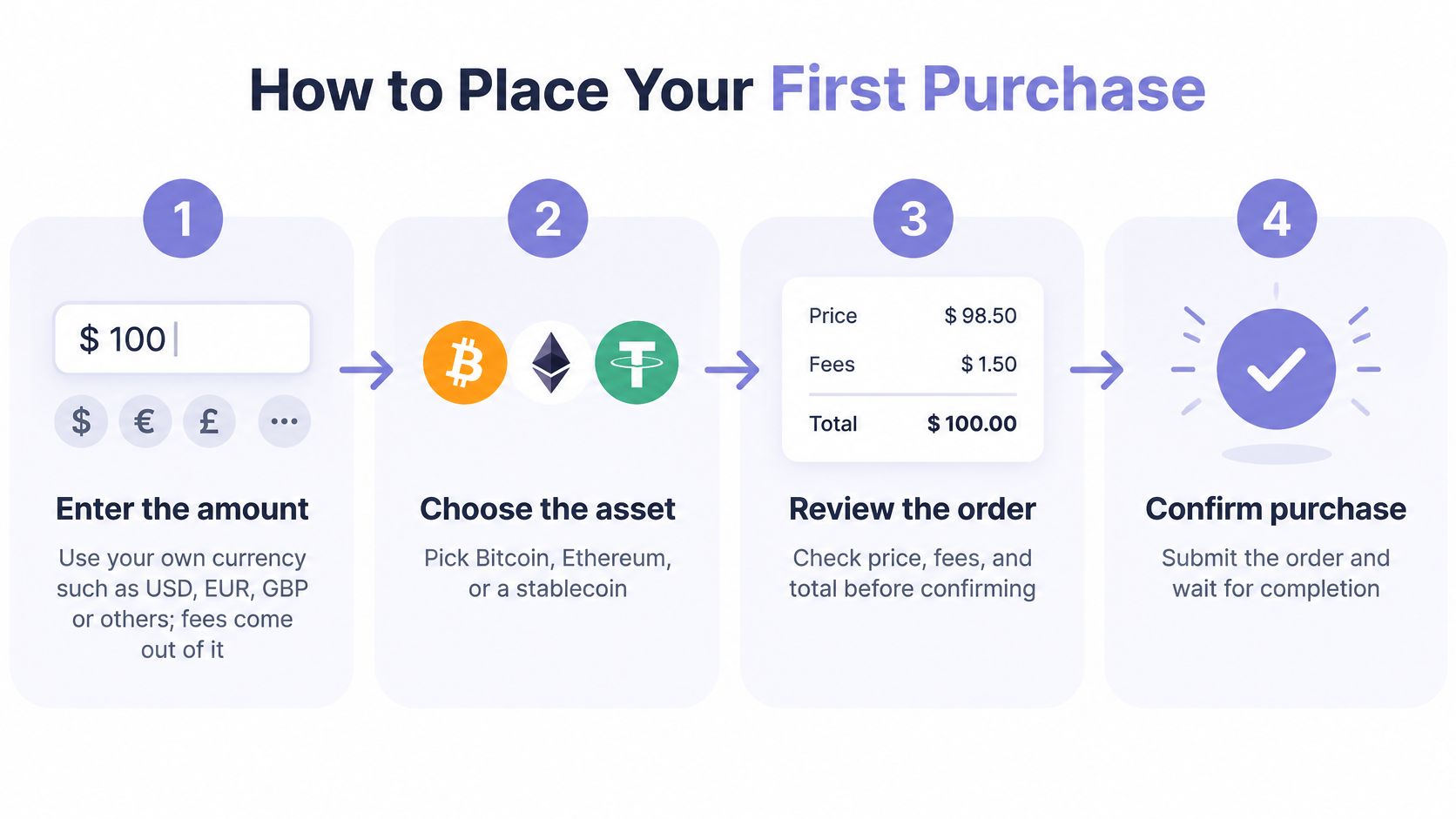
Enter and review the order
Choose your spending amount. Our purchase flow starts with an amount in USD, EUR, GBP, or UAH. Check whether the displayed total includes charges or whether fees reduce the crypto delivered; the common mistake is treating the spending amount as the value that must arrive.
Select the asset and delivery network. Choose Bitcoin, Ethereum, or a supported stablecoin such as USDC, according to what you intend to hold. Stablecoin branding doesn't remove issuer or network risk, and choosing a familiar ticker without checking its network can produce the wrong deposit.
Choose payment and complete any required checks. Our payment options include credit card, Apple Pay, Google Pay, Revolut, or PayPal, subject to availability. Basic purchases don't require an account, but payment providers may still require identity verification; use your own payment credentials rather than someone else's card.
Supply the receiving address. Enter your external wallet address, or a compatible deposit address from your exchange account. Paste the address you've verified and include any required deposit reference; don't substitute a general account identifier for a cryptocurrency receiving address.
Read the complete quote. Review the execution price, spread, payment charges, withdrawal or delivery charges, and the amount of cryptocurrency you'll receive. If the quote refreshes before you approve it, review the updated result rather than assuming nothing changed.
Pay and confirm delivery
Authorize payment and save the records. Complete the card or wallet approval, then keep the order ID and receipt. If the screen stalls, check the order status and your payment activity before retrying, because a missing confirmation page doesn't prove the payment failed.
Verify receipt at the destination. Check the transaction ID when available, the destination, the network, and the amount received. A payment marked successful isn't necessarily a fully confirmed blockchain deposit, and an exchange may wait for its required confirmations before making funds available.
Delivery involves more than card authorization. The provider may need to finish verification, process the order, and broadcast the transaction before the receiving wallet or exchange can credit it. Avoid interpreting an estimate as a promise.
Successful receipt means the intended asset appears at the intended destination on the intended network, with the receiving service showing it as available.
If the order remains pending, use the official order-status page or support channel and provide the saved order ID. Don't make a replacement purchase just because the wallet hasn't updated yet, and don't pay a stranger who claims they can speed up confirmation.
For recordkeeping, retain the original receipt alongside the transaction details. The receipt documents the purchase; the blockchain transaction documents delivery. Keeping both makes it easier to distinguish a payment problem from a transfer or deposit problem.
Decide Your Route and Place a Small First Order
Choose a card route for a small first purchase when convenience matters and you don't want an exchange account. Compare bank funding for larger or recurring buys, and use a funded exchange when you need trading controls. Skip the crypto ATM for your first purchase.
Select the asset deliberately rather than following whichever ticker someone recommends. If you're choosing between the major options, our comparison of Ethereum and Bitcoin can help you understand their different purposes.
Start with an amount you can afford to lose. Treat the first completed delivery as a practical test of your setup, not a reason to increase your budget immediately.
- Keep the purchase record: Save the receipt and order ID.
- Protect recovery information: Store your seed phrase offline if you use self-custody.
- Bookmark the official site: Return through that bookmark instead of unsolicited messages.
A completed blockchain transfer usually can't be reversed. Verification comes before sending.
NexaPay lets you buy supported cryptocurrencies using cards and available digital-wallet payment methods, with delivery to an external wallet. Visit NexaPay to review your purchase options, prepare your receiving address, and place a small first order when you're ready.