Ethereum or Bitcoin: Which Network Fits Your Goal
Ethereum or Bitcoin compared on purpose, settlement speed, security, staking risk and card purchases, with a clear way to choose the right one.
The familiar advice to buy Bitcoin for scarcity and Ethereum for utility leaves out the question that matters when money has to move: when can you safely use what you've bought? Choose Bitcoin for fixed-supply holdings without staking lock-up, and Ethereum for smart-contract applications, automated settlement and optional staking income whose liquidity risks you can accept. Neither choice guarantees a successful card payment will immediately become spendable cryptocurrency.
For merchants, the decision is even more specific. The asset arriving in your wallet, the network carrying it and your release-of-goods policy matter more than which cryptocurrency attracts the stronger investment narrative.
Bitcoin and Ethereum Side by Side
A card payment can be authorised before the cryptocurrency reaches a wallet. For a buyer or merchant, Bitcoin and Ethereum therefore differ not only in purpose, but also in how their networks record and signal settlement.
Bitcoin's supply is capped at 21 million BTC, with issuance reduced approximately every four years through halvings, according to this Bitcoin history overview. Ethereum supports programmable applications alongside transfers of its native asset, ether.
Bitcoin and Ethereum core features compared
| Feature | Bitcoin | Ethereum |
|---|---|---|
| Launch | Launched before Ethereum | Frontier was its first live network |
| Native asset | Bitcoin (BTC) | Ether (ETH) |
| Supply rule | Fixed maximum supply | No fixed cap; issuance follows protocol rules |
| Consensus | Proof-of-work | Proof-of-stake |
| Block or slot interval | Blocks arrive on a minutes-scale schedule | Slots operate on a seconds-scale schedule |
| Finality signal | Confirmations reduce reversal probability; no protocol-level irreversible declaration | Explicit checkpoint finality |
| Smart contracts | Limited scripting rather than a general-purpose application platform | Native programmable applications |
| Staking | No native staking | Optional validator rewards with liquidity and penalty risks |
| Energy per transaction, category median | Higher for proof-of-work systems | Lower for proof-of-stake systems |
The energy comparison describes consensus categories, not the electricity cost of an individual payment. Staking is an option for ETH holders, not a requirement for every ETH purchase.
Which difference should drive your decision?
A long-term holder can compare monetary rules and custody. A merchant can focus on the asset needed for expenses and the evidence of settlement required before releasing goods. A developer should check whether the workflow depends on application logic that executes on-chain.
Decision rule: Choose the network for the job your funds must perform, not for a feature you will not use.
If your next step is to acquire ETH for an Ethereum-based application, this guide to buying Ethereum explains the purchase workflow. Decide first whether you need transferable ETH or plan to stake it, since staking introduces a separate liquidity decision.
What Each Network Was Built to Do
Consider a merchant setting aside cryptocurrency receipts and a software business building conditional payouts. The merchant may want a monetary asset it can hold directly. The software business may need instructions that execute when specified conditions are met, which makes programmability a core requirement rather than an optional feature.
Ethereum's first live network, Frontier, launched on July 30, 2015, and its Beacon Chain launched on December 1, 2020, introducing the validator-based consensus layer that later supported the transition away from proof-of-work, according to Bitwise's Ethereum history. Its significance was the ability to deploy smart contracts, decentralized applications and tokens, rather than merely send ether between wallets.
The practical choice is between different jobs for the asset.
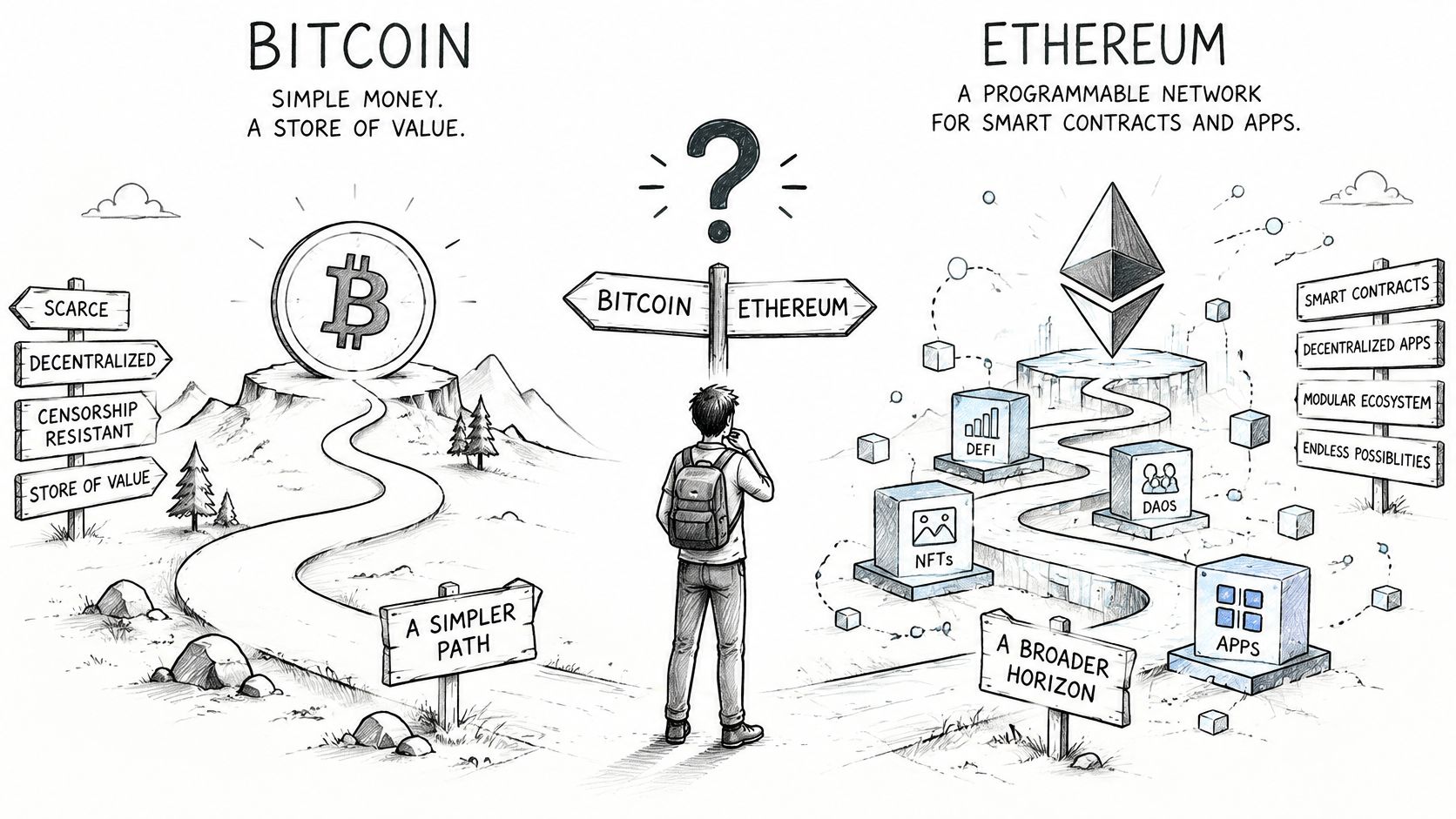
Monetary ownership versus executable instructions
Bitcoin's monetary design suits someone who wants to hold and transfer the native asset without participating in a general-purpose application environment. Its scarcity rule is part of the ownership proposition, not a promise about future purchasing power.
Ethereum's architecture supports a broader set of instructions. The ERC-20 standard became a foundation for token issuance, allowing applications to work with assets other than ether. That also creates an important distinction for buyers: owning ETH and owning a token issued on Ethereum aren't the same exposure.
- For treasury holdings, ask which asset you want on the balance sheet and who controls its keys.
- For application access, identify the application, the asset it requires and the permissions it asks you to grant.
- For merchant payouts, specify both the settlement currency and its network before configuring the destination wallet.
A business doesn't gain an operational advantage merely by choosing the more programmable network. It gains one when that programmability replaces a necessary manual step or enables a required transaction. If you only need straightforward custody, additional application capabilities may introduce decisions rather than solve them.
How Settlement and Finality Differ
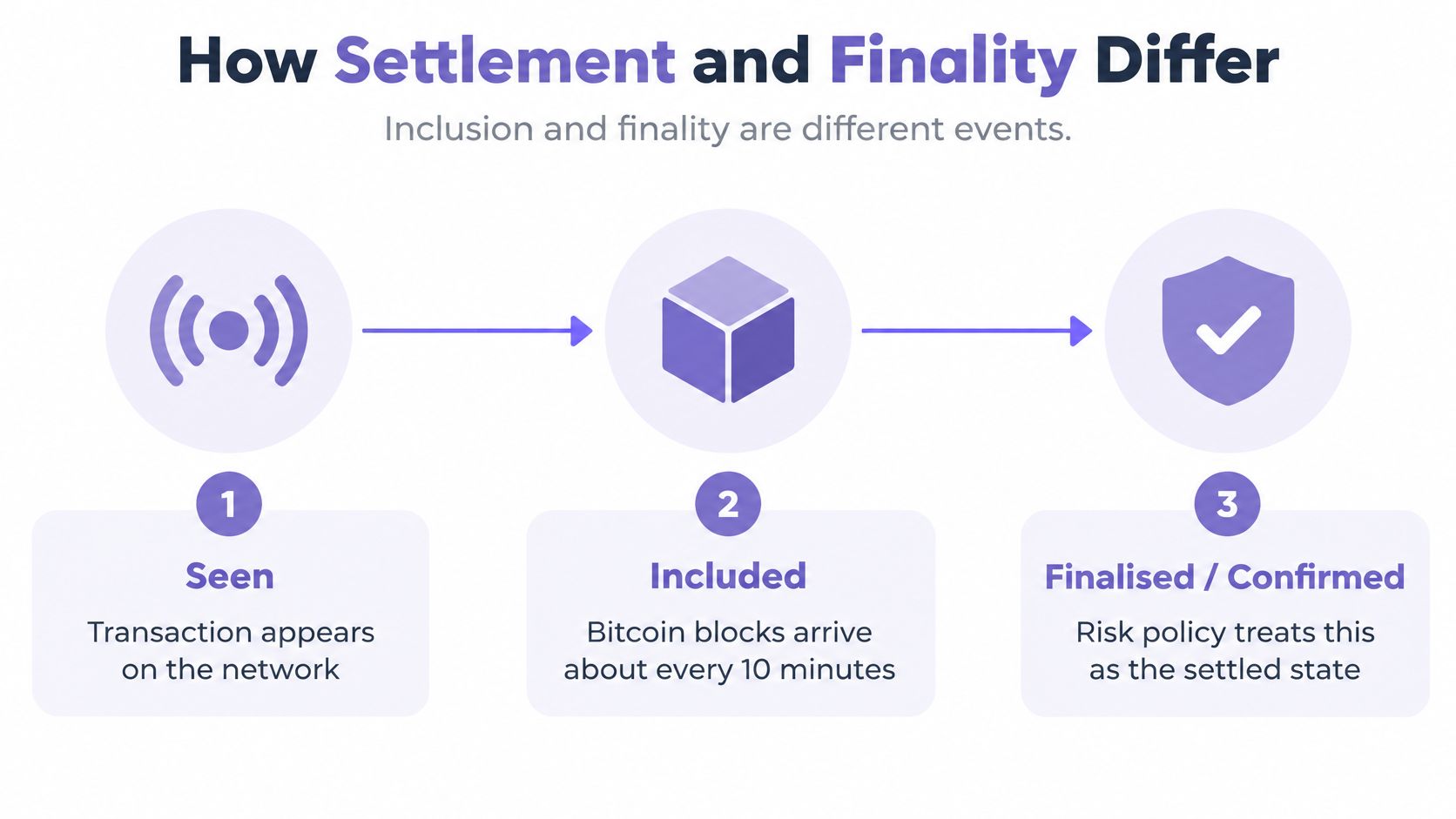
A payment can be seen, included or settled under your risk policy. These states aren't interchangeable: a broadcast transaction isn't proof that the recipient can safely release goods, and block inclusion isn't necessarily the endpoint of settlement risk.
According to Dwellir's deposit-detection guide, Bitcoin has an average block interval of approximately 10 minutes, while Ethereum uses roughly 12-second slots and targets practical finality at approximately 15 minutes. The same guide explains that Ethereum checkpoint finality requires attestations from at least two-thirds of participating stake across consecutive justification rounds.
Transaction states and typical timing
| Stage | Bitcoin | Ethereum |
|---|---|---|
| Seen on the network | Visible, not guaranteed | Visible, not guaranteed |
| Included in a block | Waits for a miner to include it; the average block interval isn't a delivery deadline | May be included within seconds when a suitable slot includes it |
| Practical settlement | Additional blocks according to the processor's policy | A finalized checkpoint covering the transaction |
| Reversal risk | Falls with additional confirmations; no protocol-level irreversible declaration | Finality provides an explicit settlement signal backed by validator penalties |
| Typical confirmation example | A hypothetical policy requiring three blocks implies roughly half an hour using the average interval | Require finalized status rather than relying only on elapsed time |
The distinction matters most when fulfillment can't easily be recovered. A digital-goods seller should not treat a successful broadcast as equivalent to permission to issue a redeemable license.
Build a release policy around evidence
Bitcoin offers a probabilistic model: the processor chooses how much confirmation evidence it requires. Ethereum offers an explicit finalized state, which can make automated release rules easier to express. Neither model lets a merchant substitute a countdown timer for checking the transaction.
- Record the state. Store the transaction identifier, destination, asset, amount and observed confirmation or finality status.
- Define the release threshold. Match it to the consequences of an incorrect release, particularly for instantly consumable goods.
- Handle stalled payments separately. If a transaction remains visible but unincluded beyond your operational window, pause fulfillment and inspect its status again.
- Reconcile the receipt. Confirm that the expected asset reached the intended address, not that a transaction succeeded somewhere on the network.
A fast checkout is a customer experience. A settled receipt is an accounting and risk-control event.
For our purchasing process, most transactions are completed within 5-15 minutes after payment confirmation, though delivery times may vary with blockchain congestion. That service timing isn't a substitute for a network finality signal. Treat completed crypto settlements as final and irreversible when designing customer support and refund procedures.
Energy and Security Models Compared
Security has a cost, but the networks pay it differently. Bitcoin miners expend computational work and electricity; Ethereum validators commit capital under rules that can penalize misconduct. Comparing electricity alone therefore answers an environmental question, not every security question.
Before using an energy-per-transaction figure, examine its denominator. Batching, network utilization and off-chain activity change how much activity gets counted against network-wide consumption, so a category average shouldn't be presented as the marginal energy caused by your next purchase.
Ethereum's proof-of-stake comparison cites an estimated 99.98% reduction in network energy consumption after the transition, with post-transition consumption estimated near 0.0026 TWh per year. Its architecture allows validators to operate on low-powered hardware rather than compete through mining equipment.
Separate the energy question from the operating-cost question
For a business with sustainability reporting requirements, Ethereum's lower-energy consensus can simplify the environmental case for using its base network. For someone operating validation infrastructure, low hardware power requirements can also reduce an operating expense. Those are specific advantages, not proof that every Ethereum-based transaction is inexpensive.
The relevant distinctions are:
- Network security expenditure describes the resources used to maintain consensus.
- Transaction fees describe what a user pays to obtain execution or block space.
- Infrastructure overhead includes the wallet, monitoring, custody and application systems a business operates.
- Capital commitment matters when a holder stakes assets rather than keeping them readily transferable.
These costs shouldn't be blended into a single claim that one network is cheaper. A low-energy architecture can still experience expensive block space, while a business using Bitcoin doesn't have to operate mining equipment itself.
Choose the metric your business actually needs
A merchant evaluating receipts should inspect the delivered asset amount after charges, not infer it from the consensus mechanism. A validator operator should model hardware, operational reliability and capital exposure. A sustainability team should document the boundaries and methodology of its network-energy estimate.
Reporting caution: A consensus-category energy estimate is not an audited footprint for an individual checkout.
Bitcoin's ongoing mining expenditure and Ethereum's committed validator capital represent different security arrangements. Neither removes the need for wallet controls, transaction monitoring or an appropriate custody policy.
The useful test is concrete: are you trying to reduce environmental reporting exposure, operate infrastructure economically or control the cost of receiving funds? Choose the measurement that answers that question before comparing the networks.
Staking, Lock-Up and Liquidity Risk
Yield doesn't automatically make an asset more suitable for your goal. Ethereum staking rewards compensate participation in a security system, and participation changes the conditions under which you can recover and move your funds.
The contrast is between keeping an asset available and committing it to earn rewards.
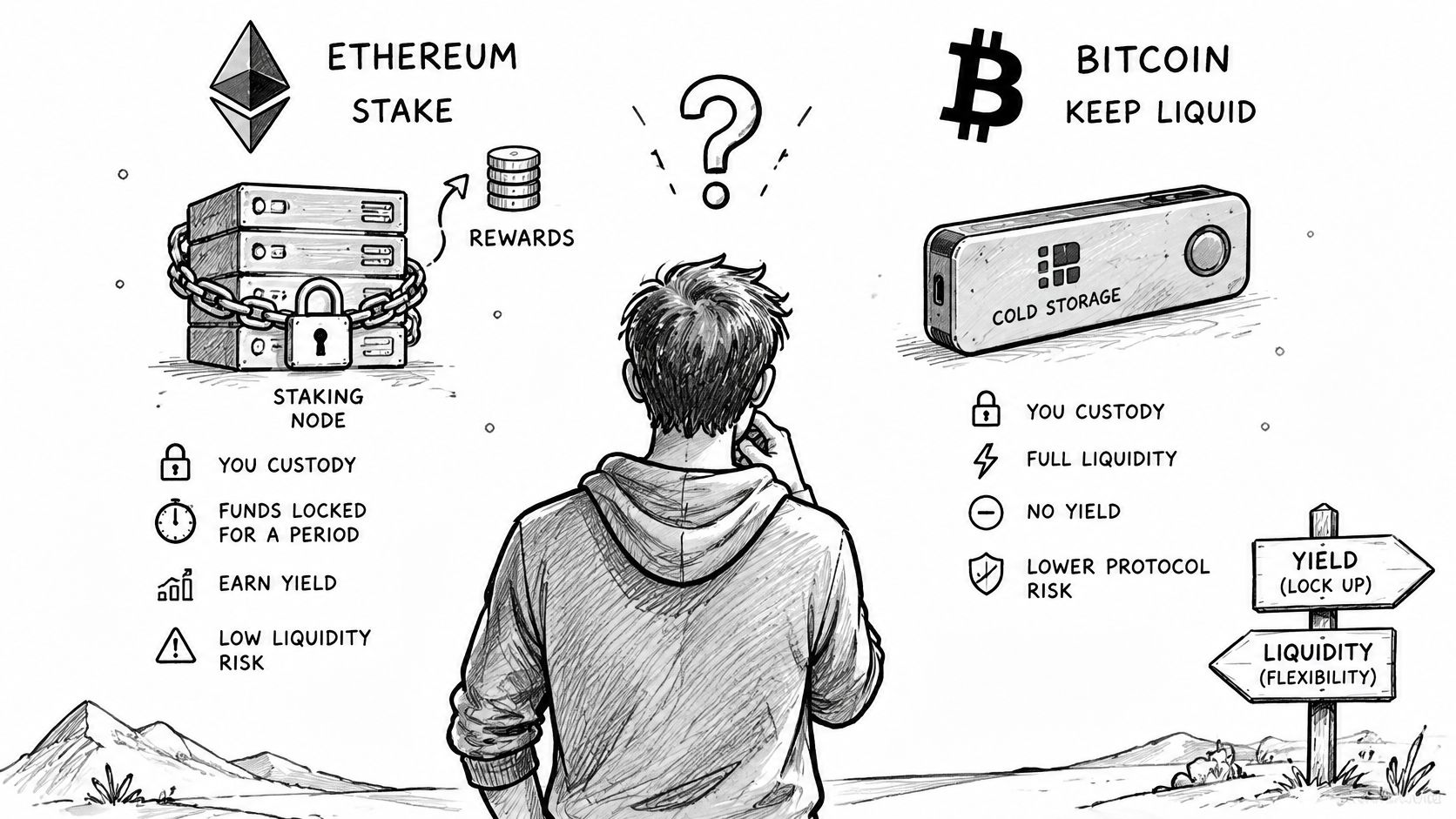
Ethereum staking offers estimated annual rewards of approximately 2.5%-3% in ETH, alongside liquidity, validator and custody risks described in the iShares cryptocurrency staking guide. That's an ETH-denominated estimate, not a guaranteed return in the currency you use to pay expenses.
Risk and liquidity factors for holding versus staking
| Factor | Holding Bitcoin | Staking Ether |
|---|---|---|
| Yield | None from simply holding | Variable rewards denominated in ETH |
| Lock-up | No protocol staking lock-up; transfer and custody constraints remain | Activation, exit and withdrawal processes can restrict movement |
| Exit time under heavy demand | Transfer subject to network processing and wallet access | Queue congestion can delay access beyond the holder's preferred date |
| Slashing penalties | Not applicable to native holding | Exposure to penalties for slashable validator behavior |
| Custody dependence | Self-custody or a chosen custodian | Solo validation, an operator or a staking provider, depending on arrangement |
| Smart-contract exposure | None inherent in direct native-asset holding | Additional exposure when using staking protocols |
Match staking to your spending calendar
Say an online seller receives cryptocurrency but needs cash for supplier invoices. Staking the invoice reserve creates a mismatch: the obligation has a due date, while access to the staked asset may depend on processes the seller doesn't control.
That mismatch can matter more than the reward. Funds needed for operations shouldn't be treated as surplus merely because the wallet shows a balance. Separate operating reserves from capital you can leave committed through an unfavorable market or delayed exit.
Unstaked ETH doesn't automatically carry staking queues or validator slashing exposure. Equally, Bitcoin's lack of native staking doesn't make it risk-free: holders still depend on secure key management or a custodian and remain exposed to price movements.
This video provides an additional perspective on the holding decision.
Keep asset risk separate from payment risk
A card purchase can succeed while the purchased asset loses market value. Successful payment processing therefore proves neither investment suitability nor protection against volatility.
The custody arrangement deserves its own assessment too. Identify who controls withdrawal credentials, who operates the validator and whether a smart contract sits between you and the underlying ETH. Don't describe all staking methods as carrying identical risks.
The central question isn't whether Ethereum can earn income that Bitcoin holding cannot. It's whether your spending needs justify accepting the additional exit, infrastructure and penalty exposure required to pursue that income.
Choosing Your Network and Buying With a Card
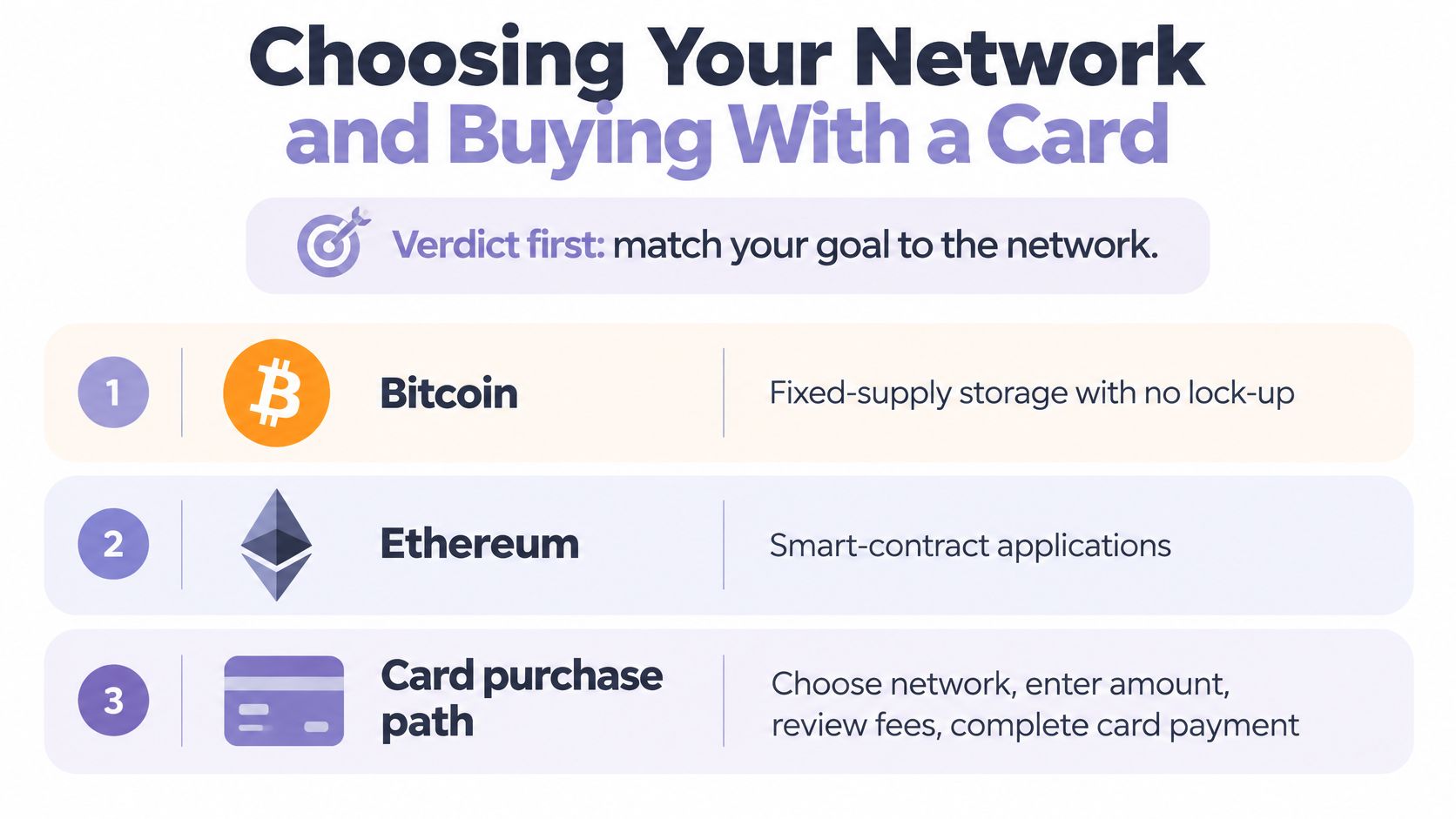
Choose Bitcoin when your priority is direct ownership of a scarce monetary asset without participating in staking. Choose Ethereum when you need programmable applications or want to stake capital you can afford to leave committed. For merchant receipts, start with the settlement asset and accounting requirement, rather than forcing every checkout into a Bitcoin-versus-Ethereum contest.
Which network fits each goal
| Your goal | Better fit | Main reason |
|---|---|---|
| Store value long term with a fixed supply | Bitcoin | Capped supply and no native staking lock-up |
| Build or use smart-contract applications | Ethereum | Native programmable platform |
| Earn staking-linked income | Ethereum | Validator rewards with liquidity and penalty exposure |
| Simple custody with no yield or lock-up | Bitcoin | No native validator participation required |
| Fast automated confirmation for workflows | Ethereum | Rapid inclusion and an explicit finality signal |
| Receive card payments in crypto | The network supporting your chosen settlement asset | Settlement currency and confirmation policy matter most |
| Lower energy footprint for reporting | Ethereum | Proof-of-stake energy profile |
A merchant settling in USDC on Polygon is making a different operational choice from an individual buying BTC or ETH. The customer's payment method doesn't determine which cryptocurrency must arrive in the merchant's wallet.
Use the purchase path to test the choice before committing funds.
Check what happens after authorization
Card authorization is approval on the payment side, not proof of completed blockchain delivery. Likewise, a displayed asset balance doesn't always mean the asset can immediately leave the platform or staking arrangement.
Under heavy demand, staking queues can stretch from days to weeks or months, as discussed in iShares' guide to investing in Ethereum. That constraint applies to staking-related processes, not automatically to ordinary ETH delivered to your wallet.
Before paying, work through these checks:
- Confirm the quote and expiry. Review the amount you'll spend, the cryptocurrency amount expected, the charges shown and whether the quote must refresh before completion. Don't compare offers solely by a headline fee.
- Distinguish authorization from delivery. Keep the payment reference and the blockchain transaction identifier as separate records. A card notification alone doesn't establish wallet receipt.
- Verify the destination precisely. Match the asset symbol, network and receiving address. A wallet supporting an asset name isn't enough if you selected a different network.
- Apply your settlement threshold. Check the transaction's actual state before spending the receipt or releasing irreversible goods.
- Confirm transferability. Establish whether you're receiving the native asset directly, leaving it with a custodian or entering a staking product.
If you're funding the purchase with a credit card, review the Bitcoin credit-card purchase guide before checkout. Check your card issuer's terms separately from the cryptocurrency quote, because those are different contractual relationships.
Turn the verdict into a usable purchase
Our buying process begins with choosing an amount to spend, selecting the cryptocurrency and completing payment. Customers can pay with Visa, Mastercard or digital wallets, and the receiving step delivers cryptocurrency directly to the buyer's wallet. That makes the accuracy of the external-wallet details part of your pre-payment checks, not something to correct afterward.
For a merchant, write down the asset you want to retain and the asset needed for operating expenses. If those differ, include conversion and market exposure in the treasury decision. Faster technical settlement won't remove a currency mismatch.
Decide the goal, select the asset, verify the wallet and establish the release rule before paying. Crypto prices move, and this is general information rather than individual financial advice.
NexaPay lets you purchase Bitcoin, Ethereum and other supported cryptocurrencies with cards or digital wallets, with delivery to your chosen external wallet. Visit NexaPay to review your purchase options, then confirm the asset, network and receiving address before completing payment.