Buy Bitcoin No ID: What Limits Apply and How to Stay Safe
Buy Bitcoin No ID safely: which routes skip account checks, which rules still apply, privacy limits and scam warnings to know first.
The advice you'll find most often about buying bitcoin no id is to hunt down an exchange that skips KYC, or to feed cash into a machine and walk away. Both suggestions will get you a transaction. Neither delivers what the advice subtly implies.
Skipping an account-level identity check is a friction decision. It isn't a privacy guarantee, and it's definitely not a safety guarantee. The routes that ask the least of you give the least back when something breaks, and the ones that settle in seconds are the ones where a mistake is permanent. What you're really choosing between is speed, recourse and exposure, and the sensible version of this purchase is the one where you pick that trade on purpose.
Which Routes Skip the Account and What They Still Require
Buying bitcoin no id usually means buying without an account, not without verification. Those are two different promises, and most providers only make the first one. The four routes below are the ones people use, and they differ in what you skip, what still gets checked, how fast the coins move, and who you can call when the payment goes wrong.
Terms shift by country, by payment method and by amount, so read the table as structure rather than as a quote. It also stopped being a niche question: Gallup found that 17% of U.S. investors owned cryptocurrency in 2025, compared with 6% in 2021 and 2% in 2018, and plenty of that wider group arrive without an exchange account.
| Route | Account needed | Identity checks | Settlement | Main risk |
|---|---|---|---|---|
| Cash or Bitcoin kiosk | Often none | Set by the operator and the amount, and the machine can ask for a photo ID before it takes cash | Immediate and usually irreversible | Scam exposure with little recourse |
| Card or wallet checkout via a third-party provider | No account for basic purchases | The provider may ask you to verify your identity before paying | Sent to your wallet after payment confirmation, with transfers typically initiated within 1 to 2 minutes | Card decline, payment hold or reversal |
| Peer-to-peer informal seller | Usually none | None from a platform, only whatever the two parties agree | Whenever the seller sends, at whatever confirmation they choose | Highest fraud risk and no reversal |
| Regulated exchange | Full account | Full identity check | Minutes to days, set by the exchange and the payment method | Least privacy, but the most recourse |
The pattern in those rows holds. The less a route knows about you, the less it owes you. A kiosk and an informal seller both hand over coins quickly, and neither can pull a payment back, which is exactly why those two rows are where fraud does the most damage. A card checkout through a third-party provider sits in the middle: no account, but the provider can pause the payment or ask who you are.
What each route costs. The price rarely sits on one screen, so compare the coins you receive rather than the headline rate.
- Cash or Bitcoin kiosk: the quoted BTC amount plus the operator's spread, shown before the cash goes in. The network fee is usually folded into that spread instead of itemised, so the total on the screen is the number that matters.
- Card or wallet checkout: three lines to check, the quoted BTC amount, any card or processing fee, and the network fee. Where a provider doesn't publish one of them before you commit, treat the missing figure as part of the price.
- Peer-to-peer seller: whatever you agree, with no fee schedule to audit. Ask for the on-chain transaction ID and the fee setting before anything changes hands.
- Regulated exchange: a trading fee plus a withdrawal fee when you move coins out. Usually the cheapest of the four and the slowest to set up.
Rule of thumb: pick the route that matches the amount you need, the verification you can accept, and the recourse you want if something goes wrong. A test purchase and a month's savings shouldn't travel the same rail.
Regional Rules and Provider Limits That Still Apply
A checkout with three fields can still run several checks behind it. Regulated virtual-asset service providers must apply customer due diligence, keep records, report suspicious activity and transmit originator and beneficiary information under the Travel Rule. That last obligation is the one buyers miss: your details can travel with the payment to the receiving provider even when you never filled in a registration form.
That perimeter keeps widening. A review of crypto privacy regulation through September 2026 reports that 91 of 109 responding jurisdictions had enacted Travel Rule legislation by 2026. Cross-border requirements are expanding, so a route that looks unregulated is still inside someone's reporting perimeter.
| Check | Value | What it means for the buyer |
|---|---|---|
| Occasional-transaction due-diligence threshold | USD/EUR 1,000 in the FATF framework | National rules and provider risk controls can require checks below this level |
| Travel Rule legislation | 91 of 109 responding jurisdictions had enacted it by 2026 | Originator and beneficiary data are passed on, and cross-border rules are expanding |
| Restricted countries on the fiat onramp | 36 countries, including Iran, Russia, Syria, Venezuela, Myanmar, Ghana and Uganda | Confirm your country is not on the list before opening checkout |
| Card issuer crypto-purchase policy | Set by your bank's own risk and lending rules | Check it with your bank before the first attempt |
Restrictions also land at the provider level, and they run stricter than a checkout screen suggests. NexaPay Instant, a fiat-to-crypto payment gateway, accepts cards, Apple Pay and Google Pay in supported regions, while its fiat onramp and gateway stay blocked across those 36 countries, a list that runs from Afghanistan and Belarus to Sudan, Tunisia and Vanuatu. Its payment providers can also ask a customer to verify identity before paying, so a short checkout form still leaves room for a document request.
When a card purchase runs through a hosted checkout, the provider in the middle decides what to ask for and what to refuse. The wallet you're funding gets no say in it.
What to confirm before you pay
- Your country isn't restricted. Check the provider's own list rather than the app store region you downloaded from.
- The buyer terms, not the merchant terms. Merchant onboarding can be as light as an email address and a payout wallet, which tells you nothing about what a buyer must supply.
- Your card issuer's policy. Some banks treat a crypto purchase as a cash advance or block the merchant category outright, and no checkout page warns you before the decline.
Privacy Limits That Remain After You Skip ID
Pseudonymity is a property of the ledger. Privacy is a property of how you behave around it, and skipping an account changes almost nothing about the second one. A longitudinal analysis of 342,744,669 Bitcoin addresses from 2009 to 2017 found that 86% of addresses were used only twice, typically once as an input and once as an output. One-time use is the norm, so a reused address stands out immediately.
The same analysis concludes that address reuse makes it substantially easier to link transactions and infer who is behind an address. The ledger never names you. It hands anyone with a copy of it the raw material to cluster your activity, and payment records plus provider files supply the name.
| Layer | What it can reveal | Practical reduction |
|---|---|---|
| Public ledger | Every transaction and address stays visible | Use a new receiving address for each purchase |
| Address reuse | Reused addresses are easier to link, since most addresses are used only once | Generate a fresh address from your wallet every time |
| Payment metadata | Card issuer, billing name, device and IP address | Assume your bank and the provider can see the purchase |
| Provider records | Customer due-diligence records kept under FATF standards | Plan on records existing and keep your own receipts |
| Later exchange deposits | A regulated exchange can connect incoming coins to your identity | Treat every exchange deposit as traceable |
| Wallet security | A leaked seed phrase or compromised device exposes funds | Keep the seed offline and never share it |
Two layers catch experienced buyers. Change-address reuse ties a new payment back to an old one, and the common-input heuristic assumes addresses spent together belong to one owner. Consolidating coins from an identifiable source into the same wallet as your long-term holdings joins those histories permanently, and no later transfer undoes it.
The honest goal: lower friction and limited exposure. Not invisibility.
Mixing services don't solve this. They bring theft, legal and taint risk, and an output that looks tainted can be harder to spend at a regulated venue than coins that were never mixed. Treat them as a liability, not a privacy tool. Wallet security belongs on the list for the same reason: the fastest way to lose coins bought without an account is to hand the seed phrase to someone who offers to help with a stuck transaction.
How to Buy Bitcoin Without ID Step by Step
The sequence below is the one I'd run at any size. It reduces to five checks: who is allowed to sell to you, what you're being quoted, where the coins are going, whether a small amount arrives, and whether the chain agrees. The FATF updated guidance on virtual assets and VASPs frames the same order and adds the detail buyers skip: an account-free route is a lower-friction purchase method, not a way around identity, sanctions or fraud controls.
Here's the same workflow as a single visual sequence.
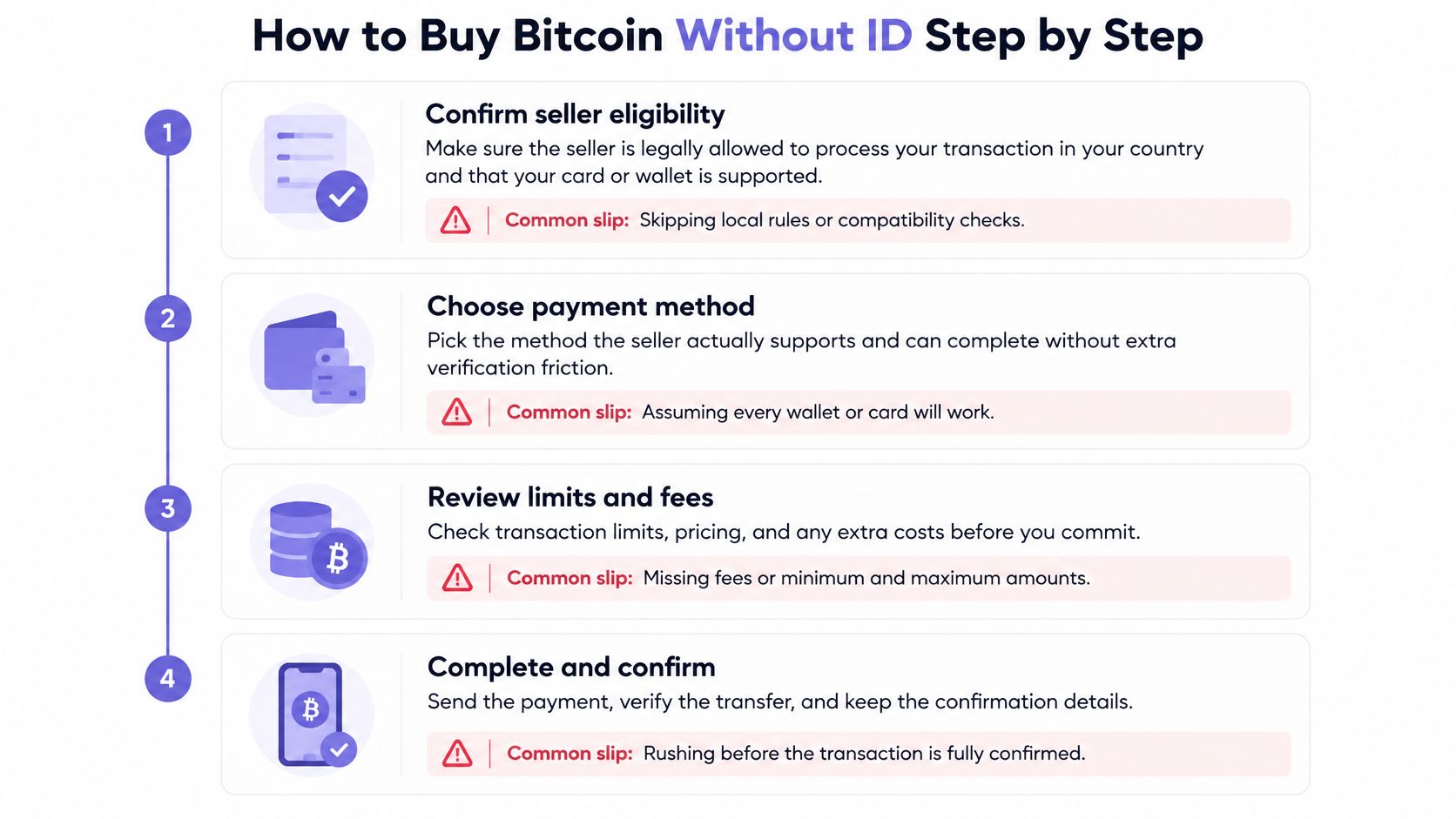
- Confirm the seller may process your transaction where you live. A provider operating outside its licensed area can freeze or reverse a payment, and you find out after the money has left. The usual slip is checking the app's language rather than the seller's jurisdiction.
- Write down the quote before you pay. You want the BTC amount, the network fee, the refund policy and the settlement time in one place, because pricing can move between the quote screen and the charge. Comparing a headline fee instead of the coins you'll receive is how buyers misjudge the cost.
- Generate a fresh receiving address and match the network exactly. Use a hardware wallet such as a Trezor, Coldcard or Blockstream Jade, or an open-source wallet like Sparrow or Electrum, and copy the address rather than typing it. Coins sent on an incompatible network or to a mistyped address are generally gone, and no support desk can retrieve them.
- Run a small test purchase. Send an amount you'd shrug at, then confirm it lands in the wallet you control. Crypto can be bought and delivered to any external wallet you name, so the wallet is the only thing standing between a delivery and a loss. The slip is assuming a clean test proves the next, larger transfer will clear the same provider checks.
- Verify on a block explorer and wait for confirmations. Look the transaction ID up on mempool.space or blockstream.info, check the outputs, and wait for the confirmation count you're comfortable with before moving or spending. A payment confirmation page is not proof of delivery. The on-chain ID is.
If you'd rather watch the process before you start, this walkthrough covers the same ground.
A purchase went well if you finish with three things: a transaction ID you can look up independently, a confirmation count that keeps climbing, and coins sitting in a wallet whose seed phrase has never left your hands. Anything short of that is a payment, not a delivery. Sellers who ask for seed phrases, remote-access software, gift-card payments or a deposit to an address unrelated to the checkout are describing a different transaction than the one you agreed to.
Failed Payments and How to Fix Them
The card decline is the failure you'll meet most often, and it usually has nothing to do with your balance. Issuers apply their own risk controls to crypto merchants, so a card that clears everywhere else can fail here on the first try and keep failing on the fifth. Call the bank, ask whether the block sits on their side, then try a different card or a wallet method. Hammering the same declined card tends to harden the block rather than clear it.
| Symptom | Likely cause | Fix |
|---|---|---|
| Card payment declined | Issuer risk controls on crypto purchases | Try another card or wallet, and call your bank before retrying |
| Payment confirmed but no transaction ID | Transfer still pending or failed | Wait for an on-chain transaction ID and contact the provider with your payment reference |
| Bitcoin not received | Mistyped address or wrong network | Check the address on a block explorer immediately, since the transfer is usually irreversible |
| Funds on hold | Compliance checks still running | Request a written status and wait for the provider's stated window |
| Payment reversed | Provider or bank reversal | Confirm the reversal in writing and don't resend until it is resolved |
Each row tells you who has to act, which is the part buyers get wrong. Waiting on a provider for something only your bank can release just burns time. If the decline happens on every card you own, the problem isn't the provider, it's whether a credit card is the right way to pay for Bitcoin at all.
Who has to act and how long it takes
- You, in minutes: check the address on a block explorer, confirm the network you used, and re-read the provider's stated settlement window.
- Your bank, in one call: release a risk block or confirm whether a pending authorisation will settle or fall away.
- The provider, in writing: a payment reference, a transaction ID, or a status update on a compliance hold.
Hold the second payment. A reversal needs the same discipline as a decline. Get it confirmed in writing before you resend anything, because two live payments for one order is how buyers end up double-charged and arguing about which one counts.
Funds held while compliance checks finish are the one failure that rewards patience. Ask for a written status and the window the provider is working to, then wait it out. Firing a second payment at the same order while the first is under review is how a simple delay turns into a refund dispute.
Scam Warning Signs in No-ID Bitcoin Offers
The cheapest and fastest no-ID route is usually the one with the least protection, which is the opposite of how buyers read it. Cash kiosks and informal sellers settle immediately and can't reverse, and the wallet on the other end is frequently impossible to identify. CFTC consumer guidance on crypto payment methods reports that scams involving crypto ATMs exceeded $388 million in 2025, a 58% increase on the prior year, with the FBI recording more than 13,400 complaints. The same guidance notes that kiosk transfers are often immediate and irreversible and that identifying the wallet owner can be difficult or impossible.
The trend has been building. The Federal Trade Commission reported that Bitcoin ATM fraud losses exceeded $65 million in the first half of 2024, with losses up nearly tenfold from 2020 to 2023.
These losses share one shape: a person under pressure sending coins to a stranger.
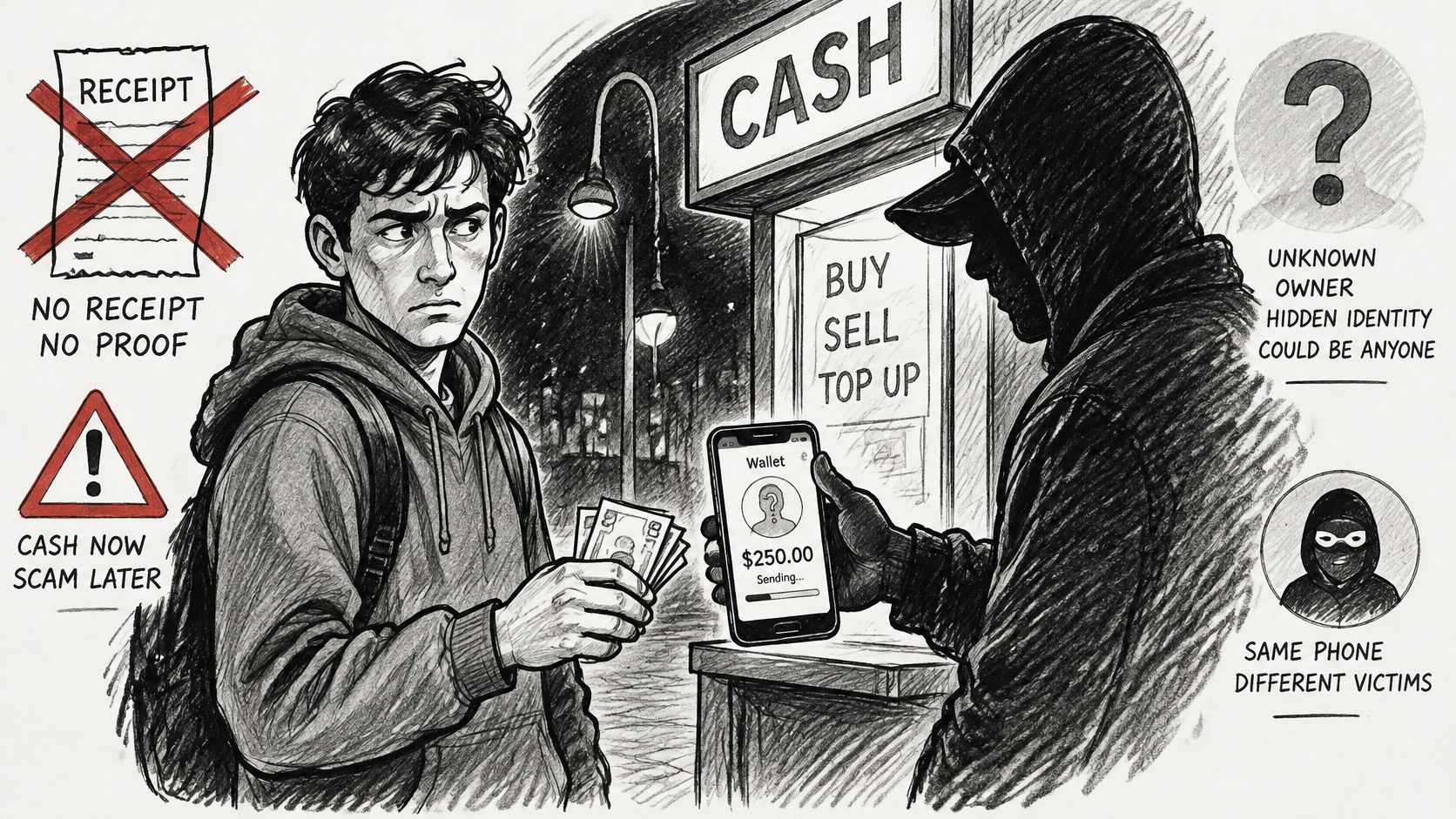
The script usually arrives as a call, a message or a direct message with urgency attached: a government office, an employer, a utility, a bank, or someone who claims a relationship with you. Guaranteed returns and requests to pay taxes, bail, utilities or fees in Bitcoin belong in the same category, and so does any instruction to buy at a specific machine and send to a wallet the caller supplies.
A valid-looking blockchain address validates nothing. It's a string of characters that will accept money from anyone, and sending a test amount first doesn't make a wrong transfer recoverable.
Refuse these outright, without negotiating:
- Seed phrase requests. No legitimate provider needs the words that control your wallet.
- Remote-access software. Anyone asking to see your screen is asking for your funds.
- Gift-card payments. Irreversible, untraceable and a hallmark of the same script.
- A deposit address that doesn't match the checkout page. The address on the page is the only one that counts.
For verification, type the provider's web address yourself instead of clicking a link, check its licensing in your jurisdiction, and read reviews that don't sit on the seller's own site. Legitimate low-friction card or wallet purchases don't come with deadlines, secrecy or a handler on the phone.
Decide Whether a No-ID Route Fits Your Purchase
The decision comes down to three questions, and an account-free route only fits when all three point the same way. How much are you moving? What verification can you accept without walking away? What recourse do you need if the payment fails or the coins never arrive?
A small, low-stakes purchase, with traceability accepted and the possibility of a identity check understood, suits an account-free route. A larger amount, a chargeback option or a clean account history for tax and audit purposes suits a regulated exchange, identity check included. Your country's restrictions sit underneath both, and they're the constraint you can't negotiate around.
Where a card checkout fits
NexaPay is one provider to check against those criteria, not a default. No account is required for basic purchases: you enter the amount, choose the crypto, supply your external wallet address and pay with a card. We may still ask you to verify your identity before paying, and the restricted-country list applies to this route as it does to any other.
If you haven't settled on an asset yet, choosing between Ethereum and Bitcoin changes the network fee and the confirmation time more than it changes the checkout itself.
Then run the actions in this order:
- Confirm your country isn't on the provider's restricted list.
- Confirm what the rules require for your amount, including the occasional-transaction threshold.
- Run the procedure with a small test purchase before committing the full sum.
- Keep the transaction ID, the payment reference and the receipt.
The aim is an informed purchase, not invisibility.
NexaPay lets you buy Bitcoin and other supported assets with a card, Apple Pay or Google Pay and receive them straight to your own wallet, with no account needed for basic purchases. If you're weighing an account-free route against a full exchange signup, start with a small order and watch how the checkout, the verification step and the settlement behave. Visit NexaPay to check availability in your country before you buy.