Fiat to Crypto Payment Gateway: How It Settles Payments
Learn how a fiat to crypto payment gateway moves card payments into crypto settlement, and what merchants should check on fees, disputes and compliance.
Choosing a fiat to crypto payment gateway by settlement speed alone is bad advice. Getting crypto into your wallet quickly doesn't answer the harder question: who pays if the customer's card transaction is disputed afterward?
A gateway connects familiar checkout methods with blockchain settlement. To evaluate it properly, follow both sides of the payment, identify who carries each risk, and calculate expected cost per order, not just the advertised processing fee.
How a Fiat-to-Crypto Gateway Works Behind Checkout
Think of the gateway as an airport currency exchange counter. A customer pays in dollars or euros by card, and the counter arranges for the merchant to receive a digital dollar equivalent in a wallet. The counter handles conversion, but its agreement determines who absorbs losses when something goes wrong.
The payment passes through distinct systems, not a single money-moving machine.
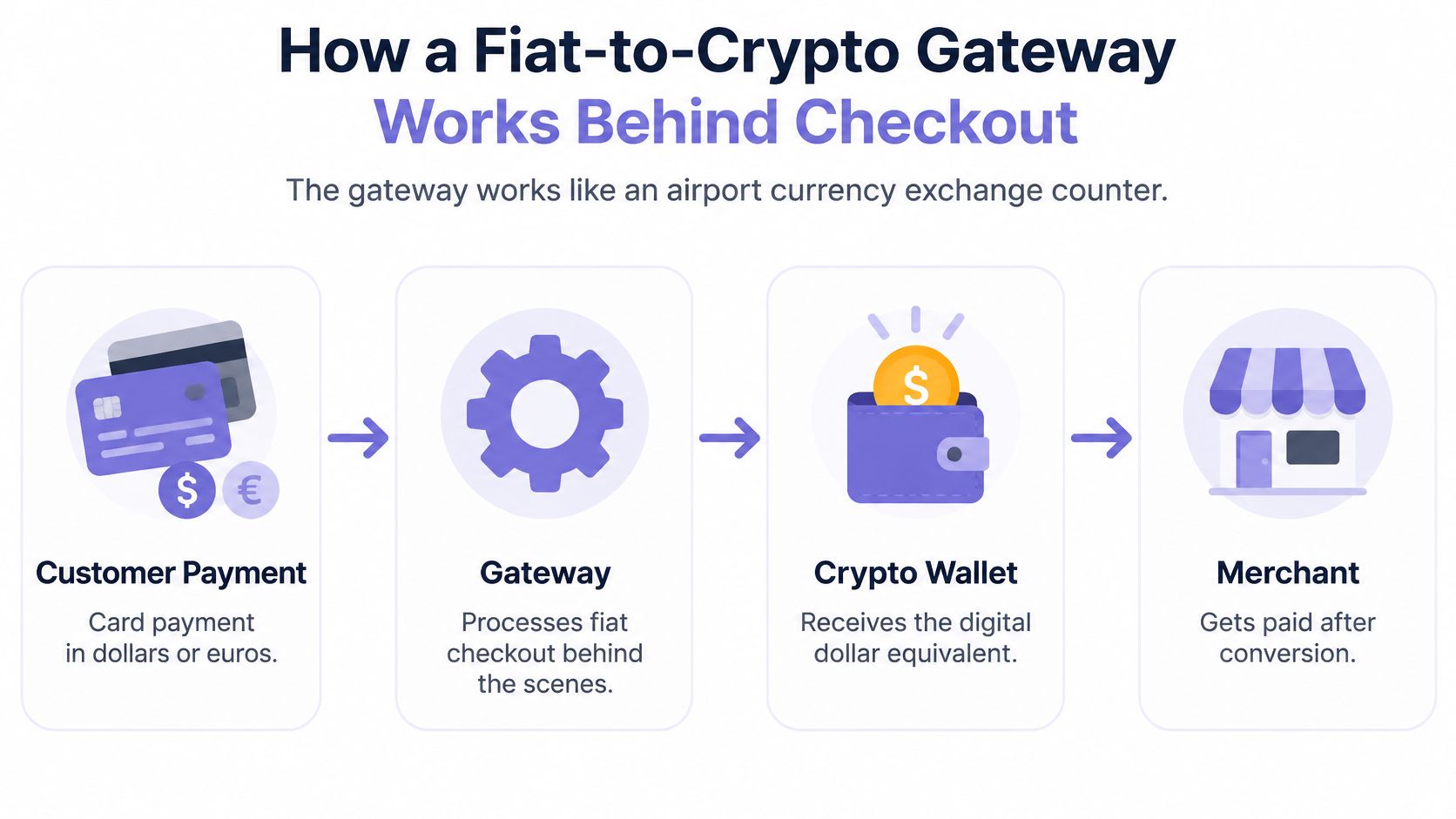
Gateway components and who typically carries each risk
| Component | Role in the payment | Who typically carries the risk |
|---|---|---|
| Merchant site or plugin | Starts the payment and shows order status | Merchant, for order and product risk |
| Hosted provider checkout | Collects card or wallet payment and runs customer checks | Payment provider, under its own terms |
| Orchestration layer | Records payment states and routes each transaction | Gateway operator, for system uptime |
| Settlement engine | Converts the fiat amount and sends crypto to the wallet | Gateway operator and merchant, set by contract |
| Merchant wallet | Holds the received crypto | Merchant, as the self-custody holder |
For an online purchase, the merchant site creates an order, then sends the buyer to a hosted checkout supporting cards, Apple Pay or Google Pay where available. The orchestration layer connects the checkout result to conversion and wallet delivery. These operational responsibilities don't automatically determine chargeback liability.
Gateways lean on cards because buyers already use them. In the euro area during the second half of 2025, cards represented 57% of non-cash payment transactions, according to the European Central Bank's payment statistics.
The concept check is simple: fiat in, crypto out, and a record connecting both sides. The buyer shouldn't need to open an exchange account just to complete the merchant's checkout.
Why Most Gateways Settle in Stablecoins
Say a customer makes a hypothetical $50 purchase. If the merchant receives bitcoin, the dollar value of that receipt can change before the merchant pays a supplier. The merchant has accepted both payment and market exposure.
Stablecoins are designed to maintain a value close to a reference currency, such as the US dollar. That makes them easier to match against dollar-priced sales, although the target value isn't a guarantee.
Between June 2024 and June 2025, USDT processed approximately USD 703 billion in on-chain transaction volume per month on average, peaking at USD 1.01 trillion in June 2025, according to Chainalysis's global crypto adoption analysis. That analysis also identifies substantial USDC activity and the importance of both assets in cross-border and institutional transactions.
Choose the asset and its route
Transaction volume demonstrates an established liquidity ecosystem. It doesn't mean every transfer represents a retail purchase, or that every gateway offers the same conversion quality.
A merchant must choose an asset-network pair, not just a token name. USDC on a supported network needs a compatible receiving address, wallet and eventual conversion route. Sending a supported asset through an unsupported network can create a recovery problem.
Stablecoins also retain issuer and redemption risk. A merchant whose expenses are in local currency needs an off-ramp, meaning a service that converts crypto into money delivered to a bank account.
Before selecting settlement, resolve these questions:
- What arrives? Confirm the precise asset and network in the settlement configuration.
- What can change its value? Understand issuer exposure, redemption access and any mismatch with your accounting currency.
- How will you spend it? Establish a supported bank withdrawal route before accumulating receipts.
A stablecoin can simplify pricing without eliminating treasury management.
Step-by-Step Flow From Checkout to Crypto Wallet
A successful checkout involves separate payment events. Card approval, conversion and blockchain finality aren't interchangeable, so the gateway should record them separately.
The customer-facing journey can look simple even when the backend tracks several states.
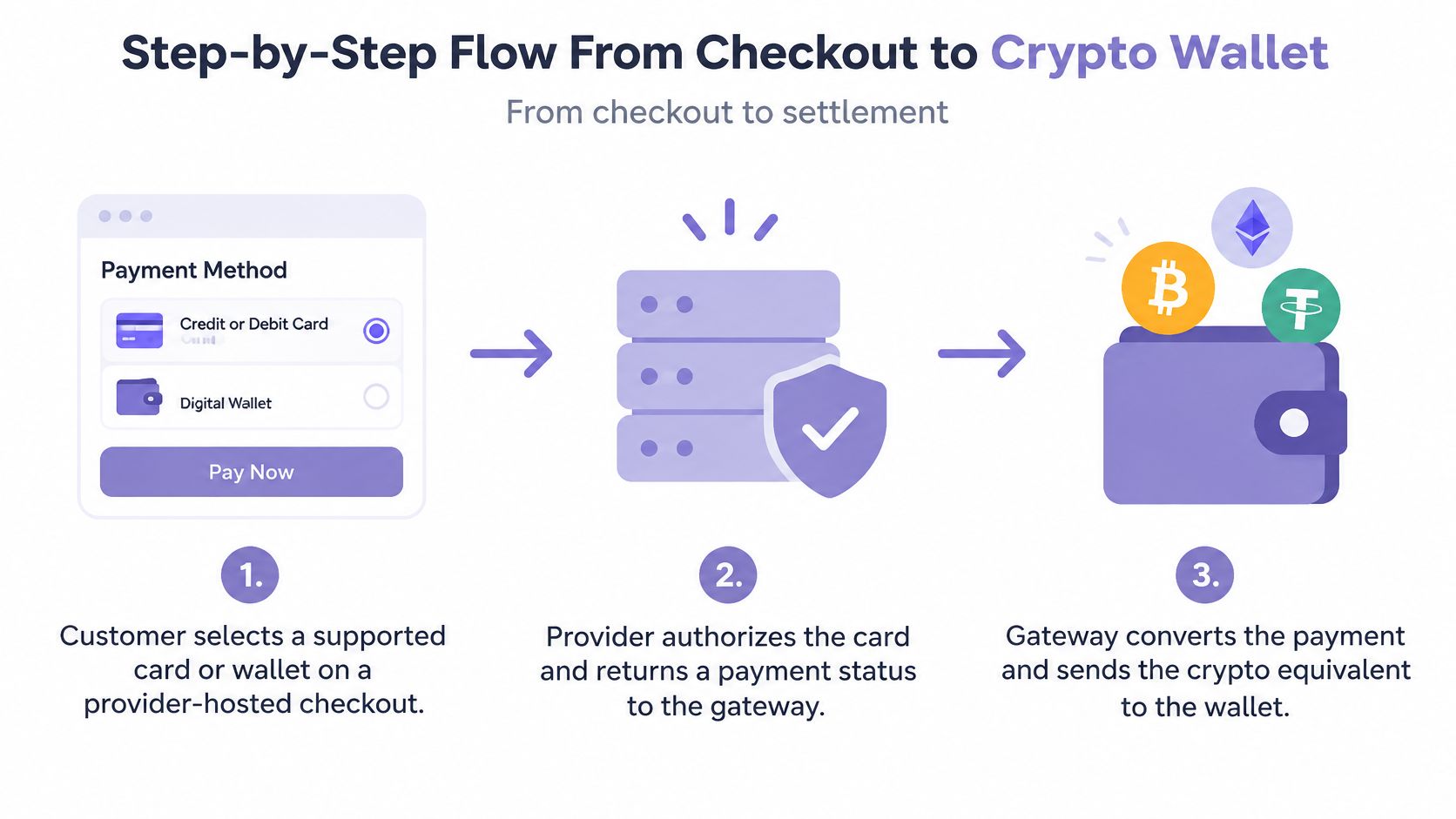
The customer selects a supported payment method. A provider-hosted checkout collects the card or digital-wallet payment. Hosting keeps payment collection separate from the merchant's order application.
The provider requests card authorization. The processor returns an approval or decline to the gateway. Approval isn't the same as capture, so the system should record capture separately when it occurs.
The gateway records fiat authorized. Assign a stable idempotency key to the payment operation and reuse it for retries. Correctly enforced idempotency prevents a repeated request from creating another charge or payout.
The settlement engine converts and submits. In our process, all fiat payments are automatically converted to cryptocurrency at the current market rate and settled to the merchant's configured wallet address, without manual intervention. Any required payout checks should clear before broadcast.
The network reaches finality. Polygon's finality documentation states that deterministic finality typically takes 2–5 seconds. That's a network-finality measure, not a promise about total checkout-to-wallet time.
The merchant receives the final event. A webhook should include the payment reference, final state and transaction hash. Verify its authenticity and process duplicate notifications safely before updating the order.
Keep an auditable state history
Payment states, triggers and records
| State | Trigger | Record to keep |
|---|---|---|
| Fiat authorized | Card processor approves the payment | Authorization ID and timestamp |
| Crypto submitted | Settlement transaction is broadcast to the network | Transaction hash and idempotency key |
| Crypto finalized | Network reports deterministic finality | Finality timestamp and destination wallet address |
| Refund requested | Merchant or buyer asks for money back | Refund reference and amount paid out in crypto |
| Dispute opened | Card issuer or buyer files a chargeback | Provider dispute reference and proof of delivery |
If the blockchain stalls after authorization, mark the payout as pending rather than telling the buyer their card failed. Otherwise, a retry could create another payment while the original payout remains active.
Keep authorization, capture, submission and finality timestamps apart. A healthy payment has linked records for fiat authorized, crypto submitted and crypto finalized, with exceptions visible rather than overwritten.
For a visual walkthrough of the payment flow, use the accompanying video.
Card Data Security and Compliance Checks
Skipping merchant identity verification does not skip the security checks. NexaPay onboarding requires no merchant KYC, and card and other payments are handled solely by licensed third-party payment providers. Whether a buyer faces verification still depends on the provider, the transaction and the region.
Two different questions get tangled here: who the merchant is, and how card data travels. A buyer can be asked to verify even when the merchant never touches a card number.
Keep card credentials outside the merchant backend
In a well-built gateway, tokenization, key management and card-data storage normally sit inside a PCI DSS-compliant environment run by the payment provider. NexaPay states that payments go through PCI DSS Level 1 certified providers and that it does not store card details. That design means the primary account number never reaches the merchant's servers.
A practical architecture looks like this:
Merchant frontend → hosted checkout → gateway orchestration → risk and settlement engine → merchant wallet
The merchant backend should receive payment status, transaction references and non-sensitive tokens, not primary account numbers. Keep full card details out of application logs, support tickets and analytics events.
CVV and other sensitive authentication data must not be retained after authorization, even in encrypted form. Build refund, retry and dispute workflows around provider-issued references rather than saved credentials. When a dispute later arrives, that reference becomes the evidence chain, and a reversal on the card leg cannot pull back crypto already sent on-chain.
Security boundary: A hosted checkout reduces card-data exposure. It doesn't remove the merchant's responsibility to secure its website, API keys and webhook handler.
Complete payout checks before broadcast
For applicable virtual-asset transfers, the compliance workflow may need originator and beneficiary information, customer due diligence and secure information exchange between providers. The regulated provider on each route determines which Travel Rule duties apply.
Operationally, place wallet screening, sanctions checks and applicable information exchange before irreversible payout. Once a settlement transaction is broadcast there is no recall mechanism, so a possible screening match should pause the payout, retain the review record and route the case to the designated compliance owner.
For businesses comparing high-risk merchant account services, crypto settlement does not replace an accepted business category and documented controls.
Before launch, establish who holds card data, where screening runs and what triggers additional verification. Give customer support a clear way to explain verification requests without exposing screening logic or sensitive identity documents.
Chargebacks and Expected Loss on a Digital Goods Store
Card payments can be reversed through disputes; on-chain transfers are generally irreversible. If the gateway has already delivered crypto, a card reversal doesn't automatically retrieve that transfer. Someone must fund the resulting shortfall.
The Datos Insights global chargeback report summary estimated 261 million chargebacks in 2025, representing $33.8 billion in disputed value. These are global estimates, not a forecast for an individual store.
Fast settlement can improve access to funds while increasing exposure if crypto leaves before sufficient fraud screening. It moves loss onto the merchant when the contract assigns that liability to the merchant, not merely because the merchant receives crypto.
The mismatch is easiest to understand by separating the reversible card leg from wallet delivery.
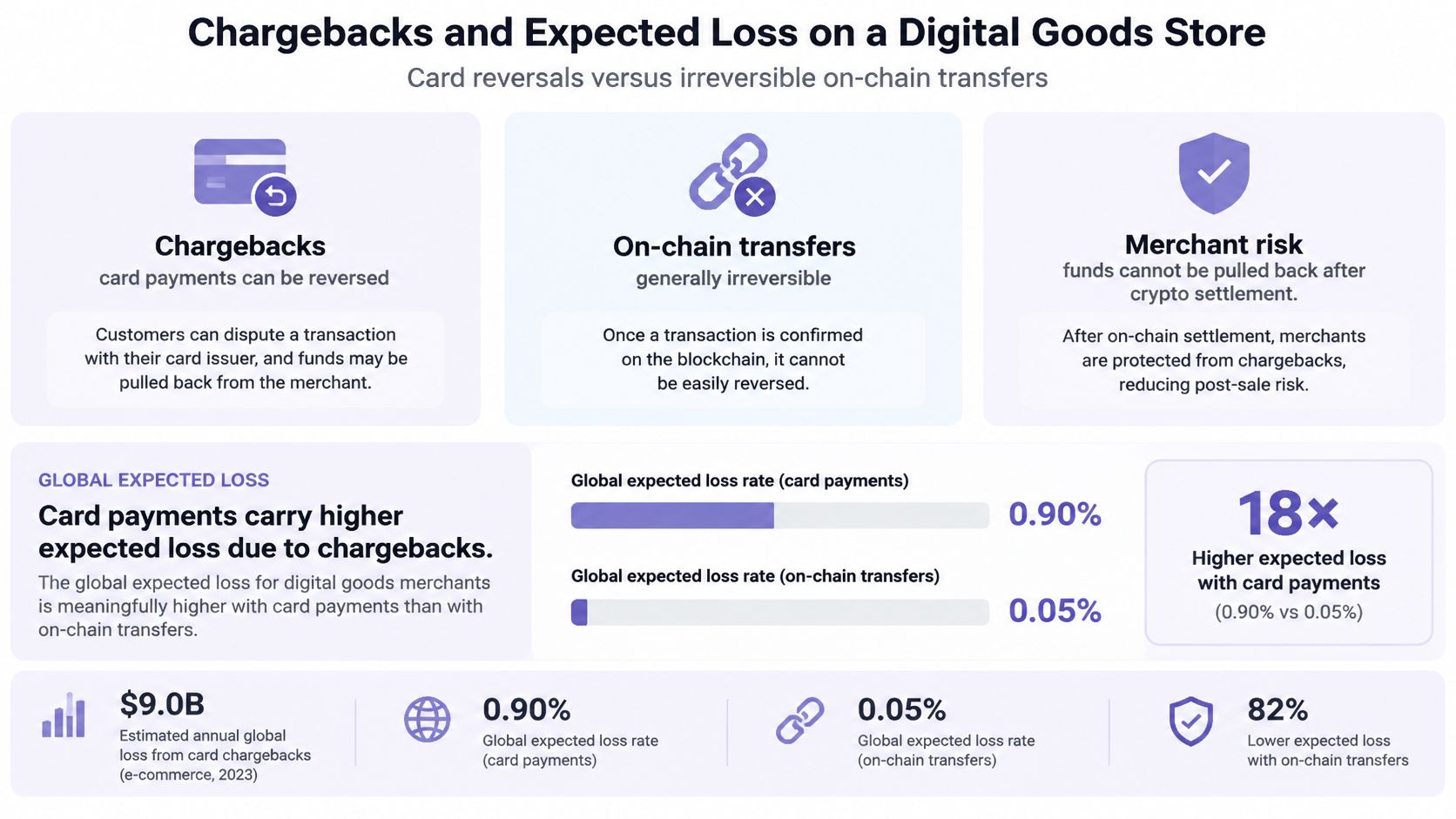
Follow a seller's first order and dispute
Consider a fictional WordPress store selling $50 e-books. The seller uses our API integration: create an account and obtain API keys, set a controlled wallet address in Settings, create a payment session, redirect the customer to hosted checkout and receive crypto when payment completes.
The seller watches the first order progress from authorization through automatic conversion to finalized wallet delivery. The store separately records when the customer accessed the download.
Later, the buyer claims the card payment was unauthorized. The seller submits the order record, download log, payment-state history and wallet-delivery record through the provider's dispute process. Wallet proof establishes settlement, not necessarily cardholder consent, so it can't guarantee a successful defense.
Before accepting this exposure, get written answers to these questions:
- Release timing: What must clear before the gateway sends crypto?
- Reserves: Can the provider hold funds or recover losses from later payments?
- Partial refunds: Who funds them, in which currency and through which payment rail?
- Evidence: Which order, authentication and delivery records must the merchant retain?
- Representment: Who submits the dispute response, and how is wallet proof used?
Model expected loss instead of assuming it away
For a deliberately simplified hypothetical, assume the seller bears the entire order value on every disputed order and uses a 1% dispute rate. Ignore successful recoveries, fees and handling costs initially:
$50 × 1% = $0.50 expected principal loss per order
Across 200 hypothetical orders, that becomes $100 in expected principal loss. These are scenario assumptions and arithmetic, not observed merchant performance.
A fuller model is:
Expected loss = order value × dispute rate × unrecovered share + expected refund loss + expected handling cost
Avoid double-counting refunds already included in dispute losses. Add dispute fees separately if the contract charges them.
Direct wallet custody gives the seller control of receipts. Only the written liability agreement establishes whether those receipts are protected from later recovery claims.
What a Gateway Really Costs Per Order
The headline transaction fee is only part of the bill. Compare what the merchant can ultimately use after conversion, transfer, withdrawal, holds and unrecovered losses.
Start with the gateway's written terms and a settlement report from a test payment. If a rate hasn't been supplied, mark it unknown, not zero.
Cost lines per order
| Cost line | What it covers |
|---|---|
| Card processing fee | Provider charge on the card payment |
| Conversion spread | Gap between market rate and rate applied |
| Network fee | Blockchain transfer cost on the chosen network |
| Off-ramp fee | Converting stablecoin to a local bank account |
| Reserve cost | Economic cost of funds held before release |
| Expected dispute loss | Order value times dispute rate, adjusted for recoveries, plus handling |
Compare complete quotes
Apply the hypothetical e-book scenario to competing quotes without inventing commercial rates.
| Comparison item | Gateway A | Gateway B |
|---|---|---|
| Card processing | Unknown until quoted | Unknown until quoted |
| Conversion spread | Unknown until quoted | Unknown until quoted |
| Network and off-ramp | Unknown until quoted | Unknown until quoted |
| Reserve financing cost | Unknown until terms are supplied | Unknown until terms are supplied |
| Expected dispute loss | Same hypothetical assumption if merchant bears liability | Same hypothetical assumption if merchant bears liability |
| Decision-ready total | Not yet calculable | Not yet calculable |
Use this calculation:
Total economic cost per order = card fee + conversion spread + network fee + off-ramp fee + reserve financing cost + expected loss
A reserve isn't automatically an expense equal to the money held. If the provider returns it, measure the financing or opportunity cost during the hold; track the held balance separately as a liquidity requirement.
For merchants assessing what a high-risk merchant account is, reserve terms deserve the same attention as pricing. A lower headline fee can be less attractive when a wide spread reduces receipts or a hold forces the business to borrow working capital.
Choose a Gateway Against These Checks
A useful gateway comparison shows how the service handles your transaction route, not just where it advertises availability. The merchant's location, buyer's location, card issuer and destination wallet can each affect access.
Astraea's analysis of stablecoin payment protections describes how the CFPB proposed extending Regulation E interpretations to certain emerging payment mechanisms in January 2025, then withdrew the proposal in May 2025. That policy sequence isn't a universal rule for stablecoin payments; it illustrates why consumer protections need route-specific review.
Gateway evaluation checklist
| Criterion | Question to ask | Red flag |
|---|---|---|
| Settlement asset and network | Which assets are paid out, and on which network? | Asset or network not named in writing |
| Settlement timing | When is crypto released relative to capture and screening? | Release before fraud screening is described |
| Reserves and holds | Is there a rolling reserve or hold window, and for how long? | Terms only given on a sales call |
| Dispute ownership | Who absorbs chargebacks, and what evidence is required? | No written dispute lifecycle |
| Refund after crypto is sent | How is a partial refund paid out? | Manual, undocumented refund steps |
| Card data handling | Where are card numbers stored, and what PCI evidence applies? | Merchant backend receives full card numbers |
| Travel Rule and screening | Who performs applicable checks and information exchange? | No named compliance owner |
| Customer verification | What triggers verification by region and provider? | An unconditional promise of no checks |
| Restricted countries | Are my buyers or destination wallets restricted? | Restricted list changes without notice |
Match the route to your business
Our fiat onramp and gateway share regional restrictions, including Afghanistan, Belarus, Iran, North Korea, Russia and Syria, among other restricted jurisdictions. Individual payment providers may impose additional requirements. Validate the complete current list against your buyers and payout arrangements before launch.
Our gateway can be added in minutes through a WooCommerce plugin, or connected to any website through our API. Installation speed, however, isn't approval for every business or transaction.
For low-dispute retail, usable funds and checkout convenience may carry more weight. For iGaming, adult content or forex, prioritize loss allocation, business acceptance and reserve terms when selecting a good payment gateway.
This week, obtain the written dispute lifecycle and restricted-country list, then run a small live payment through authorization, wallet delivery and reconciliation before committing.
NexaPay connects supported conventional payment methods with automatic cryptocurrency conversion and direct settlement to your configured wallet. Visit NexaPay to explore the hosted checkout and integration options, then validate your payment route, provider requirements and dispute terms before going live.