How to Accept Crypto Payments as a Business in 2026
How to accept crypto payments as a business: choose a payment flow, integrate checkout, set wallet settlement and explain refunds clearly.
You've added the crypto option, configured the payout wallet, and watched the first settlement land. For a week nothing unusual happens. Then four things arrive in the same week: one customer sends USDC on the wrong chain, one underpays by a few dollars because their exchange deducted a withdrawal fee, one pays an invoice two hours after it expired, and one asks for a refund on an order you've already booked as revenue.
Card disputes come with a dashboard, a reason code and a chargeback process. Crypto exceptions come with none of that. The money is already in your wallet, the order is already marked paid, and the correction has to be built by hand unless you designed it in before launch.
The practical answer to how to accept crypto payments as a business is unglamorous: pick the settlement flow, control the keys, keep the records, and write the exception rules before a customer tests them for you. Crypto complements cards here. It doesn't replace them, and treating it as a replacement is how merchants end up with a checkout nobody uses and a reconciliation mess nobody owns.
Choose Between Three Crypto Payment Flows
Say you sell digital goods, take about 200 card orders a month, and a handful of customers keep asking whether they can pay in stablecoins. You don't need a treasury desk. You need a checkout that accepts the payment, settles somewhere you control, and leaves a trail your accountant can follow.
Crypto is common enough at checkout that offering it is a reasonable ask rather than a novelty. In 2025, 39% of surveyed U.S. merchants said they already accepted cryptocurrency at checkout, according to a Harris Poll survey commissioned by the National Cryptocurrency Association and PayPal of 619 payment-strategy decision-makers.
Read that as a ceiling for one sector, not a forecast for your market. The survey was commissioned by two organisations with an interest in crypto adoption, and the euro-area picture is far thinner: only 0.2% of euro-area companies selling goods and services online reported accepting crypto-assets, including stablecoins, based on 8,205 interviews across all 21 euro-area countries, as Digital Watch reports from the ECB-linked survey.
Three flows move a customer from checkout to settled funds, and they differ in who converts the money and who carries the keys.
| Flow | Who converts to crypto | Setup effort | Main trade-off |
|---|---|---|---|
| Self-hosted wallet, direct crypto | Merchant | High | Full control of keys, but the merchant owns recovery, approvals and tax records |
| Qualified custodian | Custodian | Medium | Custody fees and reliance on the custodian's operating reliability |
| Payment processor with crypto settlement | Processor at market rate | Low | Fees and checkout coverage depend on the provider and region |
Pick the processor flow if you need to be live this week and have nobody on staff to manage custody. Pick the self-hosted flow only if finance already runs treasury controls, key ceremonies and a reconciliation process you trust.
A fiat-to-crypto payment gateway is the short path: the customer pays with a card or wallet, and you receive crypto in a wallet you control without building conversion logic yourself.
The trade-off every flow shares: the larger the share of customers paying in crypto, the more reconciliation work lands on your team. A processor removes custody risk. It doesn't remove the need to match a transaction hash to an order.
Set Up Wallet Settlement and Key Controls
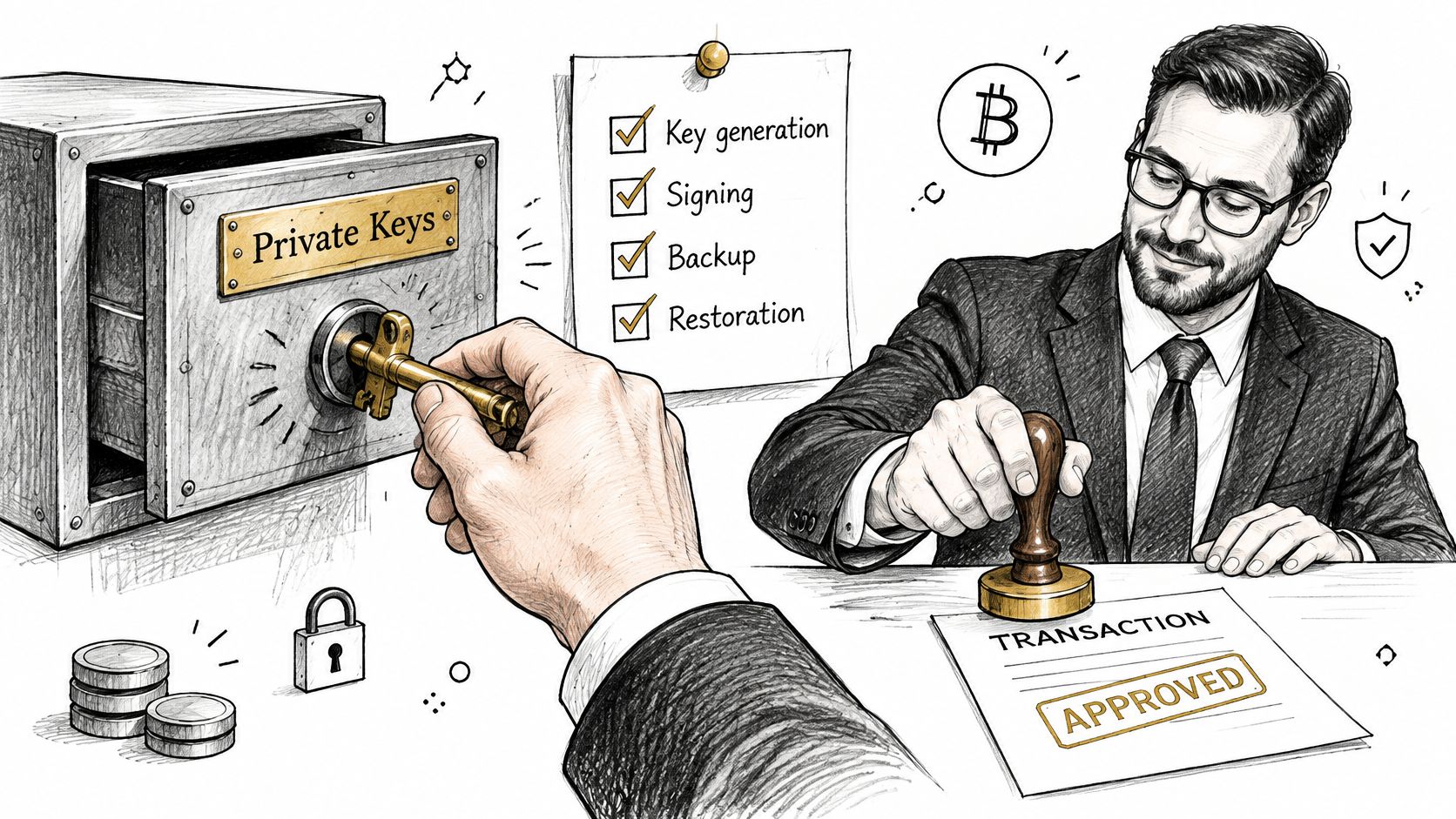
The first decision isn't which coin to accept. It's who holds the keys. If the answer is you, document key generation, signing, backup, restoration and who approves a transaction before a single order goes live. The NIST guidance on key management treats private-key management, secure storage, backup and recovery as core operational responsibilities, and warns that a poor recovery design can permanently prevent access to an account or let an unauthorised party restore it.
Treat custody as a control function with its own procedures, approvals and audit trail, not as a setting inside your application.
Controls That Survive an Audit
- Hardware-backed or multisignature treasury wallets. A single hot wallet holding every merchant fund is the fastest way to lose them. Keep routine settlement in a small hot balance and the rest behind a threshold that needs two people.
- Withdrawal limits and dual approval. Set a value above which any outbound transfer needs a second approver, and have the wallet enforce it rather than a policy document.
- A whitelist of destination addresses. Payouts should only reach addresses you added deliberately, through a change process with a cooling period.
- Separated duties. The person who creates a payout isn't the person who approves it, and neither of them reconciles it.
What Settlement Does to Your Balance Sheet
A processor converts each payment at the market rate current at the time of the transaction and settles to the wallet you configured, with no manual step. That's convenient, and it means price exposure starts the moment funds arrive. The asset you settle in determines what you must record and how often you revalue it.
| Asset | Price swing risk | Network options | What to record |
|---|---|---|---|
| Bitcoin | High | Bitcoin network | Fair value at receipt and at each later sale |
| Ether | High | Ethereum and compatible layer 2 networks | Network fee and the network used for each receipt |
| USDT | Low | Several networks | Issuer, network and any restrictions on transfers |
| USDC | Low | Several networks, including Polygon | Network used and the fiat value at authorization |
Choosing between custodial and non-custodial settlement is really a staffing question. A custodian takes the key ceremony off your plate and adds a counterparty and a fee line.
Three failures account for most of the damage. Sending USDC on the wrong chain, which is a customer mistake you inherit. Accepting an underpayment with no stated tolerance, which turns a $3 shortfall into a disputed order. And storing private keys in application server environment variables, which puts your treasury inside the blast radius of a website bug.
Compliance, Tax and Records Before Launch
Global availability is not permission. A checkout that accepts a customer in any country can still be unlawful for a particular merchant, selling a particular product, settled into a particular wallet. Map every flow against the rules of the markets you serve before the first live order, and write down the answer for each one, because the same transaction can pass in one jurisdiction and fail in the next.
Four questions drive that mapping:
- Licensing. Who is authorised to handle the fiat leg, and are you relying on a provider's licence in the customer's jurisdiction or your own?
- Sanctions and AML. Screen the payer and the destination address, not only the merchant entity.
- Consumer protection. Refund rights differ by country, and accepting crypto doesn't remove them.
- Tax. Reporting duties attach to the transaction, not to the line on your bank statement.
The FATF Travel Rule requires virtual-asset service providers and relevant financial institutions to obtain, retain and securely transmit originator and beneficiary information for covered transfers, and the FATF's targeted update on Travel Rule implementation reported that 73% of responding jurisdictions had passed implementing legislation. Widespread, not uniform. In practice that means a transfer your provider handles cleanly in one country may hit a data gap in another, and the exception lands on your desk. For U.S.-connected operations, brokers generally report digital-asset sales on Form 1099-DA, and reporting rules are changing, so confirm with your accountant which requirements apply to your transactions.
Divergence is sharpening rather than fading. The European Central Bank's July 2025 blog on stablecoins noted that major U.S. merchants were exploring stablecoins, while MiCA in the EU and the GENIUS Act in the U.S. remain distinct frameworks with their own issuer, reserve and redemption requirements. A stablecoin payout that satisfies one framework's redemption rules can sit outside the other. If you settle in USDC, know which regime governs the issuer before you build your pricing around it.
Write it into the contract: name who performs KYC, sanctions screening, Travel Rule messaging, suspicious-activity escalation, record retention and refunds. A provider's verification doesn't automatically cover your obligations.
Risk-based holds keep this workable. Pause a transaction automatically when screening flags sanctioned exposure, unusual velocity, rapid wallet reuse, a high-risk geography or an address alert, and route exceptions to a trained person rather than a support inbox. If you run a crypto payment gateway without merchant KYC, the verification burden doesn't vanish, it shifts to the transaction level and to the provider's screening, which makes your own record of each decision more important, not less. Log the reason for every hold and every release. That log is what turns a reviewer's hard question into a ten-minute answer.
Reconcile each order on six fields: fiat value at authorization, crypto quantity, network fee, settlement timestamp, refund value, and realized gain or loss on any later sale. Keep provider statements and transaction hashes next to the order record. Crypto receipts are not tax-free barter, and fees left out of revenue reconciliation are the difference between a clean audit and an afternoon of explaining.
How to Integrate Crypto Checkout Step by Step
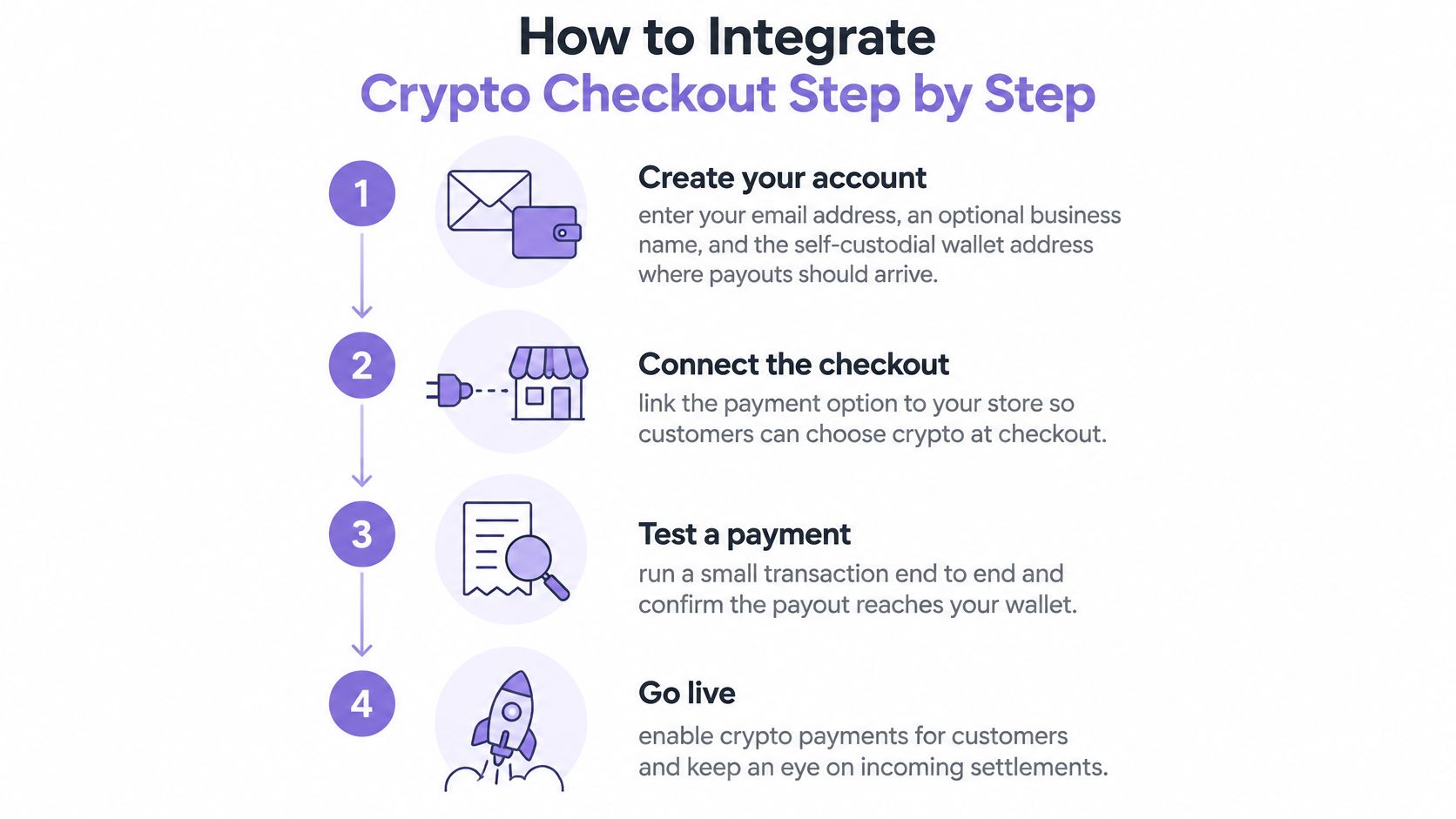
The integration is smaller than most merchants expect. Five steps take you from an email address to a confirmed settlement, and each has one failure mode worth designing around.
Five Steps From Account to Settlement
- Create the account and keys. Register with an email address, an optional business name, and the self-custodial wallet address where payouts should arrive, then generate API keys. The wallet address is the step that matters, because a wrong entry sends every future settlement to an address you don't control.
- Set the payout wallet in Settings and test it. Paste the address and push a small real payment through the live flow before you touch your storefront. A dashboard test proves nothing about routing; a real payment proves the address, the network and the webhook work together.
- Create a session per order. Call the API with the amount, asset, network and expiry, and store the returned session ID against your own order number. Skip that link and you can never prove which blockchain payment settled which order.
- Redirect the customer to hosted checkout. Hold the return URL for display only. The page a customer lands back on is a browser event, not a payment confirmation.
- Receive crypto and credit the order on the webhook. Treat paid as a state your server sets when a signed notification arrives for a matching amount, asset and confirmation count. Crediting orders on the redirect is how merchants mark transactions paid that never confirmed.
The Test That Proves the Flow Works
A correct test is boring: one order, one session ID, one webhook, one transaction hash that matches amount, asset and destination address. Make the handler idempotent by storing each transaction hash against the order and ignoring repeat notifications, so a redelivered webhook can't credit an order twice.
A walkthrough helps here, particularly for the hosted checkout stage where most of the confusion sits.
Handle Overpayments, Underpayments and Refund Requests
A card refund reverses the original charge. A crypto refund doesn't. You need the customer's destination address, a decision about refunding in the original asset or its fiat equivalent, and the exchange rate used on the refund date written into the record. Those three choices are the entire difference, and they're why a crypto refund takes longer than the sale did.
Exception handling stopped being a rounding error once ticket sizes grew. BitPay's 2025 user and merchant statistics reported a 12% increase in payment volume, an average transaction size of $800, and stablecoins reaching 40% of volume, up from 30% in 2024.
| Scenario | Typical cause | Action | Rule to set |
|---|---|---|---|
| Overpayment | Customer sent more than the invoice, often by paying twice or rounding up | Refund the excess or credit it to the next order | A tolerance above which the excess is refunded, and the address it returns to |
| Underpayment | An exchange deducted its withdrawal fee, or the rate moved inside the hold window | Request a top-up before the invoice expires | A percentage tolerance below which you accept the order as paid |
| Wrong network | The asset arrived on a chain you never quoted | Recover only if the receiving wallet supports that chain, otherwise refund minus costs | Recovery limits, who pays the fees, and the fact that some sends are unrecoverable |
| Payment after expiry | The customer paid after the invoice window closed, often from a slow exchange | Reissue the invoice at the current rate, or refund | A fixed expiry window stated at checkout, and what happens after it |
| Refund request | The customer changed their mind or the order failed | Refund in the original asset or the fiat equivalent, logging the rate used | The refund method, the timeline, and who pays the network fee on the refund |
Every dispute you'll ever have is answerable with four identifiers in a row: order number, session ID, blockchain transaction hash and refund transaction hash. Store them linked, and a support agent resolves a wrong-chain claim in minutes instead of emailing screenshots.
Instant settlement is a cash-flow win and a back-office risk at once. The funds arrive quickly; the refund trail doesn't exist unless you built it before the first sale.
Publish Your Crypto Payment Terms and Go Live
Put the rules where the customer pays, not in a policy page nobody opens. Four sentences beside the checkout button prevent most of the support threads you'd otherwise handle.
We accept USDC on Polygon only. Payment confirms once the network reports the transaction. Your price is held for 15 minutes. Refunds go back in USDC to the address you give us, at the rate on the refund date. The sender pays network fees.
Add the supported assets and networks, the confirmation count you require, and any tax note specific to your market. Write them as short statements, not as a single paragraph of legal prose.
- Run one live payment per network. One real settlement on each chain you accept, before you widen the launch.
- Check the order-to-session link. Pull the record and confirm the session ID and hash sit against the right order number.
- Push a small refund through the exception path. It's the only way to know your documented process works when a real customer asks.
- Name an owner. One person owns wrong-network recovery and knows the limit of what you'll attempt.
Opening the account takes an email address and a payout wallet, plus a business name if you want one, and payments can start as soon as the account is set up, with no approval queue to wait behind. That's convenient, and it also means nobody upstream is checking your exception rules for you. Launch narrow: one asset on one network, measured for a month, before you add a second chain. Then compare the first settled transaction hash against your order records and decide whether the volume justifies more.
Price Quotes and Fees at Checkout
A checkout quote is a promise with a clock on it. If the quote window and fee split are unclear, a small price move or network fee turns into screenshots, refund requests and reconciliation work. Price the catalogue in your own currency, then convert at session creation and record the rate source and timestamp.
How Long a Quote Lives
Set the hold window around the confirmation count you require, not around the fastest possible block time. A long hold on an asset that confirms quickly makes you carry a price move with no operational benefit. A short hold creates more re-quotes and more customer friction.
Decide who absorbs a move inside the window and state it at checkout. If you absorb it, treat the cost as part of margin. If the customer absorbs it, re-quote and require acceptance before they send funds, including when an underpayment arrives later. That is a support conversation you are choosing to have.
Three Fees, Not One
- Network fee. Paid by the sender to the blockchain. It never reaches you, and it becomes visible when a payment arrives short.
- Processing fee. The provider's percentage of the fiat amount, taken before settlement.
- Settlement fee. What it costs to move funds from the processor or custodian to your wallet, or to convert on the way out.
Show these separately on the checkout page. One blended number invites disputes when a customer compares their exchange withdrawal fee with your quote. Keep the catalogue in fiat so a weekend price move does not reprice the whole store.
If you settle in a volatile asset, the quote window and your holding period are the same exposure counted twice. Shorten both, or settle in a stablecoin on a network your finance team already reconciles.
NexaPay handles the conversion side of that flow. Customers pay by card, Apple Pay or Google Pay through supported provider checkouts, fiat payments convert at the current market rate, and settlement goes to your configured wallet, including USDC on Polygon. That reduces manual conversion work, but operating costs remain: overpayments, underpayments, wrong-network sends and refund requests still need rules, records and an owner. Open a NexaPay account with an email address and a payout wallet, then run the five-step integration against a single small order before you widen the launch.