Cloud Based Payment Gateway Explained: How It Works
A cloud based payment gateway runs checkout, routing and settlement online. Learn how it works, who handles PCI duties, and where the risks sit.
A cloud based payment gateway is hosted software that receives a payment from your checkout and passes it to the processors, card networks and banks that move the money, so you don't have to build that infrastructure yourself. Paying digitally is now ordinary for most adults worldwide, which is why merchants need online acceptance without building payment infrastructure themselves.
You have a checkout page, a business bank account, and orders arriving. Between the customer tapping the pay button and the money reaching you, a company you'll probably never meet runs the most load-bearing machinery in your business. You can read its dashboard without being able to say which parts of that machinery are yours to secure, test and answer for, and which parts the provider owns.
Getting that split wrong is expensive, and it usually surfaces at the worst possible moment: a chargeback you didn't see coming, an outage during your best week, or a security questionnaire from a customer who wants to know exactly where card data lives.
One rule runs through everything that follows. The provider runs infrastructure. You own the decisions that touch money, customers and evidence. Each stage below separates the two, so that by the time you go live you can point to every component and say who is responsible for it, who monitors it, and who gets the phone call when it breaks.
What a Cloud Based Payment Gateway Is
A cloud based payment gateway is hosted software that receives a payment from a merchant's checkout and passes it to the processors, card networks, banks and wallets that move the money. None of that machinery runs on your server. You rent the connection, the security layer and the routing.
Think of a shop counter. The till takes the cash and the back office reconciles the day's takings. A gateway is that till wired straight into the bank's back office, except the customer is on a phone in another country and nobody hands over a note. The shopkeeper sees the sale immediately and stops thinking about what happens between the tap and the deposit.
Here's the whole path in one picture.
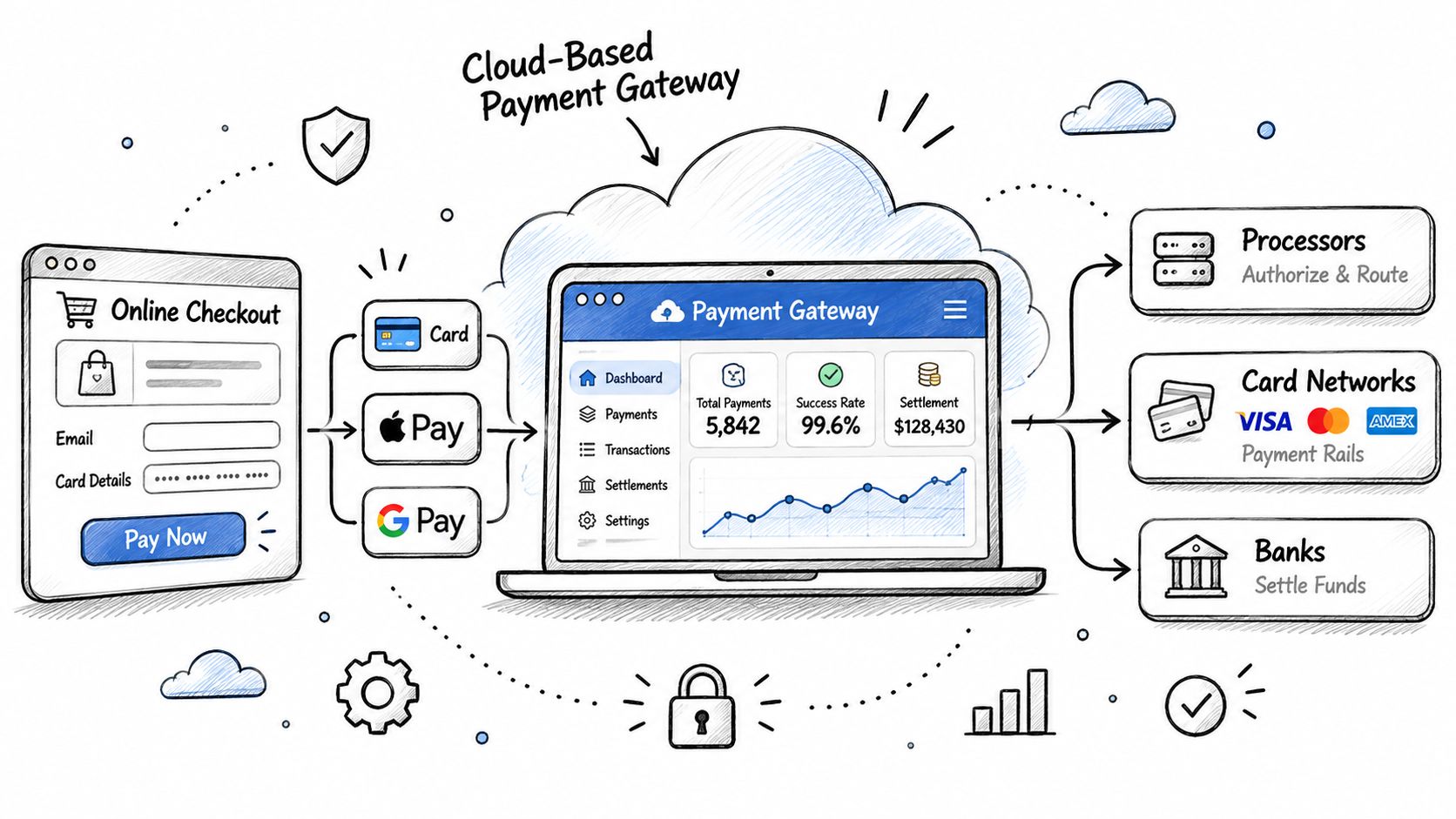
Three names do most of the work in that picture, and they get mixed up constantly:
- Acquirer: the bank that accepts card payments on your behalf and settles money to you.
- Issuer: the bank that issued the card in the customer's hand. It approves or declines.
- Processor: the system that routes a transaction between the two and clears it afterward.
The gateway takes three jobs off your desk. The link to an acquirer, so you don't negotiate and integrate with a bank just to accept a card. The security stack, so card data lands in someone else's certified environment instead of your database. The routing, so when one provider is down or doesn't cover a country, another can take the sale.
Why the model became standard is a story about volume. The World Bank's Global Findex 2021 chapter on account use, a survey of about 128,000 adults across more than 120 economies, found that 20% of adults in developing economies excluding China made a digital merchant payment using a card, mobile phone or the internet in 2021, and roughly 40% of those users made such a payment for the first time after COVID-19 began. When first-time digital buyers arrive that fast, merchants need acceptance on day one, and they need it without buying servers.
Here's the plain test to apply to any business: if it can take a card payment online without running a single payment server, a cloud gateway is doing that work.
How a Payment Moves From Checkout to Settlement
The whole path fits into six steps, and each one exists because something goes wrong without it.
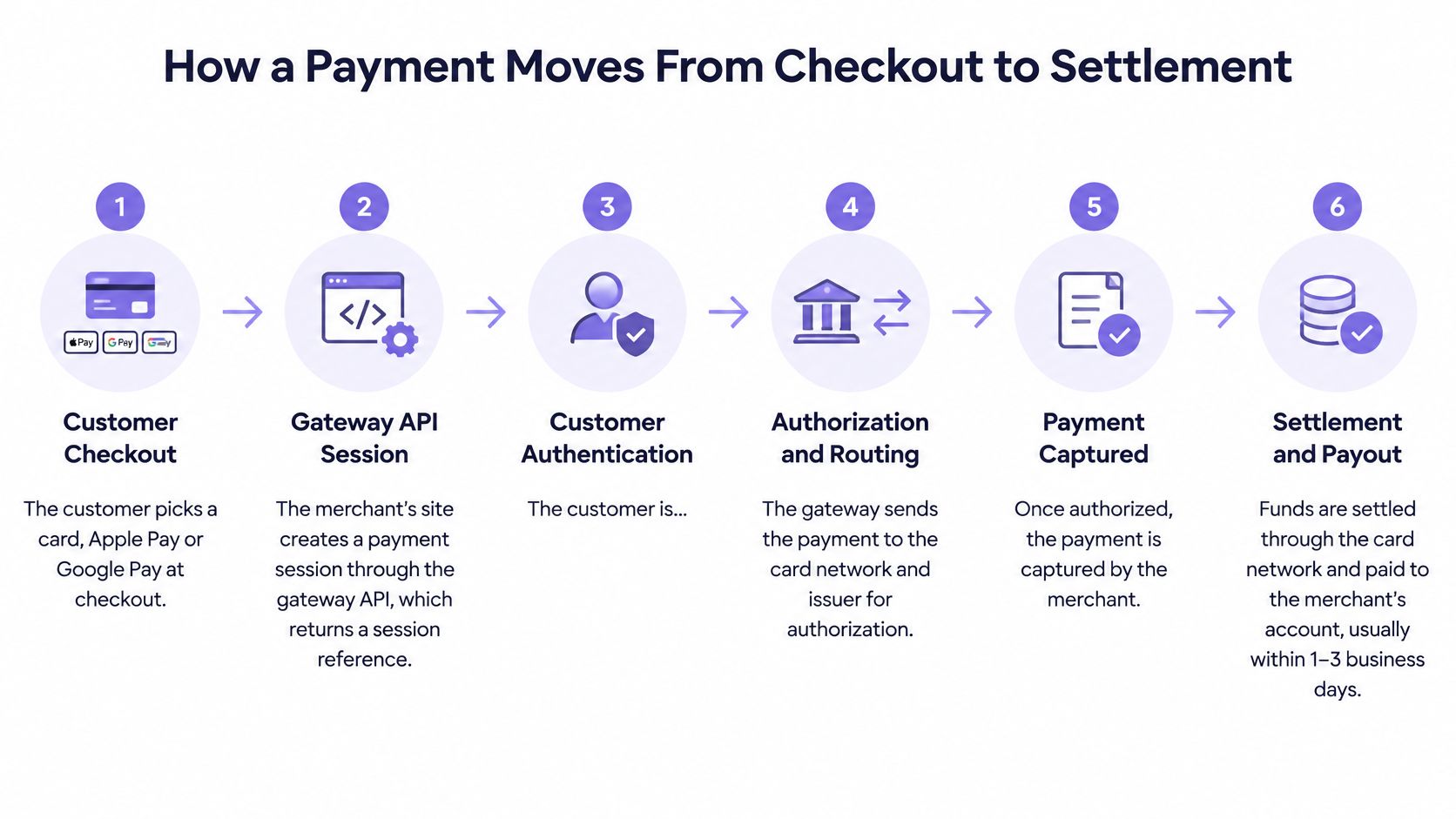
The customer picks a method. They choose a card, Apple Pay or Google Pay on the payment provider's checkout, and the methods available depend on the provider and the region. The choice decides which rail the payment travels and which authentication rules apply, so a method you can't support is worse than no method. The common slip is leaving a wallet button enabled for a country where the provider doesn't process it, so the button appears and the payment fails after the click.
Your site opens a session. Your server calls the gateway API with the amount, currency, your order reference and a return URL, and the API hands back a session reference. This exists so the money is bound to your order before anyone types a card number. The slip is creating the order record only when the customer returns, which leaves you with a payment that has nowhere to attach.
The customer is redirected to the hosted checkout. They enter their card details on the provider's page and confirm the payment, which is the only way a charge happens. The reason is scope: card data lands in an environment the provider certifies rather than in yours. The slip is rebuilding a card form on your own site to keep the branding, which puts the entire card-data problem back on your desk.
Fraud screening and authorization. The provider scores the transaction and asks the issuer for an authorization in real time. This is the moment the bank decides whether the funds exist and whether the customer looks like themselves. The slip is treating every decline as fraud and blocking the buyer, when many declines are a verification step the customer can complete if you let them try again.
The webhook arrives. The gateway posts a status update to an endpoint you control, and your order moves to paid on that event. Webhooks exist because the browser redirect is unreliable: the customer may close the tab, lose signal, or land on a success page that never runs. The slip, and the single most expensive one in payment integration, is marking the order paid when the customer bounces back to your success page.
Funds settle. Settlement moves the money to your bank account or your configured wallet on the provider's schedule. Authorization is a promise; settlement is the payment, and the two happen hours or days apart. The slip is shipping against an authorization without checking that it hasn't expired or been partially reversed.
If you'd rather watch the flow once before reading the detail, this walkthrough covers the same path.
The success page is a courtesy to the customer. The webhook is the record of truth.
Your dashboard will show at least three states, and each one means something different for shipping. Pending means a session exists and nothing has been authorized, so there is nothing to fulfil. Authorized means the issuer has reserved the funds, which is a good moment to pick and pack but not to hand over a download key you can't revoke. Settled means the money has moved, which is the only state that belongs next to your revenue numbers.
Components Behind a Cloud Gateway
A gateway is not one API endpoint. It's a distributed transaction system, and it only works while seven components agree with one another.
| Component | Job in the payment | What breaks if it fails |
|---|---|---|
| Checkout interface | Collects amount and payment method, then hands the customer to the payment step | Customer cannot pay and no order starts |
| Payment API | Receives requests from the merchant site and returns a session or status | Merchant cannot create or read payments |
| Routing engine | Chooses which provider or processor handles each transaction | One provider outage stalls every sale routed to it |
| Fraud screening | Scores each transaction before authorization | Fraud losses rise, or good orders are declined |
| Webhook service | Sends payment status updates to the merchant's own systems | Orders stay pending and confirmations are lost |
| Ledger | Records every transaction state and amount | Reconciliation gaps and disputed balances |
| Settlement module | Moves funds to the merchant's bank account or wallet | Payouts are delayed or, without idempotency, duplicated |
The three controls that hold the components together
Idempotency keys are the reason a retry doesn't become a second charge. When your server times out and sends the same request again, the key tells the gateway this is the same payment, so it returns the original result instead of creating a fresh one. Without that key, every network hiccup on your side becomes a duplicate transaction on the customer's statement.
Durable webhook queues keep a confirmation alive when your endpoint is down. The gateway stores the event, retries with a backoff schedule, and lets you query the status manually when retries run out. A queue that evaporates after one attempt turns an outage on your side into a permanently pending order.
A ledger records each state change with an amount and a timestamp, which is what lets you reconcile when an authorization succeeds and your client times out. The settlement module should sit separately from payment confirmation so a payout can be retried without sending the money twice. Keep those two ideas apart in your architecture and you avoid most of the failures described in this table.
Cloud Gateways Compared With Other Payment Models
| Model | Who runs the infrastructure | Merchant PCI DSS scope | Typical fit |
|---|---|---|---|
| Cloud based payment gateway | Gateway provider, hosted and updated remotely | Reduced when hosted checkout or tokenization is used | Online merchants that need a fast launch |
| Self-hosted gateway | Merchant's own servers and network | Full, including servers, networks and software | Large merchants with in-house security teams |
| Payment aggregator | Aggregator's pooled merchant account | Reduced; depends on the product used | Small sellers with low volume and simple needs |
| Direct acquiring account | Merchant's bank or acquirer relationship | Depends on integration method | Established businesses that pass underwriting |
With a cloud gateway, you integrate an API or drop in a hosted checkout page, and changes to routing, fraud rules and card-data handling arrive as provider releases rather than as work you schedule. You get the shortest path to live payments and the least infrastructure to maintain.
A self-hosted gateway puts servers, patches, key management and network controls in your own hands. That's the right answer for a merchant that already runs a security team and needs custom routing logic that no provider will build for it, and the wrong answer for anyone who'd be learning firewall rules on the way to a launch.
An aggregator pools sellers under one master account, so approval takes minutes and the limits, reserve terms and settlement schedule belong to somebody else. Small sellers often meet this model first, sometimes through a setup described as what a payment facilitator is, and it's a reasonable starting point while volume is low.
A direct acquiring account depends on a bank or acquirer that underwrites you, which takes longer and asks for financials. In exchange you get the most control over pricing, descriptor and settlement, and the least tolerance for surprises in your risk profile.
Practical rule: pick the model that matches the volume you have, not the volume you hope for. Moving between models later is a project, not a switch.
Most small and mid-sized online merchants start on the hosted model and move toward more control only when volume, data requirements or regional rules justify the extra work.
Who Carries PCI DSS Responsibility in the Cloud
Moving payments to a hosted service does not remove your compliance duties. The first thing to understand is how scope is drawn. PCI DSS applies to any cloud component that stores, processes or transmits cardholder data or can affect its security, including cloud identity, virtual networks and container platforms. In practice that means the responsibility is split: the provider secures the checkout where card details are entered, and you secure everything on your side that connects to it.
The work breaks into four steps:
- Get the attestation for the services you use. Not the corporate certificate, the specific products and regions in your integration.
- Write a responsibility matrix. One row per control, one column for the provider, one for you, and a named owner on your side.
- Keep card data off your systems. Hosted checkout or hosted fields mean the number never touches your servers, which is the difference between a short questionnaire and a full assessment. With a redirect flow like NexaPay's, customers are sent to the provider's hosted checkout page, where they enter their card details and confirm the payment before any charge occurs.
- Enforce least-privilege access and multifactor authentication on admin consoles, API keys and cloud identity, which is the direction PCI DSS v4.0 Requirement 8 sets.
What stays with you after all four steps: your webhook endpoints, your API keys, your admin accounts, your logs, and any wallet-settlement components in the flow. Those are system components in scope, and a provider can't audit them for you. With NexaPay, card and other payments are handled solely by licensed third-party payment providers, all payments run through PCI DSS Level 1 certified providers with 256-bit encryption, and NexaPay never stores card details. That reduces your footprint; it doesn't transfer your obligations.
Verification is a habit, not a formality. Ask for the current attestation and the stated card-data storage and encryption practices, then test each claim inside your own assessment instead of accepting a marketing page. If you want the storage rules in more detail, this guide to PCI DSS and credit card storage walks through what belongs where.
Keeping Payments Available During Provider Failures
Availability depends on every critical dependency at once: checkout, fraud screening, provider routing, webhooks, ledgering and settlement. A headline uptime percentage tells you very little, because independent comparative research evaluates these systems using end-to-end latency, throughput under increasing load and operational availability during component failures, as this study of payment gateway architecture sets out.
Multi-provider routing and controlled failover preserve authorization capacity when one processor or regional path degrades. They only do that if the retry-safe safeguards already exist in your integration, because failover without them just moves the duplicate charge to a different provider.
| Failure | Safeguard | Merchant check |
|---|---|---|
| One processor times out | Automatic failover to a second provider | Confirm failover rules and supported regions |
| Client times out after authorization | Idempotency key and reconciliation job | Confirm no duplicate charge appears in logs |
| Webhook delivery fails | Durable queue with retries | Confirm the retry window and a manual status lookup |
| Regional payment path degrades | Regional routing or provider fallback | Review which countries lose coverage |
| Fraud service unavailable | Defined fallback: approve low-risk orders or pause | Confirm the fail-open or fail-closed policy |
The regional question is separate from the technical one. The fiat onramp and the payment gateway share the same regional availability, and individual payment providers may have additional requirements, so coverage has to be confirmed country by country rather than inferred from a global map.
Before launch, run one test in staging that catches more real problems than any dashboard review. Force a client timeout after an authorization has succeeded, then check your logs and the customer's statement view for a second charge. If a duplicate appears, the idempotency key isn't being sent or isn't being honoured, and you've found it before a customer did. When you're ready to build that retry logic properly, these notes on API development and integration services cover the patterns worth copying.
Cross-Border Fraud and Authentication Corridors
A merchant in Dublin sells to a buyer in Singapore. The card is issued in Singapore, the acquirer sits in Europe, the checkout runs in the cloud, and settlement lands in a crypto wallet. Four jurisdictions touch one payment, and each one applies different fraud rules. Ireland's 2025 payment-fraud data shows why this matters: cross-border transactions represented 69.8% of fraudulent payment value (€124.89 million), with a value-based fraud rate of 0.002%, twice the domestic rate of 0.001%, according to the Central Bank of Ireland's payment fraud statistics.
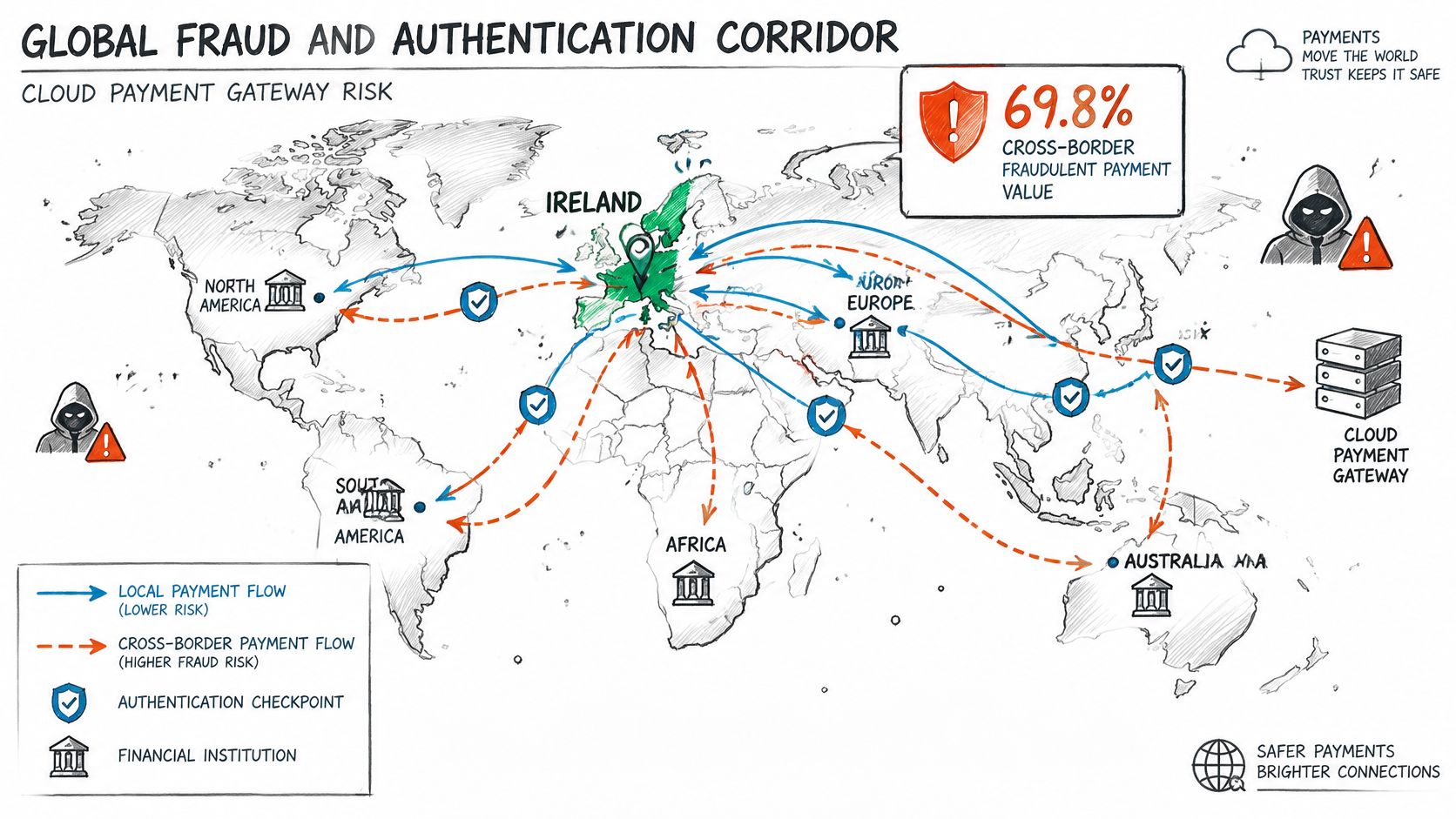
That report also cites the EBA and ECB finding that card-payment fraud was 17 times higher when the payment recipient sat outside the European Economic Area, where strong customer authentication is generally not legally required. The trade-off is real. Adding authentication cuts fraud, and rigidly applying European-style checks to every global buyer raises declines and shuts out legitimate customers in markets with different authentication rails.
Three questions decide most of this before you write any code.
- Which corridors require strong customer authentication? Map your top five markets to their rules, not to your home market's rules.
- When should you use an exemption? Low-value and low-risk transactions often qualify, but only if your fraud data supports the claim.
- How do you route a payment when the acquirer, issuer, customer and settlement wallet sit in different jurisdictions? That four-way split is where approval rates collapse.
Now the responsibility split. Card processing, fraud screening and authorization run through the licensed third-party providers that a gateway connects, not through the gateway itself. The provider's checkout screens the card, and the issuer approves or declines. What stays with you is everything a clean authorization does not settle: the chargeback exposure that survives approval, the decision about which corridors deserve extra checks, and the fraud fallback policy for your own orders.
That gap widens when settlement is crypto. A card payment that lands in a wallet remains reversible at the card layer while the crypto leg is final. If the buyer disputes the charge weeks later, the card network can pull the funds back, and the digital assets you already sent do not come back with them. Dispute, sanctions and wallet-screening exposure all survive a clean authorization, so your records need to connect each card payment to the wallet it funded.
The direction of travel is clear. A 2025 industry survey of 91 virtual-asset service providers and 10 regulators found that 100% of surveyed firms planned to become Travel Rule compliant by the end of 2025, per Notabene's State of Crypto Travel Rule 2025 report, so originator information requirements are becoming a baseline expectation for wallet settlement rather than an edge case.
Ask your provider three specific questions before you go live. What happens when a card is disputed after funds have settled into a wallet? How is a sanctioned destination wallet handled? And can the receiving virtual-asset provider accept the originator information the transfer requires? The answers tell you exactly where the provider's responsibility ends and yours begins.
Confirm Your Gateway Checks Before Going Live
Six checks cover the split between what the provider runs and what you own. Run each one against the provider's documentation, not its sales page.
- Confirm which provider handles payments in each target country. Regional coverage drives approval rates more than any checkout tweak, and the answer differs per provider.
- Obtain the PCI DSS attestation and the responsibility matrix. If the matrix doesn't exist yet, write it yourself and send it to the provider to correct.
- Force a client timeout in staging and confirm no duplicate charge. This is the test that proves the retry logic is real.
- Confirm webhook retry windows and run a daily reconciliation against the ledger. A daily match catches the payments your webhook never received.
- Set and document the fraud fallback policy. Decide in advance whether an unavailable fraud service approves low-risk orders or pauses everything, and put it in writing.
- Map each sales corridor to its authentication requirement. Do this before the first campaign aimed at a new region, not after the declines arrive.
These checks apply whichever gateway you choose, and they're the same questions a large customer's security team will ask you later. Write the answers down once and reuse them.
NexaPay says a merchant can add the gateway in minutes through a WooCommerce plugin, or connect any website through the NexaPay API, and that a payment link can be created from the dashboard. Confirm each of those steps against NexaPay's own documentation during your test run rather than assuming the flow matches your stack.
The most important check is also the simplest. Confirm that an order is marked paid only after the webhook confirms it, and never on the strength of the customer returning to your success page.
NexaPay gives merchants a hosted checkout that accepts cards, Apple Pay and Google Pay while settling cryptocurrency directly to a wallet you control, with card processing handled by PCI DSS Level 1 certified providers. If you're planning a launch, the six checks above are the fastest way to see exactly what you'd own and what we'd run for you. Connect a test site at NexaPay and work through them before your first real order.