API Development and Integration Services: A 2026 Guide
Learn how API Development and Integration Services work, from project stages and security to reliability targets and provider evaluation.
In a 2024 connectivity survey of 1,050 IT decision-makers, 99% of companies used APIs, and respondents estimated that an average of 33% of organizational revenue came from API and API-related offerings, according to the Salesforce connectivity benchmark report. That reframes what you're buying when you commission API development and integration services. You aren't buying endpoints. You're buying a distribution channel that has to keep working while providers change, regions shift and traffic grows.
Most proposals still read like a build project: scope, milestones, go-live, handover. The expensive part starts after that. A payment integration that returns the right response on the first call and then loses a webhook three weeks later costs more in support hours, refunds and abandoned carts than the original code cost to write. So the scope worth evaluating covers reliability targets, failure handling and named ownership, not just a working sandbox call.
What API Development and Integration Services Cover
An API is a set of rules that lets one software system request data or actions from another. Development and integration services design, build and connect those interfaces. Think of a standard wall socket: any appliance plugs in without rewiring the house. A well-designed API does the same for software, which is why a merchant can add a payment method without rebuilding checkout.
The diagram below splits the two jobs a quote usually blends together.
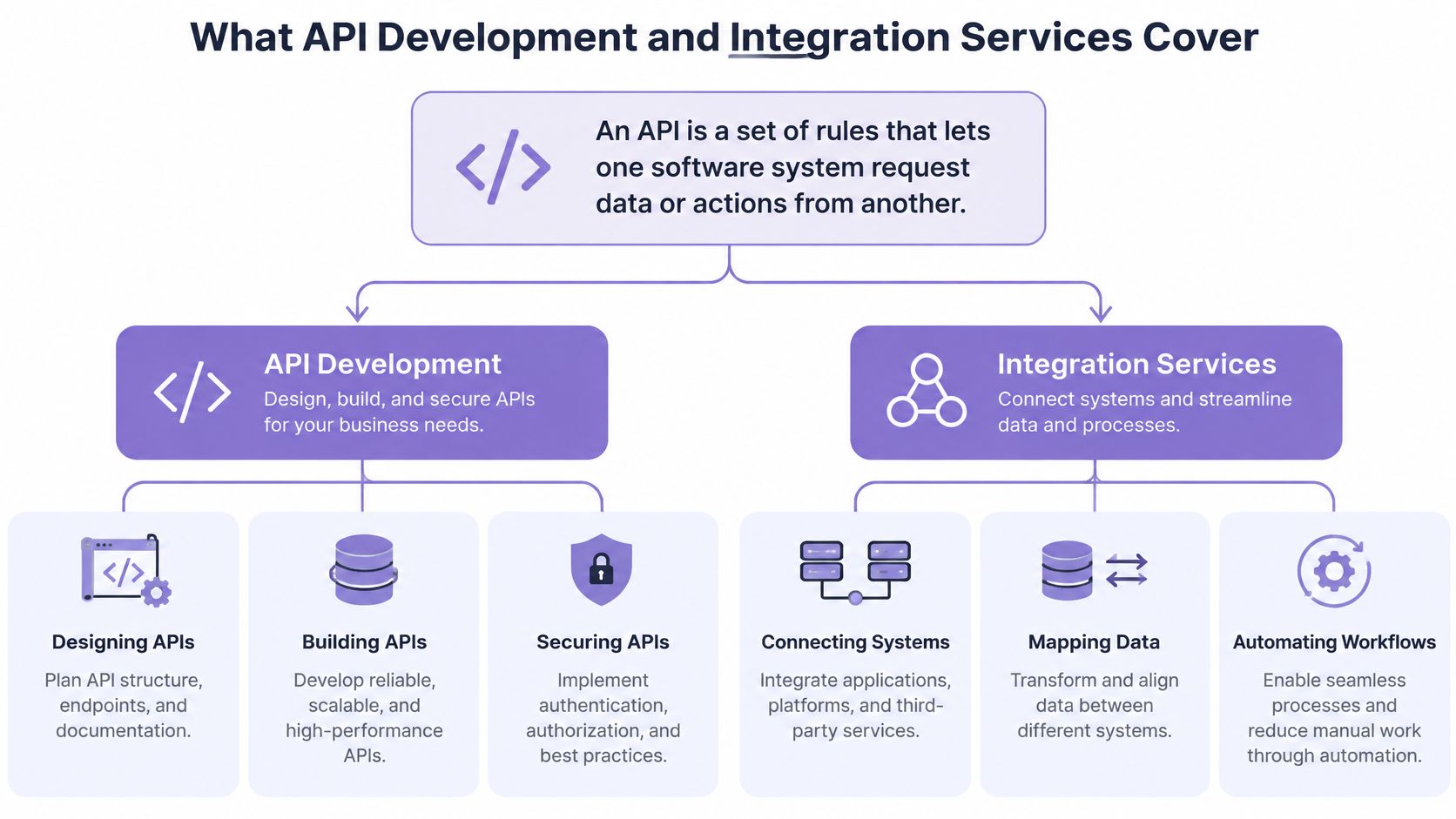
Development creates the endpoints a product exposes. Integration connects tools that already exist: payment providers, CRM platforms, identity services, analytics. Both rest on the same web standards. A 2022 industry survey compiled in Nordic APIs' API economy statistics roundup reported that 93.4% of API developers used REST, well ahead of SOAP, GraphQL or RPC-based designs, because HTTP, URLs and common data formats work across vendors and countries.
SaaS companies, e-commerce merchants, payment platforms and marketplaces buy this work so partners can connect without custom projects. What a serious engagement delivers goes past endpoint coding:
- Interface and contract design: request and response shapes, error codes, version rules.
- Authentication and secret handling: client identity, user authorization, rotation.
- Documentation and libraries: a quickstart, reference and code samples partners can run.
- Operational surface: monitoring, webhooks, changelogs, deprecation notices, testing.
Quote size moves with the number of systems and partners, the payment methods and regions involved, expected call volume, whether webhooks and reconciliation are included, and how long the vendor commits to support after go-live.
Six Project Stages From Discovery to Live Operation
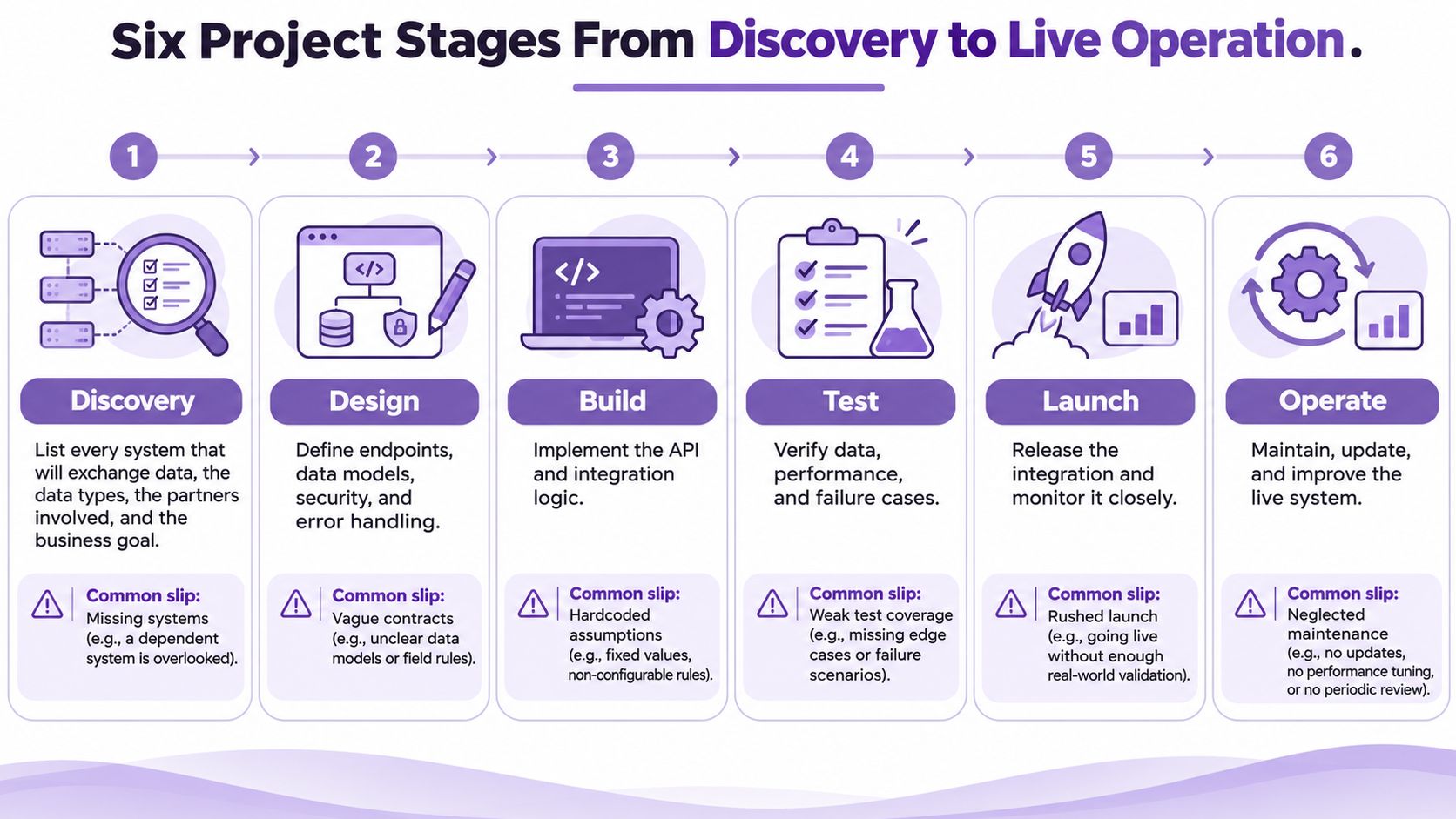
Run the work as six stages with a defined exit condition for each. The stages below are ordered by cost of correction: a missing field found in discovery takes an hour, the same gap found in production takes a week and a support queue.
Here's the sequence at a glance, including the slip that shows up most often at each step.
Stages one to three, before traffic exists
- Discovery. List every system that will exchange data, the fields each one needs, the partners involved and the expected call volume. Write down the awkward cases too, such as partial refunds, currency rounding and customers who pay twice. Teams that skip this discover a missing field during testing, when the schema is already frozen.
- Interface design. Write the contract first: endpoints, request and response shapes, error codes, pagination, version rules. Publish it as an OpenAPI file so partner developers can build against a mock while your backend is still unfinished. Vague contracts produce hardcoded assumptions on both sides.
- Build and secure. Implement endpoints and webhook delivery together, with authentication, server-side secret storage and signed callbacks from the first commit. Security retrofitted after launch means rotating every partner's credentials at once, which nobody wants to schedule.
Stages four to six, where the money is
- Test. Run contract tests against the published schema, sandbox calls for each payment method, duplicate-event tests and deliberate failure simulations (kill the provider connection mid-authorization, delay a webhook, return a malformed body). A happy-path test proves almost nothing about production behaviour.
- Launch and monitor. Deploy behind staged traffic, starting with a small share of checkouts, and put dashboards on latency percentiles, error rates and webhook delivery. Attach alerts to the targets you agreed, not to whatever the monitoring tool defaults to.
- Operate and version. Publish a changelog, set a written deprecation notice period, and assign a named owner to every endpoint and webhook. Without an owner, an old version keeps serving traffic because nobody has authority to turn it off.
Practical rule: call the integration live only when a new partner completes onboarding without a support escalation, sample transactions settle to the correct destination, and error rates stay inside the agreed target for a full week.
Notice what stages five and six have in common: they're commitments, not tasks. If a proposal ends at stage four, you've bought a build and inherited an operation.
Technical Requirements Every Integration Must Meet
Every integration has to prove two separate identities: the calling application and the end user acting through it. NIST's guidance on application security recommends API keys for identifying software clients and OAuth 2.0, OpenID Connect, SAML or JWT-based authorization for user-to-resource access. In a payment flow that means the merchant's backend authenticates as an application, while each checkout or admin action is authorized for a specific account or transaction.
The table below is the minimum set I'd hold a production integration to.
| Requirement | Standard or method | What to verify |
|---|---|---|
| Client identity | API keys sent in a request header | Keys stay on the server and rotate on schedule |
| User authorization | OAuth 2.0 or OpenID Connect tokens | Scope limited to one account or transaction |
| Transport security | TLS 1.2 or newer | No plain-HTTP calls in any environment |
| Token placement | Secured HTTP headers | No tokens in URLs or query strings |
| Token lifetime | Short-lived tokens with rotation | Expired or revoked tokens are rejected |
| Credential separation | Distinct test and production keys | Test keys cannot reach live payments |
Why headers, scopes and audience checks matter
Tokens in URLs leak. Query strings land in server access logs, proxy logs, browser history and analytics referrer headers, where dozens of people can read them without ever touching your codebase. Put credentials in headers instead. With NexaPay, every request carries the key in the X-API-Key header (recommended) or as a Bearer token, and the call runs on the merchant's server so the key stays private.
Overprivileged credentials turn one leak into a full compromise. Scope each token to an account or a transaction, keep lifetimes short, and validate the audience and issuer on every token you accept. Skipping those checks in a multi-tenant gateway produces the confused-deputy failure: one client's valid token gets accepted for another client's resources, and the gateway happily serves the wrong tenant's data.
The check to run before you sign
Ask the team to show three things on a screen, not in a slide:
- Where each secret lives: a secrets manager or environment store, never a repository or a front-end bundle.
- How a key rotates: the exact steps, who runs them, and whether old and new keys overlap briefly so traffic doesn't drop.
- How a compromised key dies: the revocation path, and how fast it takes effect across every node.
If any row in that table is missing, the integration isn't production-ready, even when every endpoint returns the right response in testing.
Reliability and Failure Handling in Payment Integrations
The failure a merchant notices first isn't an error page. It's a payment that completed at the provider while the order sits pending on the storefront, because a webhook never arrived or arrived twice and the second one confused the state. Average latency and nominal uptime hide that completely: the API was up, the mean response time looked fine, and the customer still emailed support.
Targets that expose the stuck payment
Google's SRE chapter on service level objectives treats latency as a key service-level indicator and expresses objectives as the share of requests meeting a threshold, for example 99% of small RPC calls completing within 10 milliseconds. The same chapter shows how a 99% availability objective over a defined window creates a 1% error budget that has to absorb failures, timeouts, provider outages, deployments and maintenance.
For a payment API, a workable design targets 99.9% successful API responses and 99% of checkout requests below an agreed latency threshold, then pauses risky releases or routes to a fallback provider once the budget is consumed. Track the indicators that map to merchant pain:
- Successful authorization rate, split by provider, region and payment method.
- p95 and p99 response latency, because the slow tail is where carts get abandoned.
- Webhook delivery success and duplicate-event rate, measured at the consumer, not the sender.
- Settlement-confirmation delay, from provider confirmation to funds visible in the wallet.
Matching each failure to a design response
| Failure | What the merchant sees | Design response |
|---|---|---|
| Duplicate webhook | Same payment event arrives twice | Idempotency keys and deduplication by event ID |
| Delayed confirmation | Order stays pending past the expected window | State machine with timeout and status polling |
| Provider outage | Errors from one provider across all checkouts | Fallback rules with clear switch criteria |
| Regional method change | A wallet option disappears for some buyers | Per-region availability checks before checkout |
| Wrong wallet address | Settlement sent to a mistyped address | Address validation before a payment session is created |
| Lost webhook | Payment completes but the merchant is never notified | Reconciliation job against the payments list |
The design elements behind those rows
Start with an explicit payment-state machine: pending, completed, failed, with permitted transitions written down and no path that lets a completed payment revert. Attach idempotency keys to every create call so a retry after a timeout returns the original payment instead of charging twice. Retry with exponential backoff and jitter, wrap each provider in a circuit breaker that opens after repeated failures, and process webhooks from a queue with a dead-letter policy so a poison event doesn't block the rest.
Verify webhook signatures before you trust a payload, and validate wallet addresses before a session exists. When the API returns a 429 Too Many Requests error because the rate limit is exceeded, the client backs off rather than hammering the endpoint again. Then run a nightly reconciliation job that compares local records against the provider's payment list, because reconciliation is the only control that catches events you never received.
Testing discipline is what makes this hold at scale. The 2025 Stack Overflow Developer Survey found 81% of respondents emphasizing verification of API behavior and contracts, alongside contract-first design and centralized governance as ways to cut integration friction.
More providers raise availability and increase inconsistency at the same time. Resilience comes from an abstraction layer and observability, not from a longer list of connections.
Keeping Integrations Secure and Owned After Launch
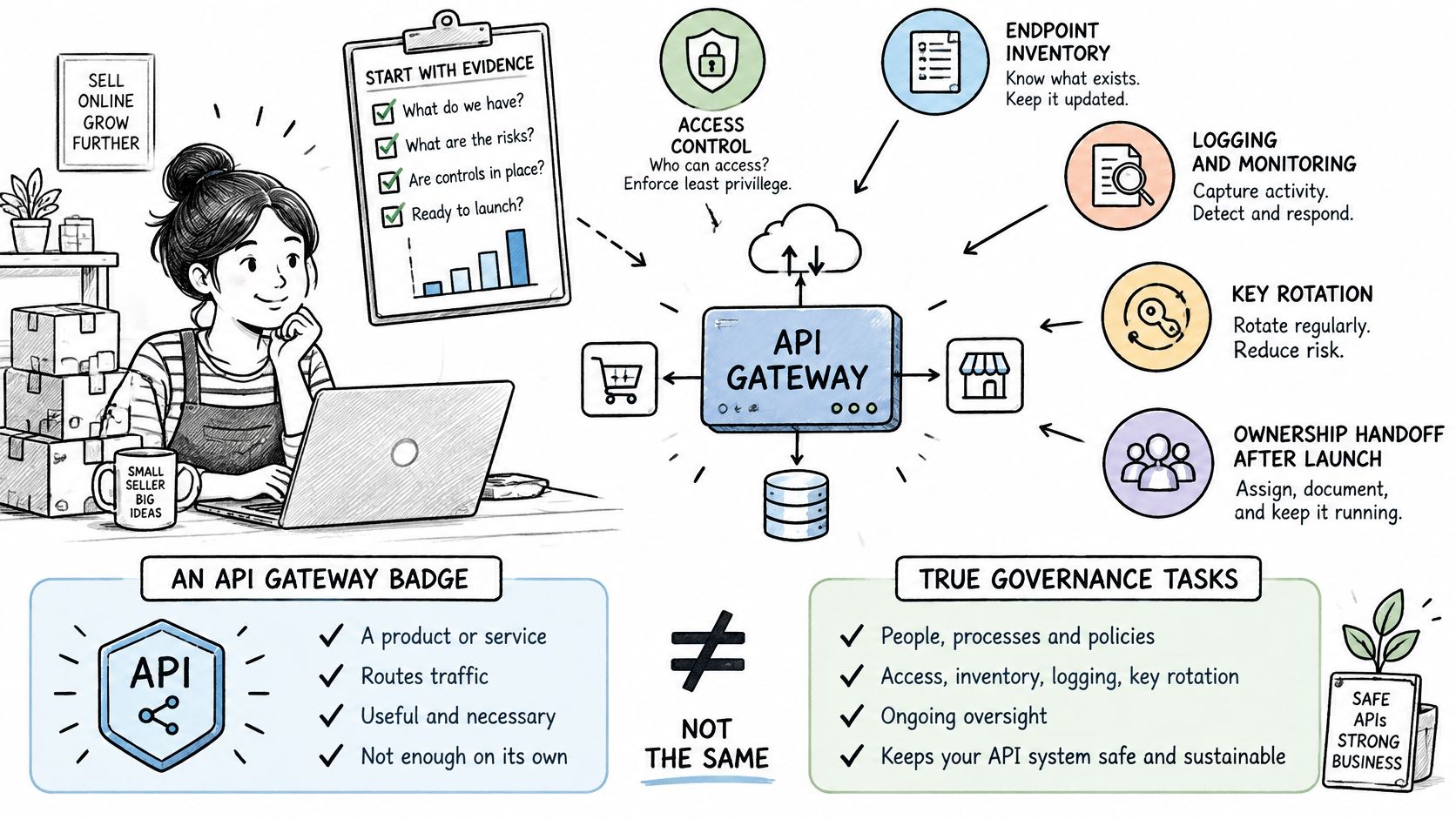
Buying an API gateway is only a traffic decision. Governance is the operating work that decides which endpoints exist, who owns them, and which ones still touch card, wallet or personal data. Many organizations have dealt with API-related breaches, and many still struggle to detect attacks at the API layer. The gap is usually ownership, inventory and routine checks, not the absence of another security product.
The illustration below captures the difference between a gateway box and an owned, inventoried surface.
What governance looks like on a Monday morning
Inventory everything: list every endpoint and webhook receiver, including the version someone shipped for a single partner and forgot.
Name an owner per endpoint: assign a person or team who answers when it misbehaves, and record that owner next to the route.
Classify the data: mark which endpoints touch payment, wallet or personal data, then review how that data is stored and retained against your PCI DSS card storage obligations.
Test authorization and replay protection: attempt cross-account reads, replay a captured webhook with a stale timestamp, and check that expired keys fail cleanly.
Watch production behaviour: alert on unusual call patterns, failed authorization bursts, and any traffic still hitting deprecated versions.
Keep runbooks current: cover key rotation, deprecation steps and incident response, then review them on a schedule rather than writing them once.
A v1 endpoint that still accepts requests long after v2 shipped is the usual failure mode. Nobody monitors it. Nobody owns it. It turns up during a breach review instead of a routine inventory. That is a governance gap, and buying more tooling will not close it. The practical fix is dull and repeatable: tie each route to an owner, a data class, a test path and a retirement plan.
API keys also need firm handling after launch. NexaPay requires the key in request headers, using the X-API-Key header or a Bearer token. The key must stay private, and API calls must run on the merchant's server. Treat any key in browser code, a mobile bundle or a shared document as exposed, then rotate it.
Ask any vendor two questions before signing. Who answers at two in the morning when an endpoint behaves unexpectedly? How would you know it happened before a customer tells you?
A Card Checkout Integration From First Call to Settlement
A small seller of digital goods wants customers paying by card while the business receives crypto. The build is short. The operational details around it are where the work lives.
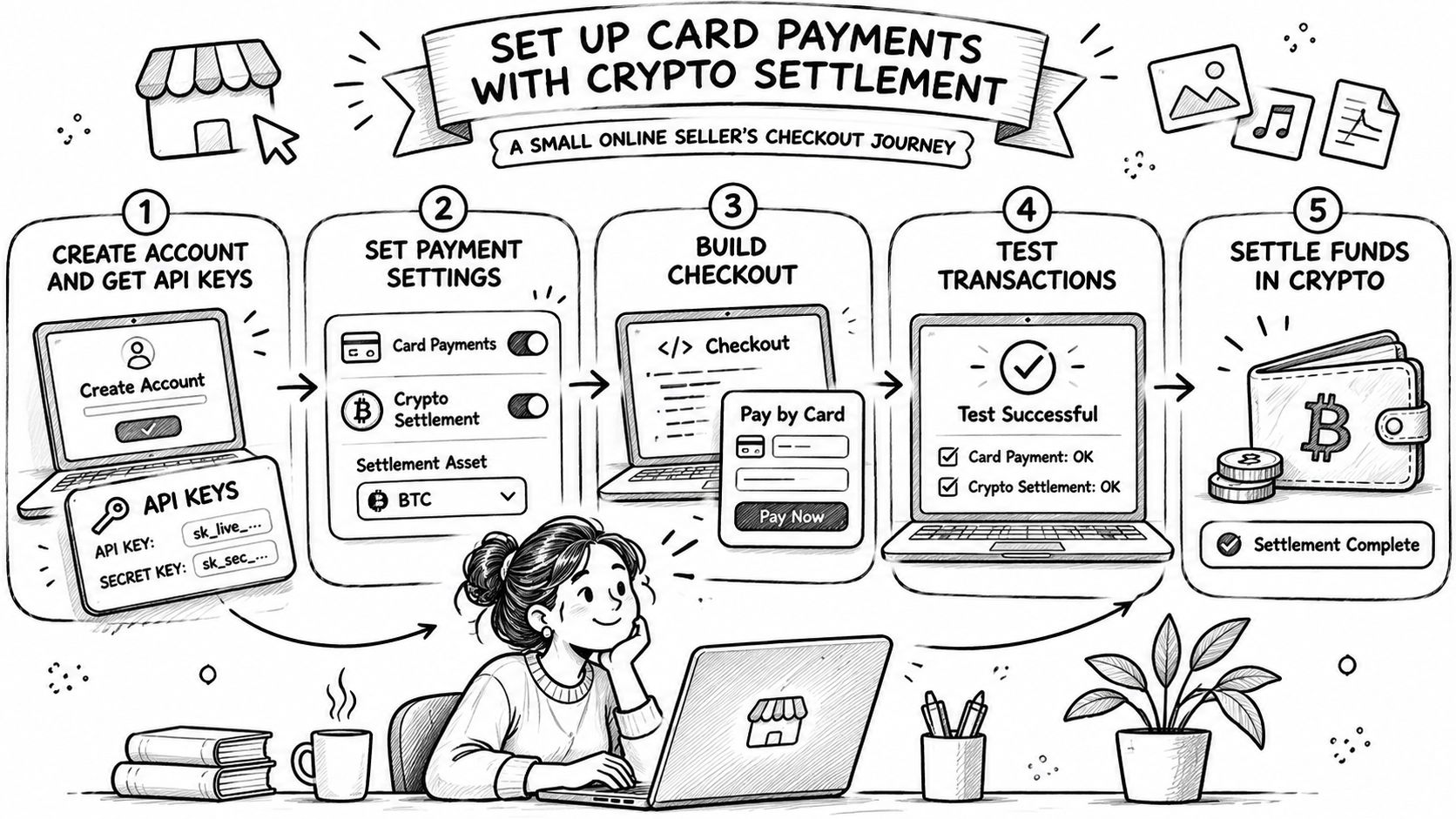
The seller creates an account and gets API keys, sets a crypto wallet address in Settings, then creates a payment session from the backend with POST /api/v1/payments, sending the key in the request header. The response carries a hosted checkout URL, so the seller redirects the customer there and lets the provider handle card entry. When payment completes, crypto arrives in the wallet the seller configured. That's the whole path a fiat-to-crypto payment gateway has to make boring.
The first test order sits pending
The seller places a test order and the storefront shows pending while the provider already shows a completed payment. Instead of waiting on the webhook alone, the team polls GET /api/v1/payments/:order_id and reads the authoritative status, then reconciles the local order record against it. That polling path stays in production as the fallback for every delayed or lost callback, which is exactly the situation the walkthrough below covers.
A month later, a reconciliation pass calls GET /api/v1/payments to list payments and finds one that never made it into the local database. The order gets corrected without a customer complaint, because the job ran before anyone noticed.
Two mistakes that cost real money
- A mistyped wallet address: funds settle to the wrong destination and no API call brings them back. Validate the address format and confirm it with a small first transfer before volume flows.
- An API key in front-end code: any visitor can read it from the browser and create or query payments as you. The key belongs on the server, in a secret store, and the create call happens there.
NexaPay's five-step flow keeps that boundary explicit: keys and session creation on the merchant server, card details on the provider's hosted page. The seller's verification is simple and required. A test order reaches completed status, and the wallet balance matches the expected amount.
Choose an Integration Partner With Confidence
Score candidates against the same criteria you'd use to review your own integration. A demo tells you the happy path works; the scorecard tells you what happens on the other paths.
| Criterion | Strong answer | Red flag |
|---|---|---|
| Documentation | Reference, quickstart and changelog available | Endpoints described only in sales material |
| Test environment | Documented sandbox or test path | No test path and unclear handling of live keys |
| SDK coverage | Official SDKs for your stack | No SDK and no examples in your language |
| Rate limits | Documented limits and 429 handling guidance | Limits discovered only in production |
| Webhook security | Signed callbacks with verification guidance | Unsigned or unverified callbacks |
| Ownership after launch | Named support tier, SLA and deprecation notice | No commitment beyond go-live |
Check SDK coverage against your actual stack rather than the logo wall. We publish official Node.js and Python SDKs for download, with PHP and Ruby coming soon, and code examples in JavaScript, Python, PHP and cURL so a team on another language still has something runnable.
Then press hardest on the test row, including with us. NexaPay has no separate test mode: a single live API key serves both development and production. That makes the row a question about process, not features. Any buyer in that situation needs a written plan covering how test transactions stay away from live funds, how keys stay out of development code and repositories, and who can revoke a key. If a vendor can't produce that plan, score it as a red flag even when the documentation is excellent.
For platforms embedding payments for their own merchants, the ownership row matters more than any feature comparison, and a white-label payment gateway arrangement should come with partner and merchant API keys, signed webhooks and a named support commitment. Reject any candidate with a red flag on security or ownership, then request integration help through the contact form by selecting Integration help and describing your platform and what you're building.
NexaPay connects card, Apple Pay and Google Pay checkouts to direct crypto settlement, with a REST API for creating payment sessions, checking status and listing payments, plus signed webhooks, SDKs and a published changelog. If you're scoping API development and integration services for a storefront, SaaS product or payment platform, bring the scorecard above and we'll tell you where our own setup needs a written process rather than a feature. Visit NexaPay to read the developer documentation and start the conversation.