White-Label Payment Gateway Explained for Platforms
A white-label payment gateway lets your platform take card payments under its own brand. Compare models, setup steps, compliance and risks.
You've built a platform your merchants depend on. Bookings, invoices, digital goods, the vertical doesn't matter. Then a merchant asks why their customer's receipt carries a payments company's logo instead of yours, and you don't have a clean answer. Money moves through your product, the checkout doesn't look like your product, and the commission you'd like to set isn't yours to set.
A white-label payment gateway solves the branding problem in weeks. It doesn't move the obligations, and that's the part founders underestimate. What follows maps who carries what once the logo changes hands, including the dispute you'll still be handling long after the crypto has left the merchant's wallet.
What a White-Label Payment Gateway Is and Who Uses One
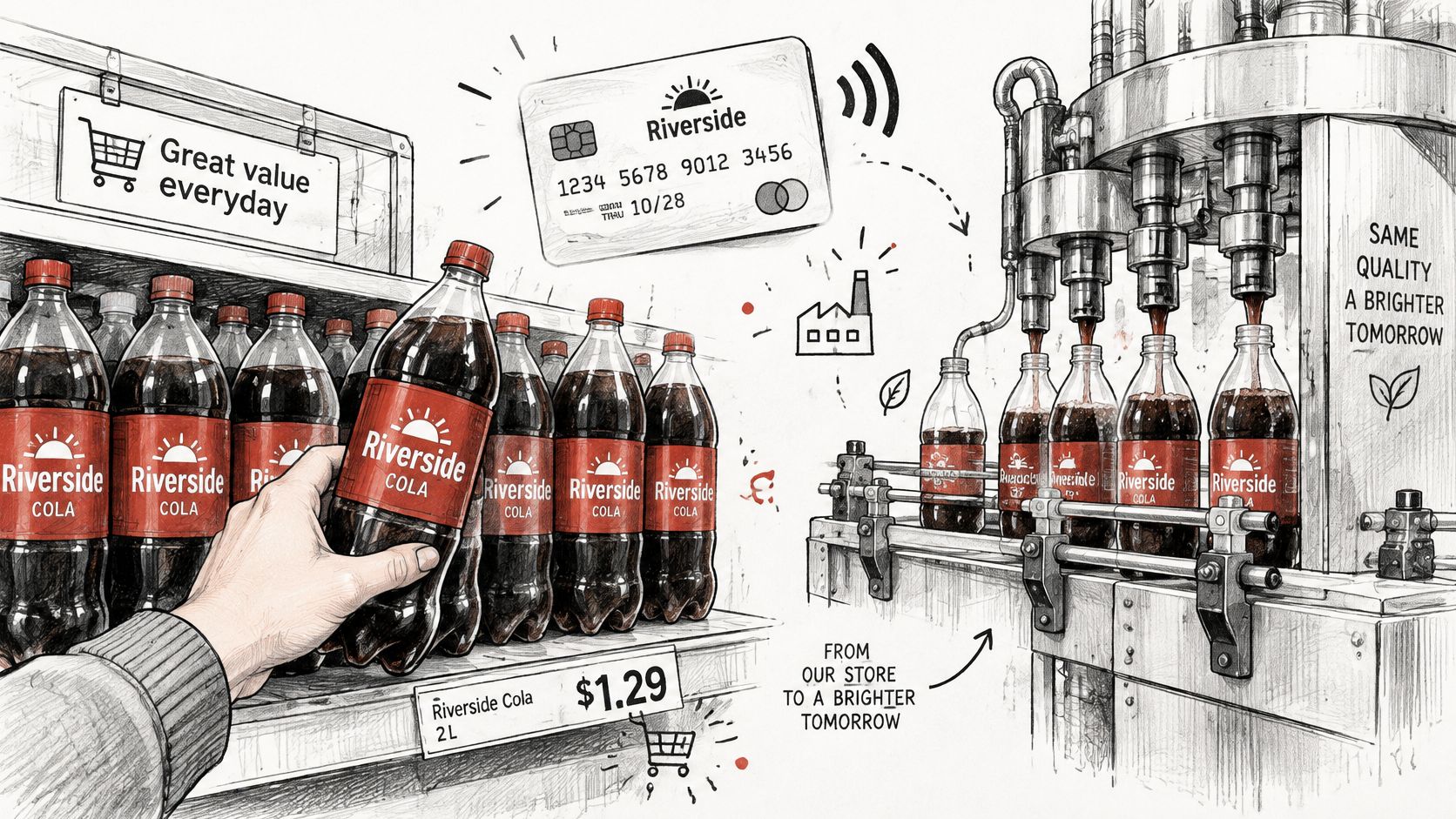
Walk into a supermarket and you'll find the store's own cola on the shelf. Shoppers see the supermarket's name. The liquid comes from a bottling plant running the same recipe for a dozen retail chains. A white-label payment gateway is that bottling plant with your label on the crate.
The shelf-versus-factory split is the whole idea in one picture: brand up front, production somewhere else.
Four terms carry the model, and vendors use all of them loosely.
- Gateway. The software that captures a payment request at checkout and sends it onward for authorisation.
- Provider. The licensed company running the checkout, holding card data and connecting to acquiring.
- Acquirer. The bank that accepts card money on the merchant's behalf and carries the underwriting risk.
- Settlement. The moment funds land in a wallet or bank account after acquiring clears.
The category is small but growing faster than payments overall. A 2025 analysis estimated the global payment-processing and gateway sector at USD 35.251 billion, with white-label and gateway-software revenue at USD 1.150 billion, or 3.26% of that total, per this Pheonix Research market analysis. The same analysis projected the segment reaching USD 2.922 billion by 2033, a 12.37% compound annual growth rate against 6.94% for the wider market. Read those as analyst projections, not audited figures: the definition bundles gateway software, orchestration and white-label services together.
The buyers who fit are narrower than search volume suggests. Fintechs embedding payments in a product, marketplaces splitting funds between sellers, SaaS platforms charging their own customers, agencies running client shops, and sellers who want one checkout across several regions.
A quick self-test. If customers should see your name at checkout and you'd rather not store card data or negotiate acquiring relationships yourself, the model fits. If you sell your own products and just want cards to work, it doesn't. You'd be buying infrastructure to resell to yourself.
Choose the Right Operating Model Before You Launch
Vendors describe the same arrangement with different words, so compare the columns rather than the labels. Three shapes cover almost every launch.
| Model | Who signs the merchant | Who holds card data | What the customer sees | Main trade-off |
|---|---|---|---|---|
| Own-brand white-label gateway | Platform, under its own brand | Licensed provider | Platform name at checkout | Platform takes on merchant oversight and commission setup |
| Provider-branded merchant account | Each merchant, directly with the provider | Licensed provider | Provider name at checkout | Less control over checkout branding and commission |
| Build your own acquiring stack | Platform, as the acquiring relationship holder | Platform, unless card data is tokenised | Platform name at checkout | Highest compliance load and longest approval time |
Signing authority comes first. Whoever signs the merchant owns onboarding, support and the awkward call when a payout is late. Card-data custody is the column that decides your real cost, because it fixes where PCI scope sits no matter whose logo appears. The customer-visible name is what you're buying, and the trade-off column is where the decision lives.
Three decision rules
- Pick own-brand when the brand and the margin are the product. If you intend to set commission per merchant and sell payments as part of your platform, this is the model that pays for itself.
- Pick a provider-branded account when speed beats cosmetics. Each merchant signs directly, activates quickly and carries fewer duties. You give up checkout branding and any say over commission.
- Build your own acquiring stack only at volume. Holding the acquiring relationship means owning the compliance load personally, and approval takes longest. Few platforms have both the volume and the in-house compliance staff to justify it.
If merchants sign under your brand and you set their rates, you're closer to a payment facilitator than to a reseller, and what a payment facilitator is explains the regulatory shape of that role.
Five checks before you commit
- Brand visibility. Customers must see your name at checkout, not the provider's.
- Dispute ownership. Contracts must name who handles disputes, refunds and fee absorption when settlement has already gone to crypto.
- Operational capability. Your team can own vendor oversight, webhook security and reconciliation.
- Monitoring. You can pull approval, fraud and chargeback rates per provider, not just a blended number.
- Coverage. Your chosen providers support the regions and payment methods your merchants need.
Three or more yeses, with clear answers on checks two and four, means the model fits. A no on check one points you to a provider-branded account instead.
The test that saves the most pain. Name the person who handles a failed payment at 2am on a Sunday. If the answer is nobody, no operating model is ready.
White Label is built for payment platforms, SaaS businesses and marketplaces, and agencies and partners running payments for a merchant network under their own brand and commission rates. NexaPay Instant is a separate product, for a business accepting payments for itself. Our team can help plan the White Label setup, and the first call goes better with a written matrix for disputes, refunds and crypto settlement already in hand.
How a Payment Travels from Checkout to Settlement
Take a platform selling a 30 euro digital download through a sub-merchant. The customer taps Apple Pay, the file becomes available, and the platform books a commission. Seven things happened between those moments, and each one has a known failure mode.
The sequence is short, which is why a single broken step is easy to miss on a dashboard.
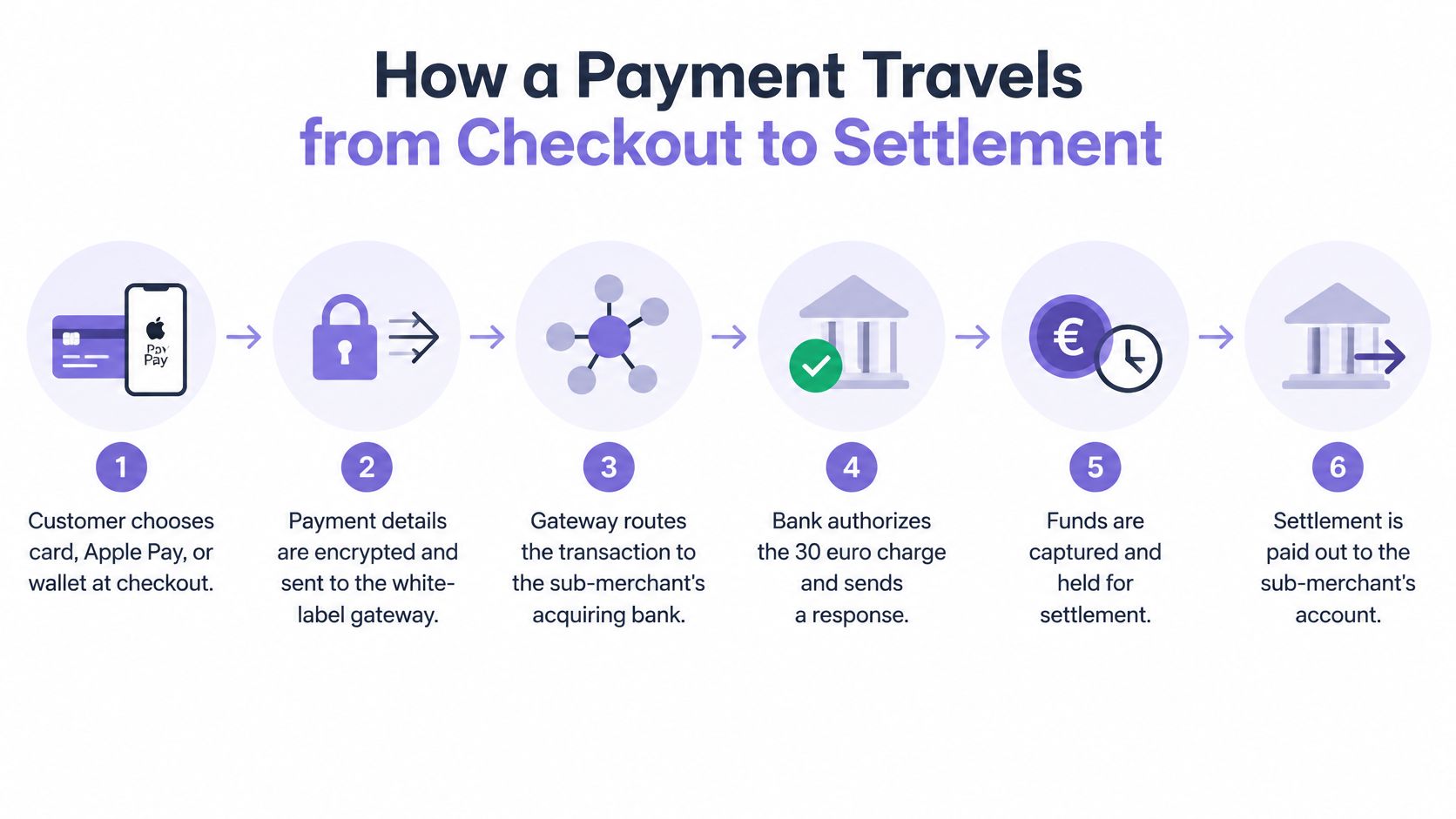
- Selection. The customer chooses card, Apple Pay or Google Pay on the provider's checkout, where the card fields live. Add your own card form alongside it and primary account numbers enter your stack immediately.
- Authorisation. The provider runs the payment and applies 3-D Secure when the issuer asks for it. Treat the authorisation response as the whole story and you lose the authentication result that decides who eats a fraud loss.
- Notification. The provider returns a result and posts a signed webhook. A single dropped webhook leaves a paid order in limbo until someone reconciles by hand.
- Attribution. The platform records the state and credits the sub-merchant. Credit late or loosely and commission splits drift for weeks.
- Capture. Funds are captured once the order is confirmed. Capturing at authorisation before delivery leaves you exposed on refunds you can't claw back.
- Settlement. Funds move to the configured wallet or bank account, and crypto transfers can complete within minutes. One wrong character in the payout address sends money somewhere you can't retrieve.
- Commission. The platform's cut is recorded as its own line. Skip the line and the split only surfaces at month end, as a reconciliation project.
The same flow on screen is worth watching before you map your own event handling, especially the gap between authorisation and capture.
The reconciliation rule that keeps this honest: match the provider's reference to your own order ID on every event, and log both. That single habit means any payment can be traced from checkout to wallet by a support agent who wasn't there when it happened.
Security, PCI Duties and Authentication Responsibilities
Outsourcing card handling is not outsourcing compliance. That assumption costs platforms more than any licence fee, and the compliance record shows why the distinction bites.
Verizon's 2020 Payment Security Report found that only 27% of organisations worldwide held full PCI DSS compliance, including about 20% in the United States and roughly 70% in Asia-Pacific, as reported in this Security Magazine coverage of Verizon's Payment Security Report. The same outlet reported a 2023 survey in which 86% of respondents expected to rely mostly or entirely on third-party vendors, which is a sound instinct and an incomplete plan.
Card and other payments are handled solely by licensed third-party payment providers. That's the correct architecture, and it still leaves you with governance, vendor oversight and the PCI DSS duties that attach to your own systems.
| Area | Usually handled by provider | Still the platform's job |
|---|---|---|
| Card data collection | Hosted fields or provider checkout | Keep checkout on the provider's page and never add your own card form |
| Token storage | Stores card data and tokens | Store only tokens and transaction references |
| Logs and analytics | Provider-side logs only | Redact PAN-like values from logs, analytics and support tools |
| Webhook handling | Sends event notifications | Verify signatures and isolate webhook storage |
| 3-D Secure | Runs the authentication flow | Track requested, frictionless, challenge required, challenge completed, failed and unavailable states |
| Vendor oversight | Supplies compliance documentation | Review each provider's PCI status and record the review |
Where tokenisation stops
PCI Security Standards Council guidance states that an EMV payment token used outside a token service provider's token-data environment is not itself account data and generally falls outside PCI DSS scope, but systems come back in if they also store, process or transmit PANs or connect to ones that do, per the PCI SSC tokenisation FAQ. That's a direct cause and effect. A tokenised checkout shrinks your card-data footprint, and one PAN captured in a debug log, an analytics event or a support screenshot expands it again. Keep collection inside the provider's hosted checkout, store tokens and references, and document who owns the token solution contractually.
Why a blanket challenge costs sales
EMVCo describes EMV 3-D Secure as an exchange of transaction, payment-method and device data between merchant and issuer, so the issuer can approve low-risk payments through a frictionless flow and challenge only the risky ones, as set out in the EMVCo overview of EMV 3-D Secure. Preserve the full data set, including device and browser parameters, billing details, amount, currency and recurring indicators, because richer inputs improve automated decisions. Challenge every transaction and you'll convert fewer of them; approve on authorisation alone and you'll carry fraud you could have deflected. If your merchants sit in harder verticals, high-risk merchant account services covers what changes in provider selection.
How to Launch Your Own Branded Gateway
A branded gateway fails in the same places every time: a payout wallet nobody verified, webhooks that were never tested, a flat commission that ignores merchant risk. The order below prevents each of those. Skip a step and the failure surfaces later, under live traffic, when it costs a real customer.
- Open the account and the subscription. White Label starts with a NexaPay account plus an active White Label subscription, since branded setup can't begin without both. The mistake here is commissioning design work or a domain before the subscription is live: you end up with assets and nothing to attach them to.
- Set the brand and the payout destination. Add your logo and colours, connect a custom domain, write the checkout messaging and configure the payout wallet that receives commission. A wrong wallet address sends revenue somewhere you don't control, and it's the single most expensive typo in the build.
- Onboard merchants and connect the API. Create merchants, set a commission rate for each one and connect with partner and merchant keys. A flat rate across every merchant is easy and usually wrong, because risk and volume differ per merchant from day one. Tailoring rates takes an extra conversation and pays for itself at the first high-volume account.
- Choose the payment route per merchant. A payment link generated from the dashboard lets a merchant start accepting payments without a custom integration. WooCommerce stores get the plugin, and any other website connects through the NexaPay API. Signed webhooks keep order status in sync either way, and unverified webhook handling is how failed payments stay invisible.
- Confirm before live traffic. Verify signed webhook handling and check that the commission split appears in the dashboard, paid as USDC splits into the Polygon wallet you configured. Test against live traffic only after both are proven, then track payments and manage merchants from the same dashboard.
Before step two, settle these in writing: checkout colours and messaging, custom domain, payout wallet, the commission rate per merchant, and which payment methods appear at checkout. Each merchant also needs a decision on integration route: dashboard payment link for speed, plugin or API for an embedded experience, signed webhooks in all cases.
The pre-launch test plan. Run one payment per merchant, one refund and one deliberately failed payment before you open the gateway publicly. Write down the result of each, including the provider reference and the wallet balance afterwards. Undocumented tests get repeated, and the second run costs a real customer.
Unlimited sub-merchants are supported, so the constraint on growth is onboarding discipline rather than headroom on the provider side. If the setup has more moving parts than your team has planned for, NexaPay's team can help scope the White Label configuration before you commit to a launch date.
Who Owns Chargebacks After Crypto Settlement
Here's the question most explainers skip until a dispute lands. A customer paid by card, the merchant already received cryptocurrency, and now the cardholder files a chargeback. Card rails stay governed by issuer and network dispute rules, so a crypto settlement never removes the liability.
The volume makes this worth designing for rather than improvising. Global chargeback volume is forecast to rise from 261 million transactions in 2025 to 324 million in 2028, a 24% increase, while first- and third-party fraud together account for about 45% of merchant chargeback volume, according to Mastercard's 2025 State of Chargebacks report.
The dispute arrives whether or not the funds can be recovered, and the merchant may already have moved them.
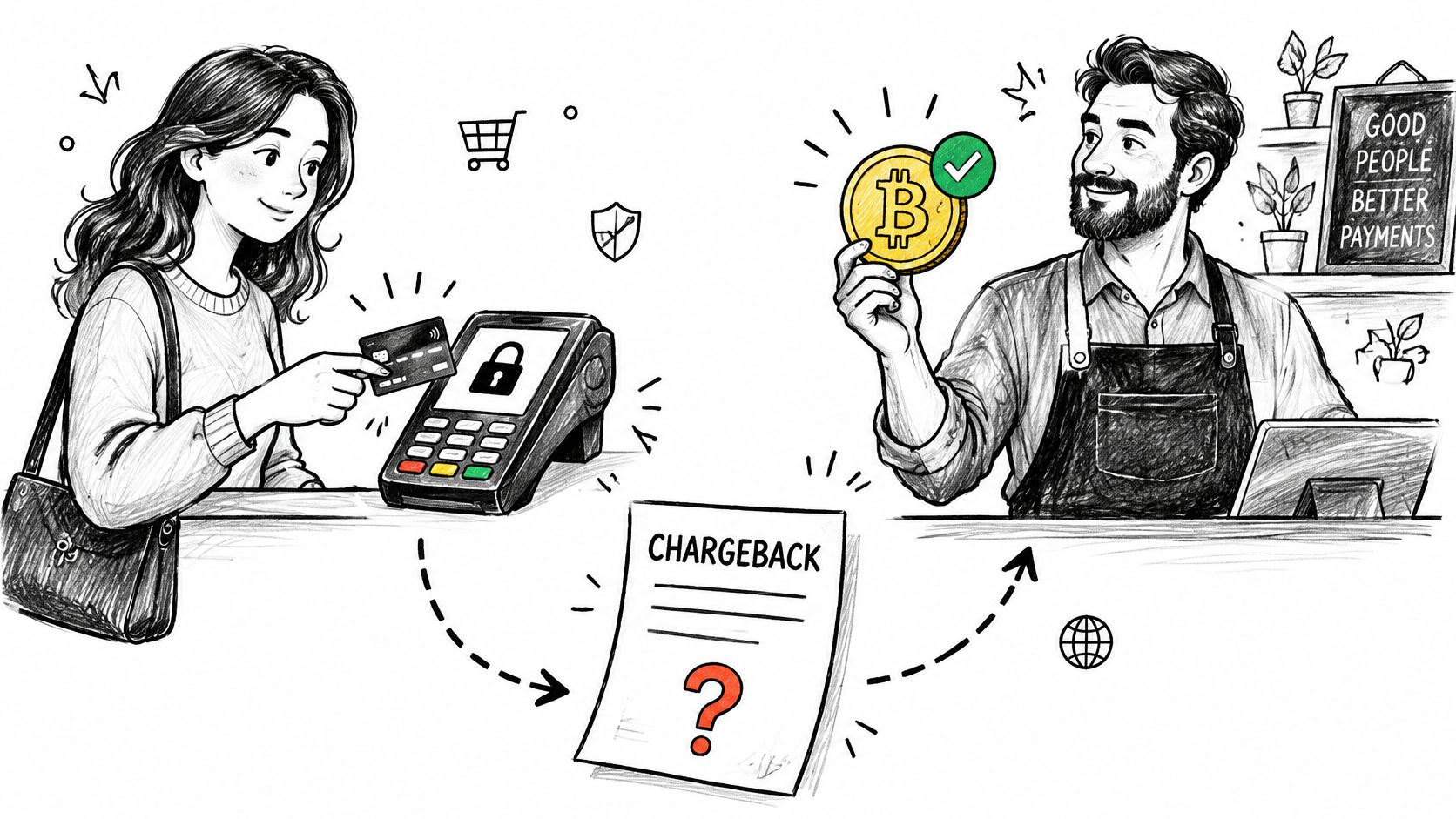
Take a concrete case. A customer disputes a 100 dollar purchase two months after delivery, by which time the equivalent value sits in the merchant's wallet and has moved on-chain. Nothing can be pulled back. Someone still has to answer the network, supply evidence and decide who absorbs the shortfall.
The matrix a contract has to answer
- Notice. Which entity receives the dispute notice, and how many hours pass before the merchant hears about it.
- Evidence. Who assembles delivery records, service logs, authentication results and customer correspondence, and to what deadline.
- Reversal. Whether any recovery route exists once funds are on-chain, and who decides when it doesn't.
- Refund basis. Which currency a partial refund is calculated in when the asset price has moved since the sale.
- Fees. Who absorbs network, processor and conversion costs on a refund or a lost dispute.
- Reserve. Whether a rolling reserve is held against future losses, whose money it is and when it releases.
Write each answer into the merchant agreement before launch, with a named owner and a response deadline. A white-label gateway that settles in crypto is still a card acceptance business, and the fiat-to-crypto payment gateway model changes the settlement leg, not the dispute leg.
Multi-Provider Routing and Where It Backfires
More providers means more approvals. That's the claim, and it deserves testing rather than repeating.
Routing earns its keep in one clear case. A transaction declines for a technical reason at the first provider, a timeout, an unsupported card type, a regional outage, and a fallback provider in the same region approves it. That's a recovered sale, and it's worth the integration.
Then the bill arrives. A fallback can change the acquirer, the statement descriptor, the authentication path, the risk score and the evidence available in a dispute. The customer may see a merchant name they don't recognise, or face a challenge the first attempt never triggered. Repeated retries across several providers start to look like card testing from the outside, which is a monitoring problem you created.
The fraud backdrop makes this an operational decision rather than an engineering preference. 98% of merchants surveyed experienced at least one form of fraud in 2025, with real-time-payment fraud, refund or policy abuse, phishing, first-party misuse and card testing among the leading threats, per the Merchant Payments Ecosystem 2025 trends report.
Routing rules that hold up
- Route on decline codes, not on instinct. Limit fallbacks to clear technical declines. A genuine "insufficient funds" won't approve anywhere and just doubles your retry count.
- Cap retries per customer and per session. A hard ceiling, applied across all providers rather than per provider, is what keeps a legitimate retry from resembling an attack.
- Log the provider on every attempt. Store which provider handled each attempt, the response code and the descriptor used, attached to your own order ID.
- Review performance per provider. Approval, fraud, refund and chargeback rates each belong in their own column. A blended dashboard hides the provider that's failing.
Smart routing, which automatically selects the best available provider in the buyer's region, is only as good as the rules behind it and the monitoring above it. Redundancy without attribution creates compliance blind spots and makes performance impossible to explain to a merchant asking why their approval rate fell. I'd rather run two providers with clean per-provider reporting than five with a single merged number.
NexaPay gives platforms the infrastructure to run payments under their own brand, including a custom domain, logo, checkout messaging, per-merchant commission rates and settlement in crypto through provider-hosted checkouts. If this article has clarified which obligations stay with you, the next step is to map them against a real setup and see where yours land. Visit NexaPay to review the White Label product and start planning with the team.