Crypto Payment Gateway Without KYC: What It Really Skips
Learn how a crypto payment gateway without KYC works, which checks merchants skip, which still apply to customers and providers, and how to verify claims.
The most popular advice about a crypto payment gateway without KYC starts with the wrong test: find a service that doesn't ask for identity documents, then assume the payment is verification-free. An empty upload form tells you very little about what happens when a customer pays or when funds reach a wallet.
The useful test is more demanding: whose identity isn't checked, by which company, and at which stage? A merchant can avoid onboarding paperwork while a buyer still encounters a verification prompt. To assess the claim properly, you need to follow the payment, not just the registration screen.
Which Checks a No-KYC Gateway Actually Removes
Who checks what in a no-KYC crypto payment flow
| Check | Merchant onboarding | Customer checkout | Provider and bank layer |
|---|---|---|---|
| Merchant identity (KYB) | Not required to open an account under the stated no-merchant-verification offer | Not applied to the buyer as merchant KYB | Separate provider and banking-partner eligibility rules apply |
| Customer identity (KYC) | Buyer verification isn't performed during merchant registration | Provider may verify by amount, region or risk score | Provider's own customer-verification rules apply |
| Sanctions and AML screening | Skipping documents doesn't establish a screening exemption | Licensed providers apply relevant checks before settlement | Bank and wallet controls may add checks |
| Travel Rule transfer data | Transfer-specific information isn't collected merely by opening an account | Required information is collected for qualifying transfers | Relevant information passes between providers handling covered transfers |
This table describes a limited-onboarding model, not a universal specification for every gateway. Exact verification triggers, supported regions and information requests are provider-specific. Get the applicable rules in writing before treating any cell as a promise about your checkout.
Know your business, or KYB, concerns the merchant: its registration, ownership and business activity. Know your customer, or KYC, concerns the person or customer relationship being verified. Marketing pages can collapse these into the same phrase, even though they involve different participants.
Skipping a document isn't skipping a decision
The surprising distinction is between identity verification and transaction screening. A provider can evaluate an address, transaction pattern or sanctions exposure without first requesting the merchant's incorporation documents. Conversely, a completed identity check doesn't automatically make every subsequent payment acceptable.
Travel Rule information is another separate category. Information about a transfer's sender and recipient isn't another merchant-registration field. Its collection belongs to the applicable transfer process, which means a clean account-opening experience tells you nothing conclusive about later information requests.
At NexaPay, we don't ask merchants to upload business registration documents to open an account. Payment details and customer verification are handled by the payment provider in its secure checkout. That allocation matters more than whether a landing page uses the abbreviation KYC.
Practical rule: Treat every no-KYC claim as a statement with a missing subject and stage until the provider identifies both.
Before integrating, distinguish account creation, permission to process a payment and release of settlement. They're separate decisions. A gateway may simplify the first without controlling every condition attached to the others.
The implication is straightforward: a no-KYC claim can describe one stage accurately without describing the whole payment accurately.
Merchant Onboarding, Customer Checks and the 2019 Rule Shift
A nightclub can skip your membership form and still check your ID at the door. Your bank can check your account without checking the bartender's identity. Payment verification works through similarly separate relationships: the merchant opens an account, while the buyer enters a provider's payment process.
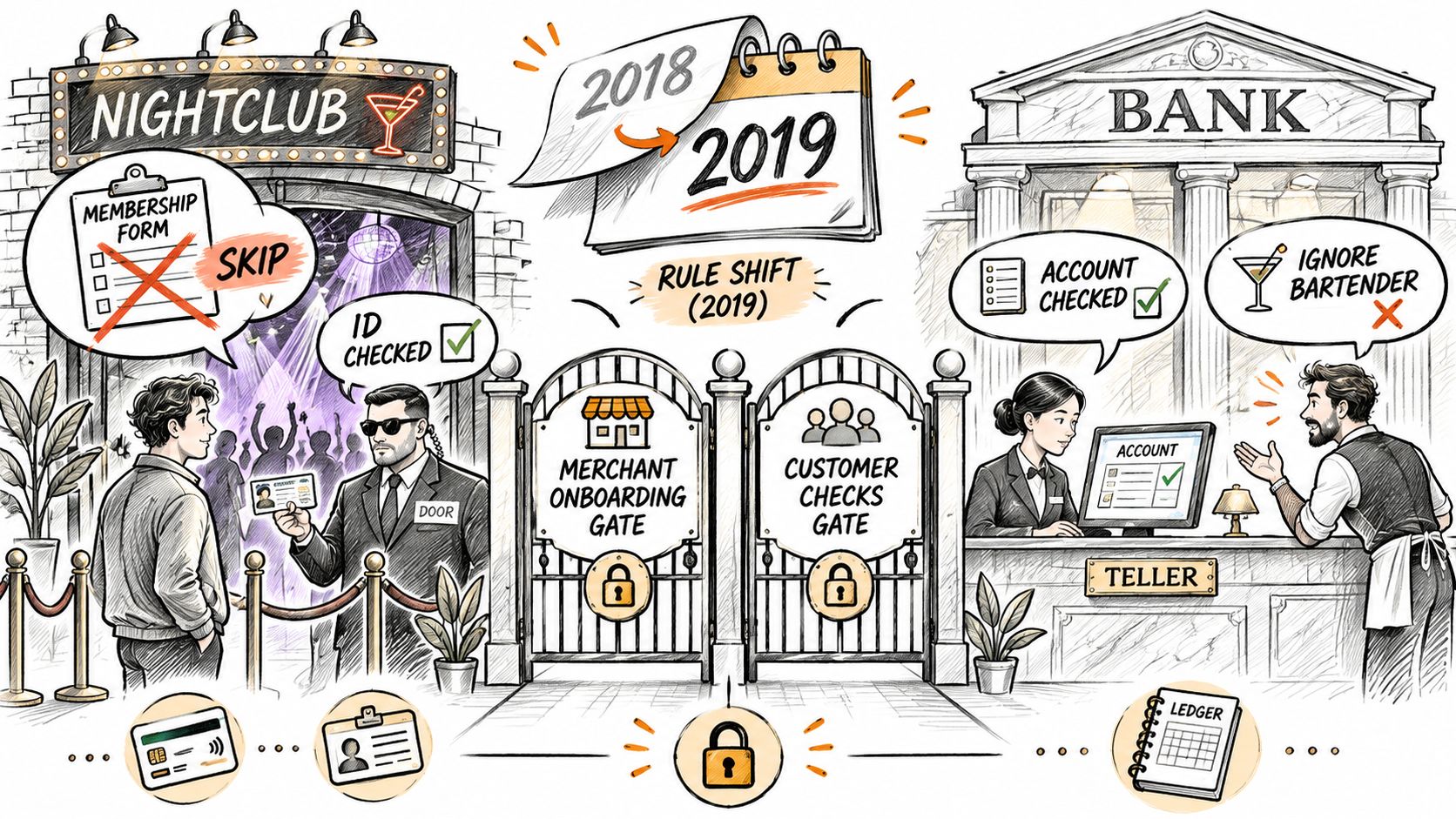
With us, merchants open an account using an email address and a payout wallet, with a business name if they wish. No KYB documents must be uploaded. Payment providers may nevertheless ask customers to verify their identity before paying.
That split isn't a legal exemption that travels unchanged across borders. In June 2019, FATF revised its standards to apply anti-money-laundering and counter-terrorist-financing requirements explicitly to virtual assets and virtual-asset service providers; its subsequent review recorded 32 jurisdictions with VASP AML/CFT requirements, including 15 with revised wire-transfer requirements and 17 without them, according to FATF's report to the G20.
The framework includes the Travel Rule, under which relevant providers obtain, retain and transmit originator and beneficiary information for qualifying transfers. These are international standards implemented through jurisdiction-specific rules, not a single worldwide checkout law.
Map the relationship, not just the brand
Grant Thornton's crypto-compliance analysis distinguishes obligations associated with activities such as payments, asset conversion, transfers and custody. For a merchant, the practical consequence is that the company displaying the checkout button might not perform every regulated activity behind it.
Assign responsibilities explicitly:
- Merchant: Supplies its payout configuration and maintains evidence connecting sales to receipts.
- Gateway: Connects the merchant's site to the payment flow and communicates payment states.
- Card or crypto provider: Applies the checks relevant to its customer relationship and processing activity.
- Acquiring bank: Applies its own acceptance and risk requirements where card acquiring is involved.
- Wallet service: May apply account and transfer controls if a hosted service participates.
- Blockchain: Records on-chain transactions. It doesn't itself approve a customer's identity.
Understanding what a payment facilitator does helps distinguish the merchant-facing interface from the institutions participating behind it.
The commercial risk is deferred friction. Registration can be easy while the first meaningful check appears during a buyer's payment, a provider review or a later banking inquiry. Identify who performs that check before promising customers a verification-free experience.
Screening, Settlement and Records Behind Each Checkout
A useful checkout review follows both the money and the decision trail. The workflow below is a control model to evaluate, not a claim that every gateway performs each function itself. For our payment flow, licensed third-party providers carry out customer identity checks, AML controls, sanctions screening and transaction settlement, not NexaPay.
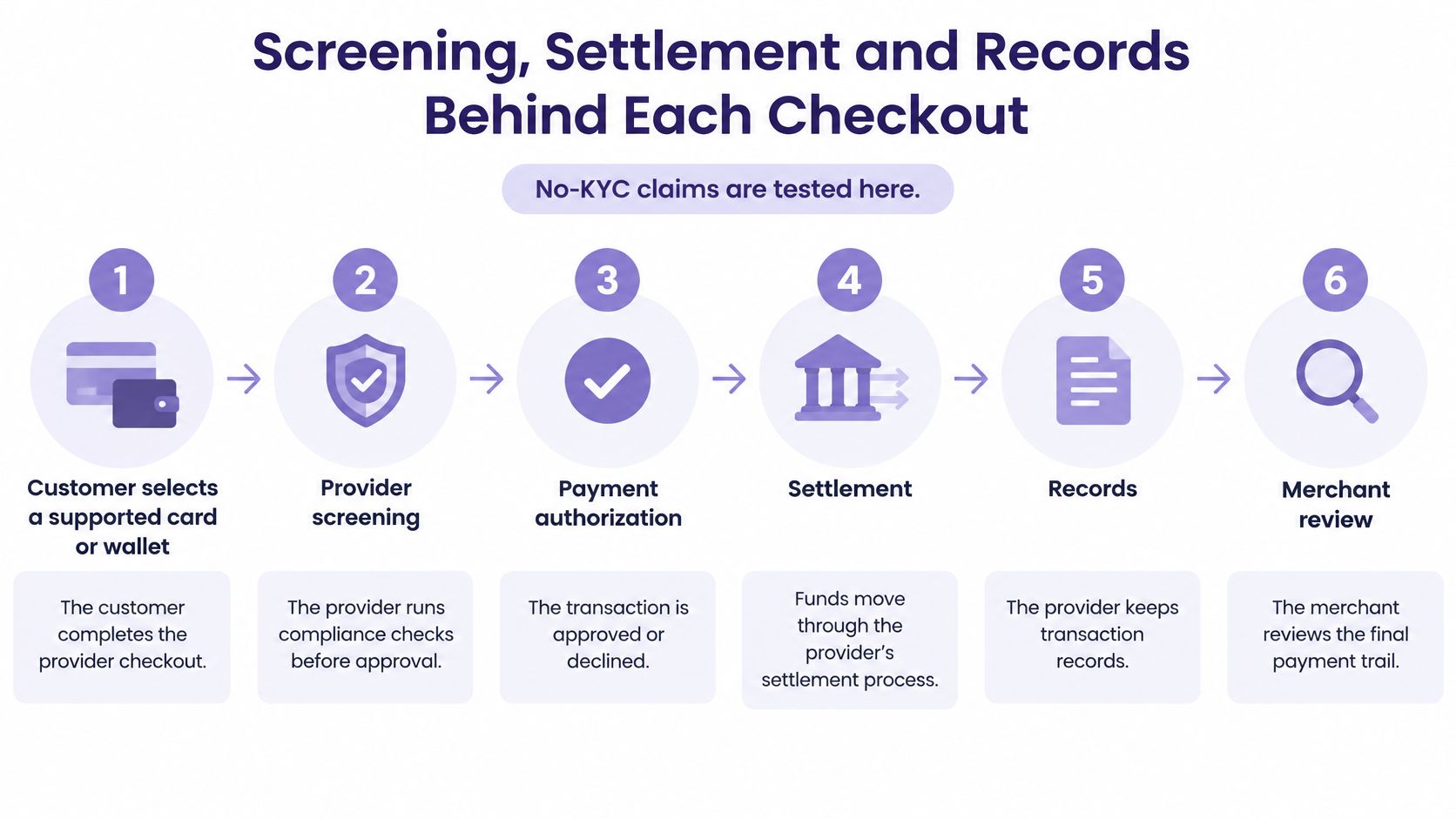
Follow the checkout through to release
The customer enters the provider checkout.
The buyer selects a supported card or wallet method and completes the provider's payment interface. Record which provider received the session, because its rules govern the customer's experience. A payment-method logo alone doesn't identify the institution making the approval decision.The provider evaluates identity and payment risk.
Verification can reflect amount, geography, payment instrument, risk score and chargeback exposure. FATF's updated guidance for virtual assets and VASPs specifies a EUR/USD 1,000 threshold above which customer due diligence is required for occasional transactions. That's a reference point within the FATF framework, not a guarantee that smaller payments avoid checks or that every jurisdiction applies an identical trigger.The payment record connects the checkout to its destination.
Bind the merchant order and provider reference to the payout wallet address, asset, network, timestamp and payment state. Preserve state changes rather than overwriting the history. Otherwise, a final success status can conceal an earlier hold, retry or destination change that matters during reconciliation.Screening occurs before settlement release.
The responsible provider should evaluate relevant sanctions and blockchain-address exposure, alongside amount and velocity controls. Velocity means transaction frequency over a defined period. Looking only at individual amounts can miss repeated activity that requires closer review.A recorded decision releases, holds or blocks the payment.
Route high risk to enhanced due diligence or manual review under the responsible provider's procedures. Record the reason and the party making the decision. The merchant needs a usable status without receiving sensitive identity documents unnecessarily.Settlement and reconciliation complete the trail.
Match the provider's settlement reference and any on-chain transaction reference to the order. Keep an auditable history of blocked and held payments as well as completed ones. A receipt proves less than a record explaining how the payment reached its final state.
For a fiat-to-crypto payment gateway, distinguish card-side approval from crypto-side completion. Don't fulfill an order merely because the buyer returned to a success page. Use the authoritative payment status specified by the integration and reconcile it with settlement evidence.
Compare the settlement destinations
Direct wallet settlement: The provider sends crypto to the configured external address. Review the asset, network, address exposure and confirmation requirements.
Bank payout: The payment passes into a banking relationship. Review intermediary checks and the documents needed to explain the commercial source of the funds.
Neither destination is an automatic compliance shortcut. FATF's Travel Rule supervision guidance addresses required information for covered transfers, including provider interactions involving unhosted wallets. An unhosted, or self-hosted, wallet doesn't remove the participating provider's responsibilities.
For wallet settlement, use a network allowlist, meaning an explicit list of permitted networks. Establish confirmation-depth rules appropriate to the asset and network, exposure thresholds for address review, and escalation procedures for sanctioned entities, mixers or high-risk services. Flag address reuse for investigation rather than treating it alone as proof of wrongdoing.
A blockchain transaction reference shows that assets moved. It doesn't, by itself, explain the commercial purpose or the provider's risk decision.
The operating principle is narrower than the marketing shorthand: no universal upfront identity check doesn't mean no monitoring, no records or no intervention.
Four Payment Scenarios and the Checks Each One Triggers
Buyer scenarios and the checks they trigger
| Scenario | Merchant onboarding | Customer checks | What to plan for |
|---|---|---|---|
| Low-value card purchase | No KYB upload under the stated merchant offer | Provider rules determine whether identity verification appears | Issuer declines and a clear retry or support route |
| Illustrative purchase above EUR/USD 1,000 | No KYB upload under the stated merchant offer | Plan for customer due diligence under applicable rules | Verification prompts and payment delay |
| Cross-border payment to a high-risk region | No KYB upload under the stated merchant offer | Enhanced checks may follow the provider's regional risk assessment | Holds, declines or manual review |
| Stablecoin transfer to an unhosted wallet | No KYB upload under the stated merchant offer | Required transfer information for covered transactions | Address screening and retained records |
These are planning scenarios, not approval predictions. The amount in the illustrative purchase isn't a universal boundary between anonymous and identified payments. Equally, a high-risk-region designation requires the provider's actual classification, not the merchant's assumption about a country.
Chainalysis estimated that illicit activity represented 0.14% of attributed cryptocurrency transaction volume in 2024, down from 0.61% in 2023, and reported stablecoins at 63% of illicit transaction volume. The stablecoin figure describes the composition of illicit flows, not the proportion of stablecoin payments that were illicit.
Translate market-wide findings into checkout planning
A low aggregate illicit share doesn't establish that an individual buyer or wallet is low risk. A merchant's exposure depends on the transactions it receives, including counterparties, regions and address history. Screening decisions therefore need transaction-level inputs rather than reassurance drawn from a market-wide percentage.
Stablecoins also have a legitimate payment role: BitPay's payment statistics state that stablecoins accounted for 40% of its total payment volume in 2025, up from 30% in 2024. Those figures describe BitPay's business, not the entire payments market, but they explain why dismissing stablecoin screening as relevant only to speculative trading would be a mistake.
Planning insight: The scenario requiring the most preparation is the one your customers will actually encounter, not necessarily the one with the largest purchase amount.
For a small digital-goods seller, issuer rejection may be the immediate support problem. For a cross-border seller, regional eligibility and review procedures may matter more. A wallet-settled business should prioritize destination configuration and the evidence available when an address is flagged.
Create a written risk file before launch. Record the scenario, provider, payment method, expected customer prompts, possible hold state, support owner and fulfillment rule. Where a trigger isn't disclosed, mark it as unconfirmed rather than assuming the check won't occur.
Red Flags in No-KYC Gateway Claims
A credible claim has boundaries. A provider doesn't need to publish every fraud-detection rule, but the merchant needs enough information to understand eligibility, customer friction and settlement responsibility.
Test the promise against an answerable question
A promise that nobody is checked anywhere.
This blurs merchant registration with buyer verification. Request the identity of the company handling the buyer's payment and the circumstances in which it can request documents. Our payment providers may ask customers to verify their identity before paying.Anonymity language without transfer-information procedures.
Privacy isn't the same as absence of required sender and recipient information. Establish who collects applicable Travel Rule information, how it reaches the responsible provider and what happens if it's missing.No explanation of screening responsibility.
A shield icon isn't an operating procedure. Request the responsible legal entity, the categories of screening performed and the escalation route. Tool names can help due diligence, but naming a blockchain-analytics vendor alone doesn't prove that controls are configured appropriately.Settlement to any wallet without qualification.
Silence about supported assets, networks and destination checks leaves basic execution questions unanswered. Obtain the permitted combinations and the procedure for changing a payout address. Don't interpret unrestricted wording as a promise that every destination will be accepted.No record-retention or retrieval policy.
Establish which company stores payment records, how long it keeps them and what the merchant can export. A dashboard screenshot isn't a substitute for a retrievable transaction history.A promise that payments cannot be declined.
Issuers and participating providers make their own decisions. Distinguish a merchant's chargeback arrangement from the buyer's ability to receive an approval. They're not equivalent promises.
The same caution applies to consumer searches such as buying Bitcoin without ID. A purchase interface and a merchant gateway create different relationships, so a statement about one shouldn't be transferred to the other.
The strongest answer isn't an unlimited promise. It's a written allocation of responsibility, with a clear procedure when a payment cannot proceed.
Treat unanswered operational questions as launch issues, not details to resolve after customers start paying.
Confirm the Checks Before You Accept Payments
Turn the provider's answers into a launch record that your developer, support team and finance owner can use. The record should describe the checkout customers will encounter, not just repeat the language on the sales page.
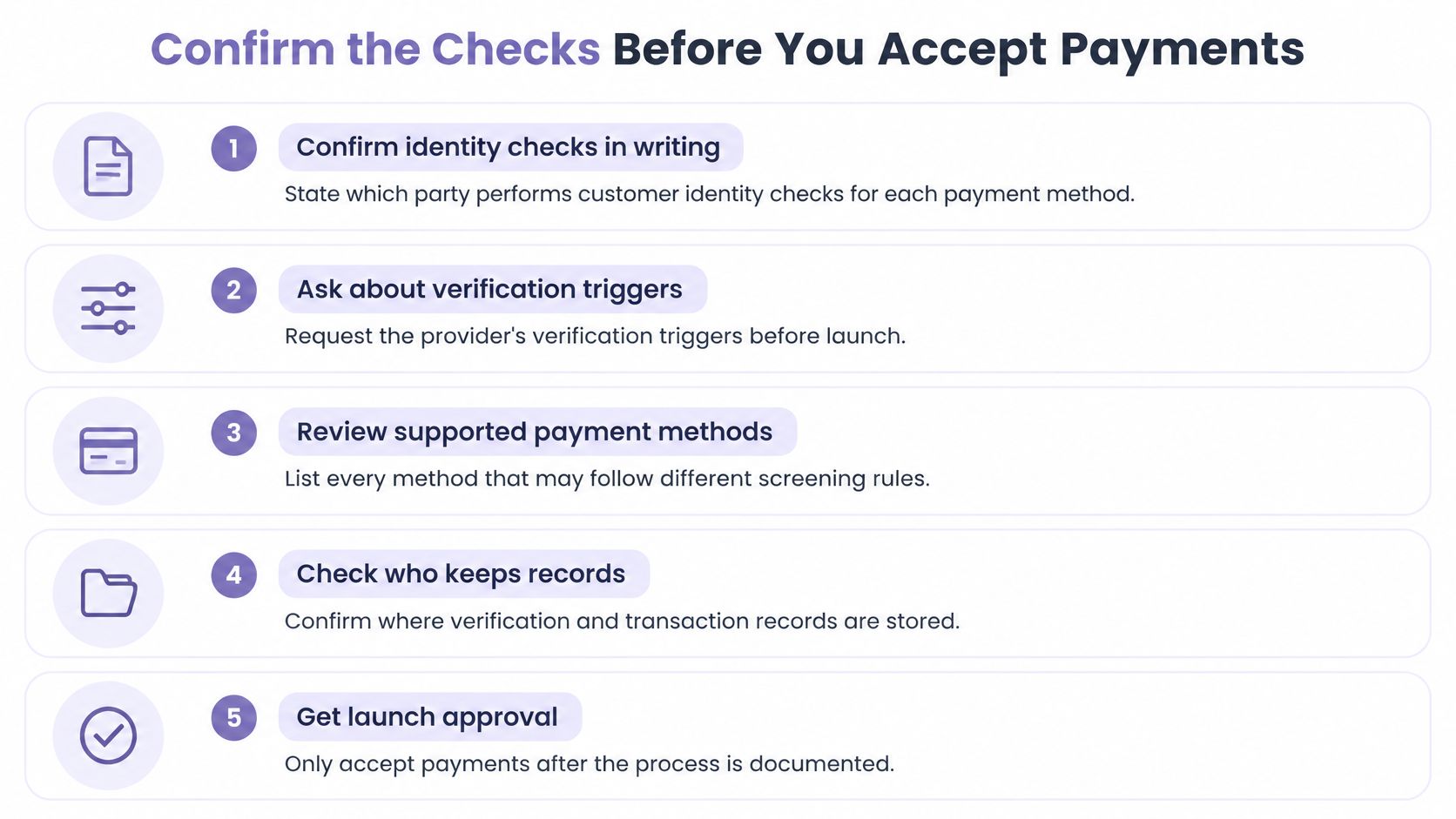
Build a usable launch checklist
Name the identity-checking party for each method.
For our flow, licensed third-party providers handle customer verification. Record the provider associated with each enabled checkout method so support knows where verification questions belong.Document the disclosed verification triggers.
Capture amount, region and payment-instrument conditions where available. Separate confirmed requirements from risk-based checks whose precise triggers aren't published. Don't advertise an identity-free customer journey unless the applicable terms support that statement.Validate wallet and network settings.
Confirm the destination address, supported asset and network. Identify who performs sanctions and address screening, and which payment state permits fulfillment.Resolve transfer-information handling.
Establish how required information is collected for covered transfers involving unhosted wallets. Include the response to missing or inconsistent information.Confirm record ownership and access.
Document retention periods, export options and the relationship between order IDs, provider references and settlement records. Keep identity-document handling with the responsible provider rather than creating unnecessary merchant copies.Test the customer journey.
Run a small transaction through each intended payment-method and regional route where permitted. Log prompts, redirects, status messages and settlement evidence. A successful test confirms that route worked under those conditions, not that future payments can't trigger review.
NexaPay Instant is a fiat-to-crypto product with no merchant KYC required to start. Customers use third-party provider checkouts, providers may require customer verification, and cryptocurrency settlement goes to the merchant's configured wallet.
Before choosing a crypto payment gateway without KYC, answer a specific question: which checks does it remove, and which does it assign to another party? The no-merchant-KYC claim covers merchant onboarding, not a blanket exemption from provider, bank or blockchain-related controls.
NexaPay offers fiat-to-crypto payment infrastructure that connects provider-hosted customer payments with settlement to your merchant wallet, without merchant KYC required to start. Visit NexaPay to review the payment flow and assess the provider responsibilities, customer-verification conditions and wallet configuration before accepting payments.