Custodial vs. Non-Custodial Wallets: Who Holds the Keys
Compare custodial vs. non-custodial wallets on control of funds, security duties, recovery options and which model fits your crypto use case.
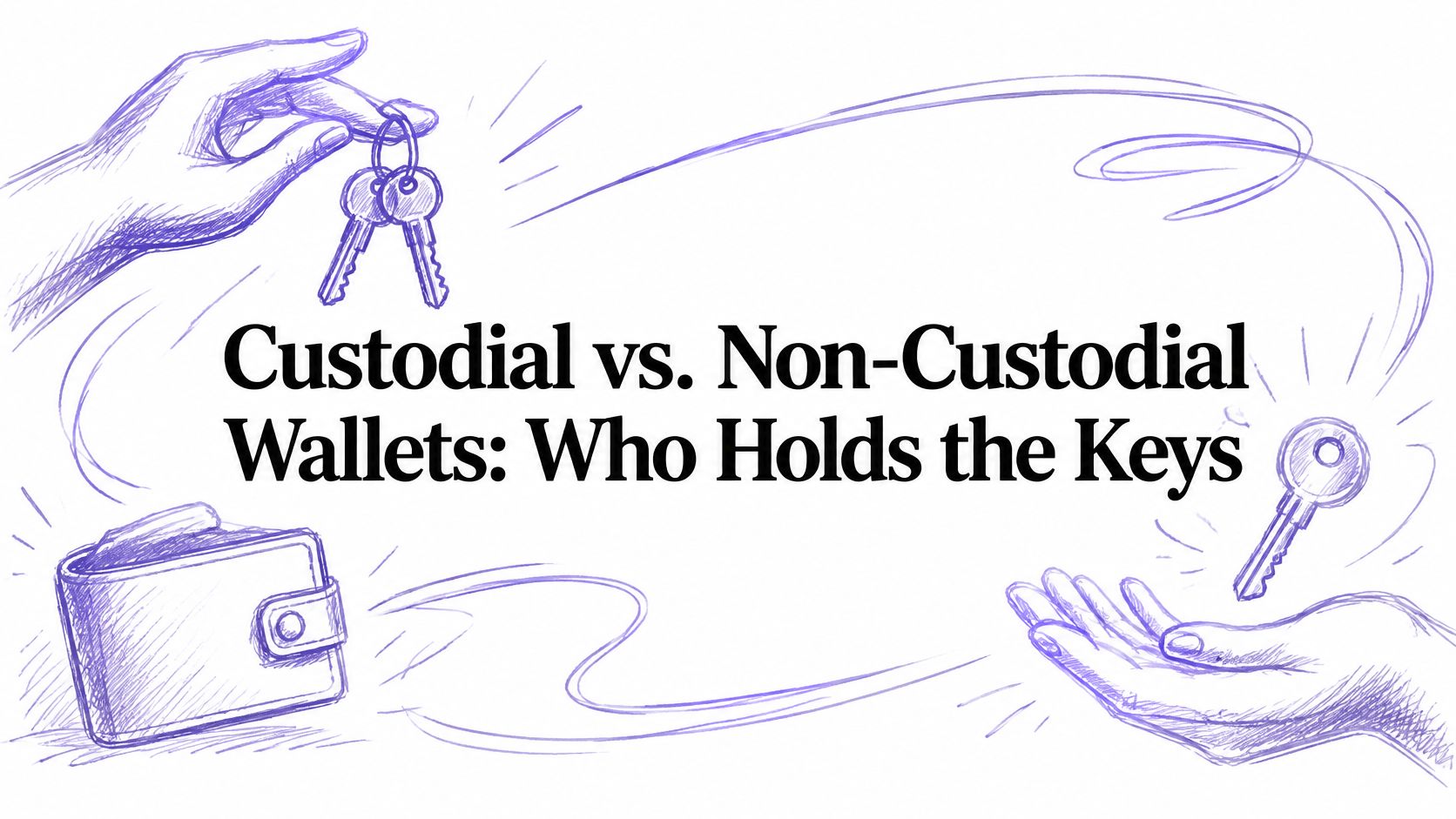
A custodial wallet is run by a provider that holds the private keys, while a non-custodial wallet keeps the keys, and therefore the signing power, with you. Neither model is universally safer: the meaningful difference is where a failure happens and who can help you recover.
A wallet can protect you from an exchange failure while leaving you exposed to a stolen recovery phrase. An account provider can restore a forgotten password without being able to return assets it no longer holds. Comparing custodial vs. non-custodial wallets therefore means asking a more useful question than which is safest: which failures can you prevent, and which recovery process can you rely on?
Custodial vs Non-Custodial at a Glance
The simplest distinction is operational: a custodial provider signs for you, while a non-custodial wallet lets you authorize transactions using credentials you control. The academic analysis of wallet custody models describes this separation between submitting instructions to an intermediary and directly authorizing a blockchain transaction.
Custodial vs non-custodial wallets on key criteria
| Criterion | Custodial wallet | Non-custodial wallet |
|---|---|---|
| Who holds the private key | Provider | You |
| Who signs transactions | Provider, on your instruction | You |
| Access restored by password reset | Usually yes, after account checks | Usually no; seed phrase or another configured recovery method required |
| Access if the provider freezes or fails | Withdrawals can be blocked | Signing authority remains yours, provided you retain working credentials and network access |
| Main security exposure | Provider compromise, insolvency, withdrawal restrictions | Phishing, malware, lost or stolen seed phrase |
| Typical examples | Exchange accounts, hosted payment balances | Self-custodial software wallets, hardware wallets |
| Reversing a mistaken transfer | Sometimes possible for internal movements; completed blockchain transfers generally aren't reversible by the provider | Generally not possible without the recipient's cooperation |
The table isn't a ranking. Each row identifies where responsibility moves. A password reset is useful because someone maintains an account-recovery process, but that same organization also controls whether it executes your withdrawal.
Read the table against your next transaction
Don't classify a wallet by its appearance. A mobile app can display either a provider-hosted balance or assets controlled by keys on your device. A hardware wallet is a signing tool, not a guarantee that every transaction you approve is harmless.
Recovery also needs careful interpretation. Restoring account access isn't the same as recovering missing assets, and restoring a wallet from a backup isn't the same as reversing a transfer. Those are separate operations with different technical limits.
Practical rule: Choose the responsibility you can manage, not the label that sounds more secure.
Pick the column that matches your next transaction rather than your general opinion about cryptocurrency. For holdings you intend to leave untouched, recovery deserves particular attention. For frequent trading, access and withdrawal procedures may matter more immediately, but convenience shouldn't conceal who ultimately controls the funds.
Who Holds the Keys and Who Can Move Funds
On February 7, 2014, Tokyo-based Mt. Gox halted Bitcoin withdrawals; later that month it filed for bankruptcy after reporting approximately 850,000 bitcoins belonging to customers and the exchange missing, according to the Learnsignal Mt. Gox case study.
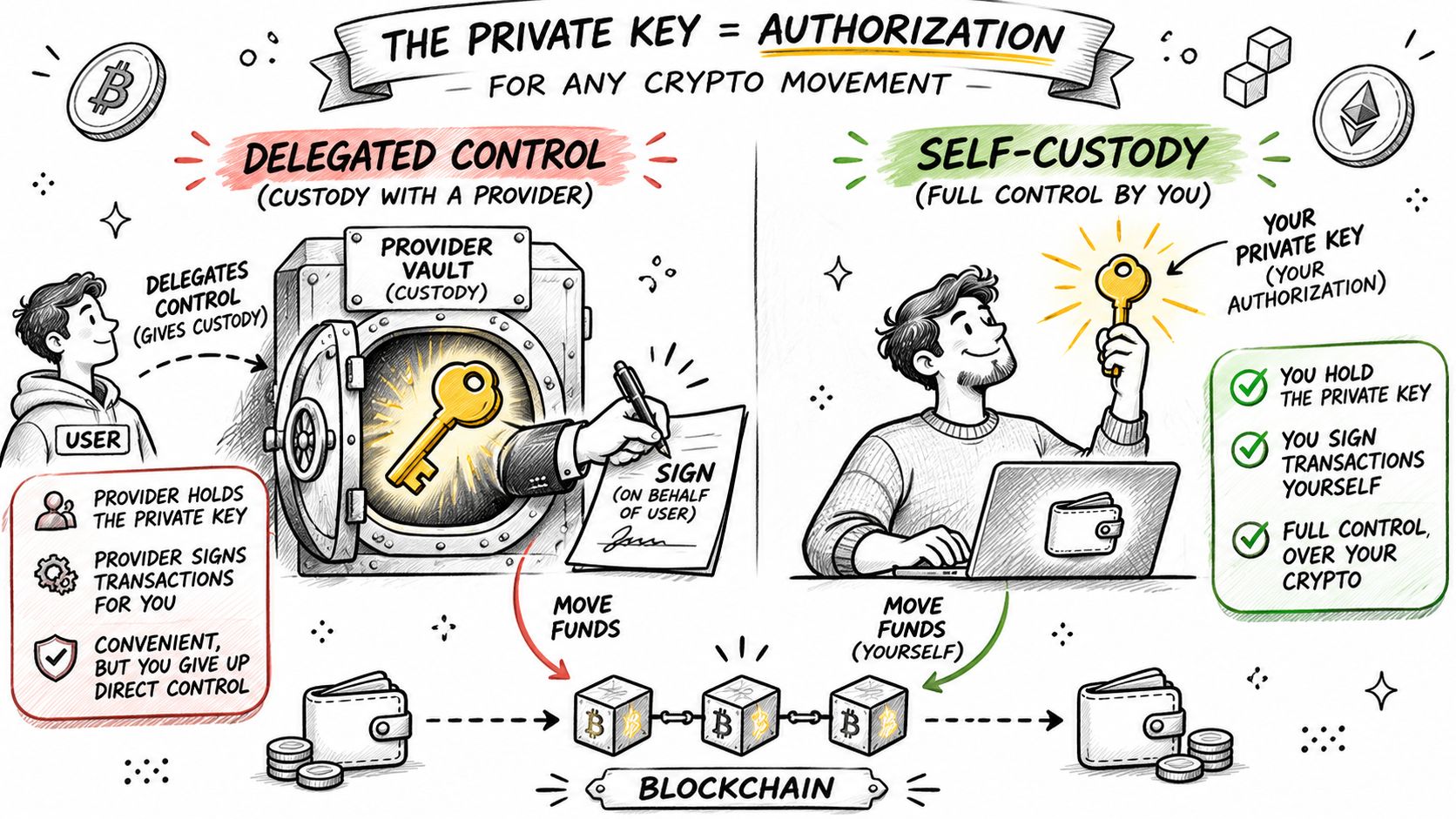
The customer-facing problem was straightforward. An account could show a balance without giving its owner a way to move the corresponding bitcoin. Customers had access to an interface, but the exchange controlled the mechanism required to release their assets.
A balance isn't signing authority
A private key provides the cryptographic authority to sign a transaction. In a custodial account, you typically authenticate yourself to the provider and submit a withdrawal request. The provider then applies its controls and uses its signing infrastructure to authorize the blockchain movement.
Until that withdrawal happens, your displayed balance is generally an internal claim against the provider. Knowing the deposit address or seeing assets on a block explorer doesn't give you the credentials needed to spend them.
Say you buy cryptocurrency through an exchange and leave it in your account. You can request a transfer, but you can't independently produce the required signature. If the exchange stops processing withdrawals, your password won't bypass that restriction.
With a self-custodial wallet, you hold the key or recovery credentials and authorize the transfer yourself. You don't need a key-holding custodian's approval, although network conditions, transaction fees, and asset-specific restrictions can still affect execution. Self-custody removes one permission gate, not every possible obstacle.
Follow the asset, not the interface
Fast settlement doesn't change custody. A provider-hosted balance remains custodial even when the underlying blockchain is transparent and transactions settle promptly. Conversely, receiving assets through a payment service doesn't make the destination custodial if only you control its signing credentials.
This distinction matters when several businesses participate in a purchase. The checkout company, payment provider, wallet software developer, and asset custodian aren't necessarily the same organization. A service can help arrange a purchase without retaining the delivered assets.
If you can't authorize a transfer without the provider's permission, you don't have independent signing control.
Apply that test to every account or wallet you currently use. Identify who holds the credentials, whether you can move the assets independently, and what happens if the company disappears. Don't accept an account password, a visible address, or a non-custodial marketing label as a substitute for that answer.
Security Risks Each Model Carries
Chainalysis's mid-year cryptocurrency crime update attributed 43.8% of stolen cryptocurrency to private-key compromises and documented two single-incident losses far larger than typical retail theft: approximately $305 million taken from Japan's DMM Bitcoin in May and $234.9 million from India's WazirX in July.
Those incidents show what concentrated custody does to the scale of a failure. One compromised signing system can expose thousands of customers at once. Self-custody compresses the blast radius to a single wallet, yet it also removes every institutional safeguard: an unsafe backup or a malicious approval can drain the same wallet just as completely. The model doesn't determine whether you face risk. It determines where the failure sits and who bears it.
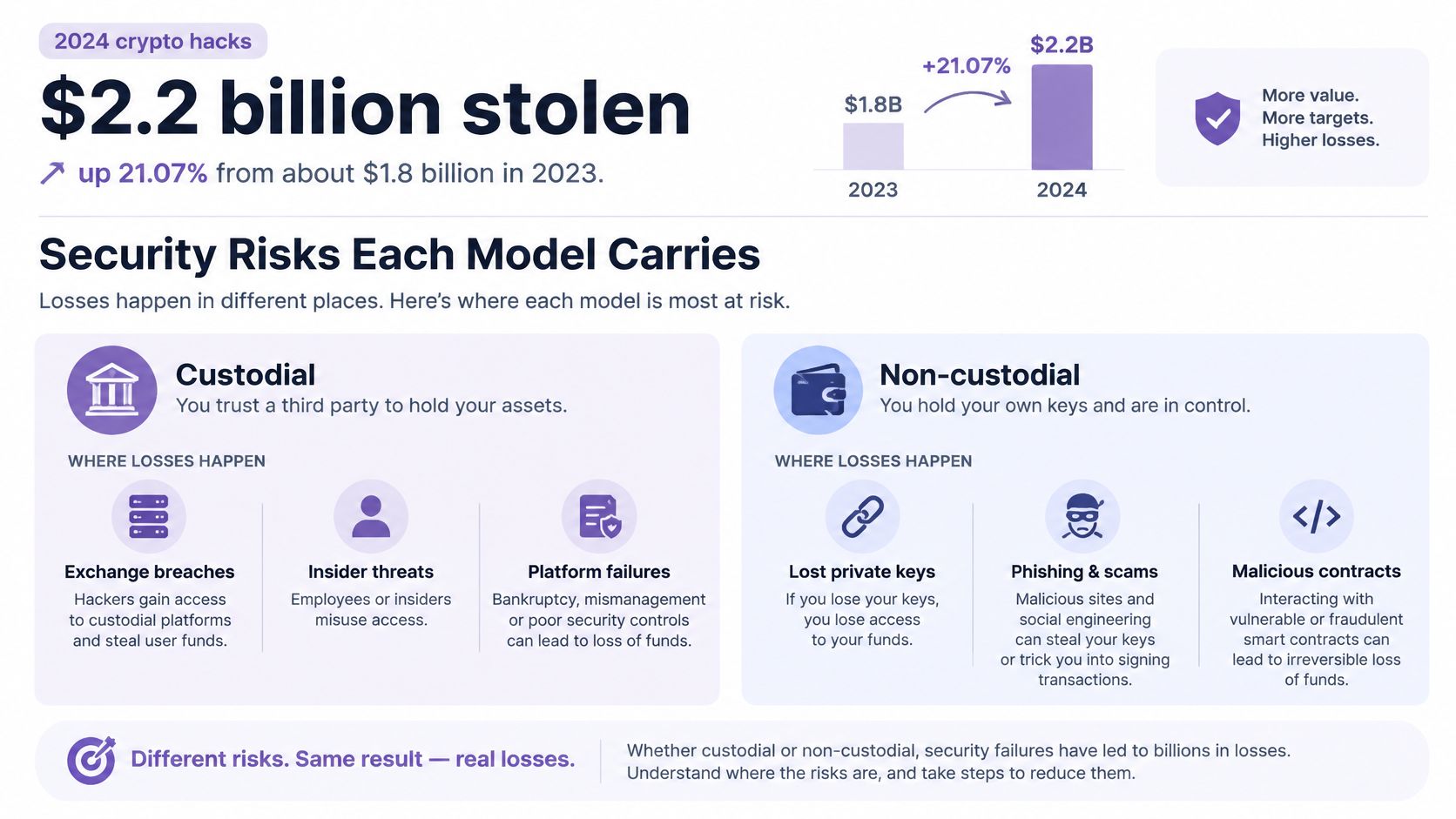
Failure modes by model and who bears the loss
| Failure mode | Most exposed model | Who absorbs the loss | Reversible? |
|---|---|---|---|
| Platform hack or hot-wallet theft | Custodial | Provider and potentially customers, according to available assets and reimbursement arrangements | Blockchain theft usually isn't reversible; reimbursement may be possible |
| Insolvency or withdrawal freeze | Custodial | Customer may become a creditor or lose access temporarily | Recovery follows provider or insolvency procedures; full recovery isn't assured |
| Private key or seed phrase theft | Non-custodial | Wallet owner | Usually no once assets are transferred |
| Phishing or malicious token approval | Mostly non-custodial for malicious on-chain approvals; account phishing affects both | Affected user, unless another party reimburses them | Usually no for completed transfers |
| Wrong address or wrong network | Both | Sender | Usually no; some cases allow recipient or technical assistance |
| Device malware | Non-custodial for direct key exposure; both for credential theft | Wallet owner or account holder | Usually no after an unauthorized transfer |
Read the third column before the first. Almost every row ends with the same two candidates absorbing the loss: a provider with lawyers and insurers, or you alone.
Match controls to the failure
Cold storage claims don't settle the custodial question. ACM-published exchange-security research identifies attack categories including private-key compromise, server compromise, insider exploitation, data leaks, and phishing. That range explains why one reassuring feature says little about the resilience of the whole service.
For custodians, evaluate segregation of duties, withdrawal controls, multiparty authorization, cold-storage policies, incident recovery, and reserve-governance disclosures. Proof of reserves can inform an assessment, but it answers nothing about liabilities, access controls, or who approved the last large withdrawal.
For self-custody, use hardware-backed signing, transaction simulation where supported, and encrypted backups. Read the permissions a transaction requests, not just the amount shown in the interface. A hardware device protects a key from extraction while still signing a harmful instruction you approved.
Identity requirements are a separate decision. If you're considering buying Bitcoin without ID, don't treat reduced onboarding friction as evidence about key protection or recovery.
Write down your most likely failure modes, then assign a control to each. If your concern is malicious approvals, improve signing discipline. If it's provider failure, another password factor does nothing for that counterparty exposure.
Recovery Options When Access Is Lost
A 2025 academic study of 331 participants found that 61 people, about 18%, had lost their keys, and 17 couldn't recover them and therefore lost their funds; storing complete keys with family or friends also received especially poor usability and security ratings.
The useful lesson isn't that everyone should avoid self-custody. It's that recovery design belongs inside the security decision, rather than being postponed until a device breaks or credentials disappear.
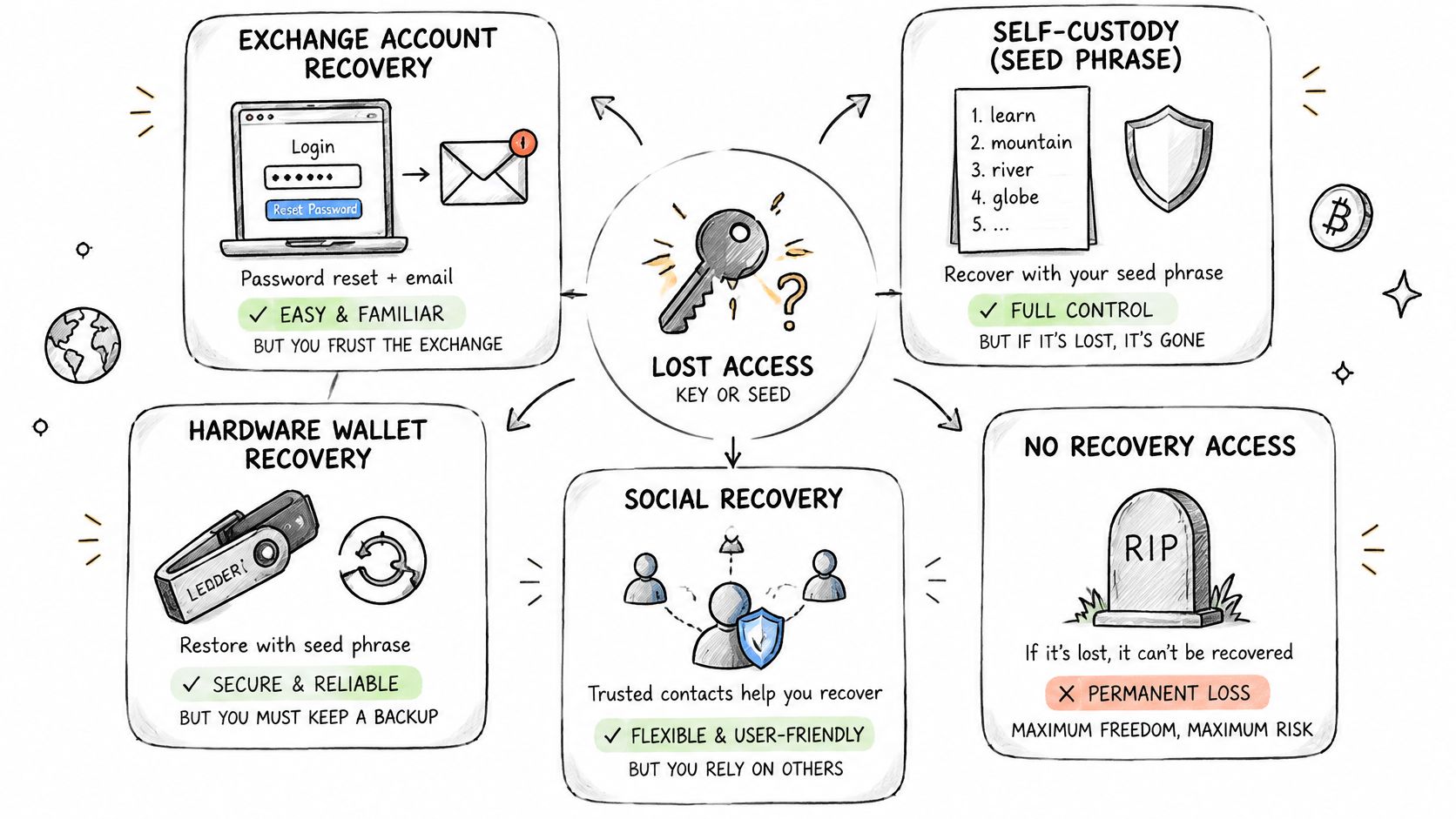
Recovery designs compared
| Recovery design | How access returns | Who can help | Main risk |
|---|---|---|---|
| Exchange account recovery | Password reset with email and identity checks under provider procedures | Provider support | Provider controls the assets and recovery approval |
| Seed-phrase backup | Restore from written recovery words | You, or someone entrusted with the backup | Loss can prevent restoration; theft can enable unauthorized access |
| Multisignature | Enough approved keys remain available to meet the signing threshold | Other keyholders | Access fails when too few required keys remain available |
| Social recovery | Trusted guardians approve restoration under the wallet's rules | Chosen guardians | Collusion, compromise, or guardian absence |
| Professional recovery service | Specialist attempts retrieval from available devices, files, or partial credentials | Third-party firm | Fraud, exposure of sensitive material, and no guarantee of success |
Recovery creates another access path
Exchange account recovery delegates identity assessment to an organization. That's useful when you've forgotten a password, but the procedure itself needs protection against impersonation and compromised email accounts. A recovery process that admits the rightful customer must also reject an attacker pretending to be that customer.
A seed backup takes the organization out of that decision. Anyone with the necessary recovery words may be able to restore the wallet, so a readable backup protects availability while also becoming a theft target. Giving someone a complete copy isn't merely asking them to remember where you stored it.
Multisignature and social recovery offer a middle ground, but they aren't interchangeable. Multisignature requires a configured threshold of signing keys; social recovery uses a wallet-specific restoration mechanism. Neither works just because you've named trusted people informally.
A recovery plan is only useful if the required people, credentials, and instructions remain available when you're unable to use the original device.
Separate restoration from reversal
Professional assistance can sometimes help retrieve credentials from a damaged device, accessible backup, or partially remembered material. It can't reliably recreate a properly generated private key from a public wallet address. Don't disclose a seed phrase to someone whose only qualification is a promise to recover stolen cryptocurrency.
Also distinguish a lost device from a compromised one. Restoring access solves availability; it doesn't necessarily remove an attacker's existing access. A compromise response may require moving remaining assets to a newly secured wallet rather than continuing to use restored credentials.
Before choosing a design, answer this precisely: who could help if your seed is lost or your device is compromised, and what could they technically do without taking control of your assets? If the answer is unclear, the recovery arrangement isn't ready.
Matching the Model to Your Situation
The right model follows your activity, not your identity as a beginner or experienced user. Someone can manage a long-term hardware wallet competently while finding frequent smart-contract approvals too demanding. Another person may prefer account support but be unable to tolerate a provider's withdrawal restrictions.
Coverage of a 2026 survey of U.S. crypto users reported that 66% considered self-custody important, while 33% used a cold wallet and 88% kept assets on centralized exchanges, according to the DEV Community discussion of self-custody adoption. These reported results don't establish which model is safer or prove how each respondent allocated funds, but they're consistent with users retaining centralized services alongside an interest in self-custody.
Which model fits each situation
| Situation | Usually better fit | Why | Trade-off to accept |
|---|---|---|---|
| Active trader making frequent trades | Custodial exchange account | Internal trading and simpler account recovery | Counterparty, freeze, and insolvency exposure |
| Long-term holder of significant savings | Non-custodial hardware wallet, with a workable recovery plan | Key isolation from platform failures | Strict backup and recovery discipline |
| Card buyer receiving crypto for the first time | Non-custodial wallet you control, once recovery is configured | You control the delivered asset | Delivery mistakes may be irreversible |
| Small merchant receiving card payments in crypto | Non-custodial settlement to your own wallet | Payouts reach a wallet under your control | Address management and key custody become operational duties |
| Holder splitting funds for liquidity and security | Hybrid, custodial for activity and self-custody for longer-term holdings | Separates convenient access from platform-independent storage | Separate procedures to maintain |
Merchant settlement changes the operating job
At NexaPay, payouts go to the self-custodial wallet address you enter in your account, and only you control that wallet. Every completed order is paid out instantly in USDC or another supported cryptocurrency directly to the merchant's own self-custodial wallet.
That arrangement makes wallet administration part of running the business. Decide who can change the receiving address, who can authorize outgoing transfers, and how the business continues if its usual operator is unavailable. For a team, exclusive personal control without a continuity plan can create an operational bottleneck.
Choose against your actual constraints
Weight transaction size, frequency, technical skill, geographic exposure, recovery needs, and counterparty risk. A large balance with infrequent movement calls for different procedures from working funds used throughout the day. A hybrid arrangement only helps if you maintain both sides properly.
For a card purchase, separate payment-credential protection from wallet recovery. Secure card processing doesn't give the processor the signing credentials needed to recover assets from your destination wallet. When preparing to buy Ethereum, decide where the delivered asset belongs before choosing the checkout route.
Which row describes your situation, and what does it require you to change before the next transfer? Treat the answer as an operating decision, not a permanent declaration of loyalty to either custody model.
Confirm Your Custody Plan Before Sending Funds
A custody plan should explain what you hold, how you move it, and how you regain access after a failure. It should also distinguish wallet problems from payment problems so you don't waste time contacting a company that lacks the authority to help.
Use the checklist below before funding a new wallet or account. Write the answers somewhere you can consult without exposing private keys or recovery words.
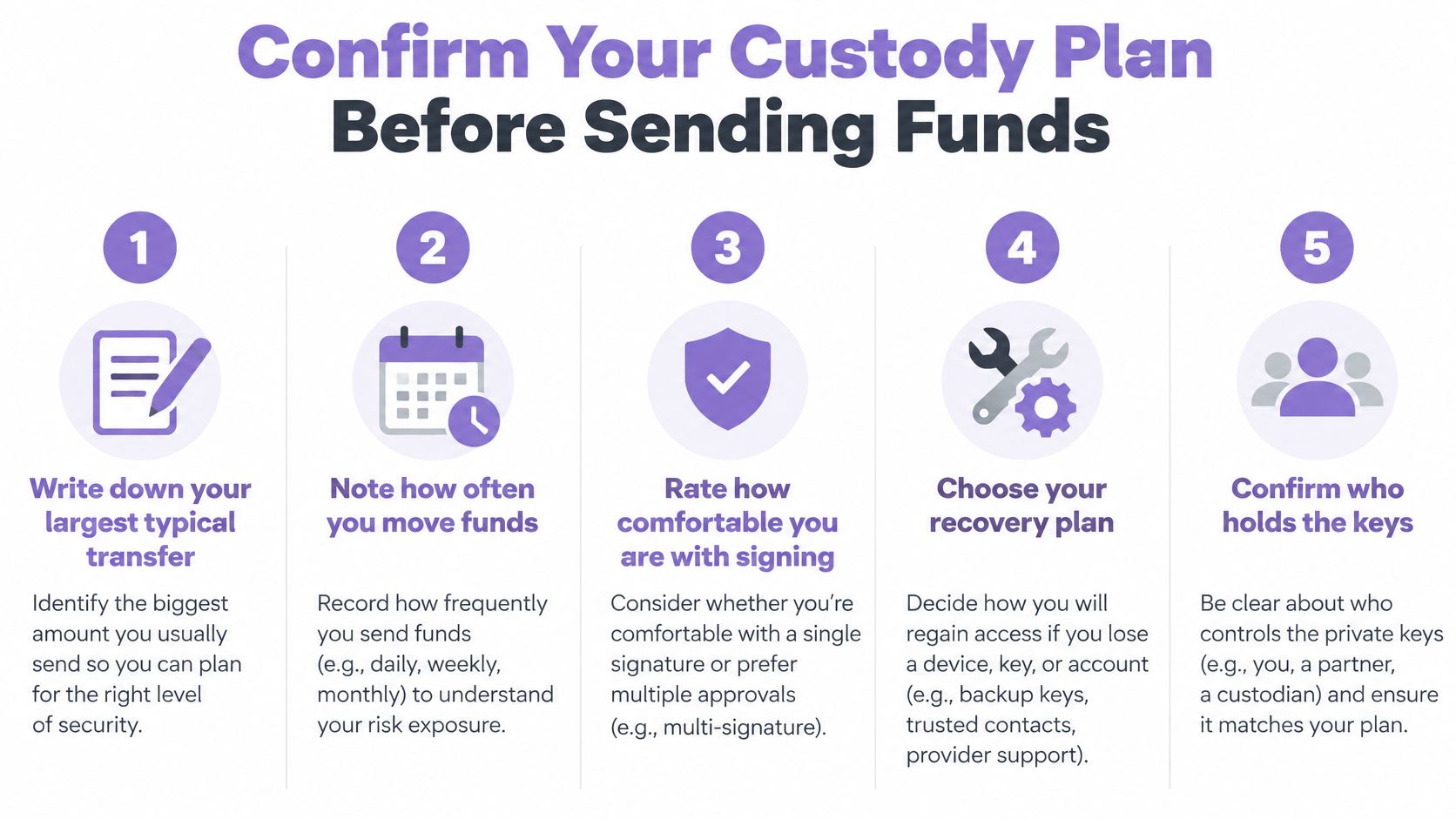
Describe your transaction pattern. Write down your largest typical transfer, how often you move funds, and how comfortable you are interpreting signing requests. This identifies whether your main challenge is protecting a stored balance or repeatedly authorizing transactions correctly.
Allocate assets deliberately. Decide which funds remain custodial for liquidity and which belong in self-custody. Assign each balance a purpose so that convenience doesn't turn a temporary exchange deposit into an unintended long-term holding.
Prepare recovery before depositing. Keep seed backups offline and protected from unauthorized access, test restoration through a trusted wallet workflow, and document what you'll do after device loss or compromise. Never type recovery words into a website merely to test whether the backup works.
Verify the delivery details. Confirm that the asset and network match the receiving wallet, check the full address on your own trusted device, and use the hardware wallet's display when available. Send a small test amount and confirm receipt before moving the intended balance; a successful test doesn't replace checking the final transfer.
Keep the correct support route. Save the payment receipt and identify the licensed provider that processed it. Questions about a specific payment, including disputes, chargebacks, or verification, must go to that provider, not to someone offering wallet recovery.
Make the decision after the checks
If you're still comparing purchase routes, use our guide to buying cryptocurrency alongside your written custody plan. The purchasing method should fit the destination and recovery arrangement you've chosen, rather than deciding them by default.
Repeat the checklist when your holdings, transaction patterns, devices, or business responsibilities change. A setup that works for an occasional personal purchase may be unsuitable for merchant receipts or shared treasury operations.
Don't send funds to a new destination until you can complete steps one through five. The best custody choice is the one whose normal operation and failure response you can both carry out.
NexaPay connects conventional payments with cryptocurrency settlement directly to a merchant's own self-custodial wallet. Visit NexaPay to explore the payment options, and configure your receiving wallet and recovery plan before accepting your first payout.