SaaS Payment Solutions Compared: 10 Platforms for 2026
Compare 10 SaaS payment solutions across billing, processing and settlement, with fees, merchant-of-record models and selection criteria for 2026.
Your customer's subscription is active, but their renewal payment failed. Finance is checking whether you collected tax correctly in a new country, while engineering is trying to reconcile a successful checkout with a missing payout. You don't necessarily need a new payment provider. You need to identify which part of the stack isn't doing its job.
SaaS payment solutions involve four separate decisions: billing logic, payment acceptance, merchant-of-record tax handling, and settlement. Billing software decides what a customer owes. A processor collects the payment. A merchant of record takes responsibility for the sale and associated tax obligations within its service scope. Settlement determines where the proceeds arrive, whether that's a bank account or a cryptocurrency wallet.
The distinction matters because a successful checkout doesn't guarantee a successful subscription business. Industry estimates summarized by Orb's SaaS billing statistics suggest that 5–10% of recurring card charges fail on the first attempt. Replacing your checkout won't necessarily fix expired credentials, poorly timed retries, or billing-state errors.
Before comparing vendors, name the missing job:
- Billing logic: Plans, usage, invoices, prorations, and renewals.
- Payment acceptance: Cards, wallets, bank payments, and authorization.
- Merchant-of-record handling: Responsibility for covered sales, tax collection, and remittance.
- Settlement: Moving proceeds to the account or wallet your business needs.
These platforms overlap, but they aren't interchangeable.
1. NexaPay
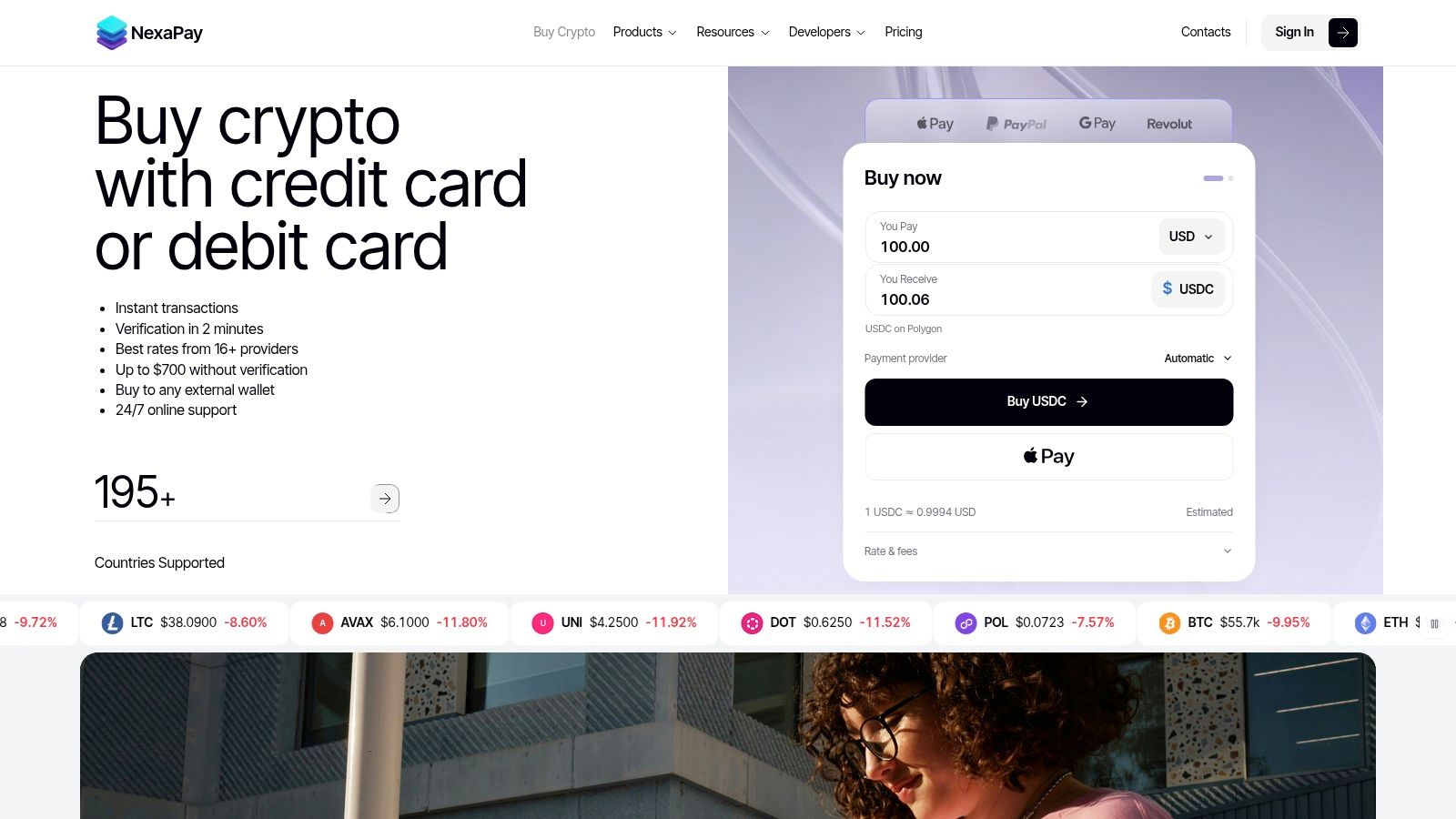
Best fit: conventional payment methods connected to cryptocurrency settlement. We connect merchants' websites with independent, licensed payment and cryptocurrency providers. Customers complete payment on the provider's checkout, while merchants follow the payment from one workspace.
Our Instant product serves businesses accepting payments for themselves. White Label serves platforms, SaaS businesses, marketplaces, and partners building a payment business for their own merchant network, under their own brand and commission rates. Those are different operating models, so choose based on whose transactions you're accepting.
Where the settlement model matters
A merchant can create a payment link or integrate through our API. The integration connects an account and wallet address to a payment session, redirects the customer to hosted checkout, and uses webhook events to report completion or expiration.
- Starter scope: Includes 4 provider integrations, live-mode access, basic analytics, and up to $10,000/month in processing.
- Professional scope: Includes 15 available providers, 2 coming soon, up to $75,000/month in processing, advanced analytics, and webhook notifications.
- Separate roadmap: Flow's native checkout, smart routing, and automatic provider fallbacks are forthcoming, not capabilities to assume are available in Instant.
The trade-off is architectural: direct wallet settlement doesn't, by itself, establish responsibility for subscription calculations or international tax. Map those responsibilities separately rather than treating a payment-completed event as a complete billing system.
We sell software, not payment or money-transfer services. Licensed third-party providers handle payments and customer verification in secure checkout, and we never store card details. Merchants need an account to accept payments, even though the basic consumer cryptocurrency-purchasing flow doesn't require one.
2. Stripe Billing
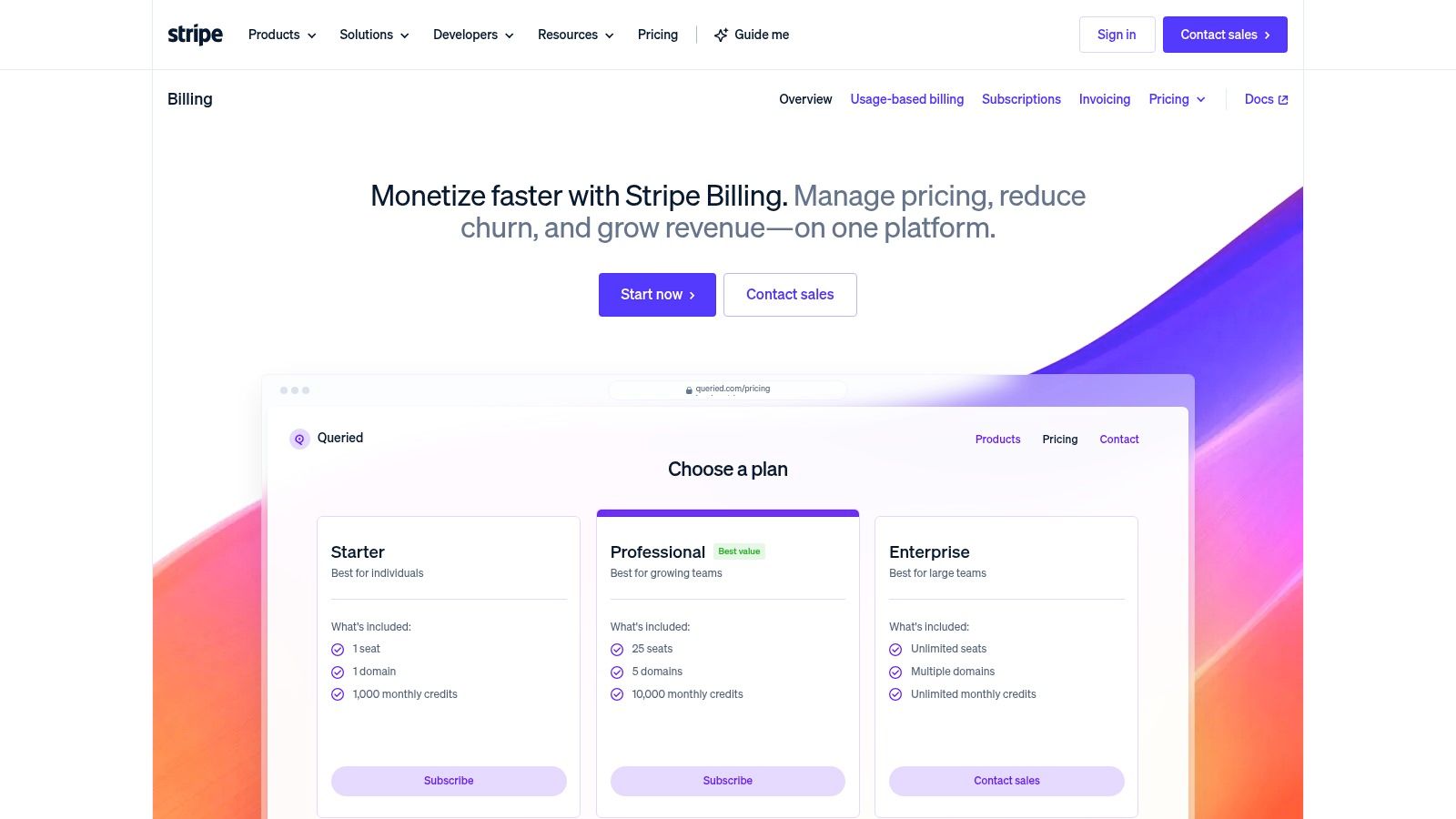
If your application already uses Stripe for payments, Stripe Billing is a natural billing-layer candidate. It supports subscriptions, invoices, trials, usage-based charges, and a hosted customer portal, with Dashboard tools for standard workflows and APIs for custom implementations.
The advantage is fewer integration boundaries between the invoice and the payment attempt. Your developers can keep subscription changes, payment status, and customer self-service within a connected ecosystem rather than synchronizing unrelated systems.
Separate billing from legal responsibility
Standard payment processing doesn't make Stripe the merchant of record. Its separate Managed Payments offering can assume merchant-of-record responsibilities for eligible transactions, but that's a different service decision from enabling subscriptions.
Understanding what a payment facilitator does also helps prevent a common procurement mistake: assuming that simplified payment onboarding transfers every tax and seller obligation.
- Works well for: Developer-led SaaS teams that want payment acceptance and configurable billing together.
- Needs careful costing: Billing, processing, tax, and optional managed services can create separate charges.
- Test before committing: Mid-cycle upgrades, failed renewals, cancellation timing, and whether your application updates access correctly after asynchronous events.
I'd shortlist Stripe Billing when integration flexibility matters more than outsourcing the entire commercial relationship. Don't choose it solely because the initial checkout is easy.
3. Paddle

Paddle belongs on the merchant-of-record shortlist, not merely the payment-processor shortlist. It combines checkout, subscription billing, payment processing, tax handling, fraud management, disputes, and buyer support for eligible software and digital-product businesses.
That bundle changes the comparison. A processor-only quote may look cheaper, but it doesn't represent the same set of responsibilities. Compare Paddle against the processor, billing software, tax operations, and support work you'd otherwise maintain.
Compare the work you retain, not just the transaction fee you pay.
For a self-serve SaaS selling internationally, the practical attraction is assigning several commerce responsibilities to one provider. Localized checkout and customer billing tools can also reduce the number of separate interfaces your team maintains.
The control trade-off
You give up some direct control over the payment relationship in exchange for managed responsibilities. Before migrating, review how buyers see the seller, where billing questions go, and how refunds and disputes affect your reporting.
Paddle is less compelling when your only missing component is card acceptance. It's more relevant when your team wants to avoid building a separate operating process for international software sales.
Test entitlement changes independently of checkout. A refunded purchase, canceled renewal, and expired payment attempt shouldn't all produce the same access outcome inside your application.
4. FastSpring

Start with FastSpring when you need managed software commerce rather than a gateway added to an existing stack. Its merchant-of-record offering combines payment processing, subscription management, global tax collection and remittance, localized payment options, fraud tools, and buyer support.
B2B invoicing is relevant if your SaaS serves both self-serve buyers and customers purchasing through finance departments. A card checkout and an invoice workflow need different handling, even when both ultimately activate the same product.
- Main strength: Bundles commerce operations that would otherwise involve separate vendors and internal owners.
- Main limitation: Quote-based pricing makes an initial spreadsheet comparison less straightforward.
- Implementation concern: Existing subscription records, checkout behavior, and customer communications must fit the new merchant-of-record arrangement.
Evaluate the operating workflow
Request a proposal against your actual sales mix: recurring subscriptions, invoiced contracts, refunds, currencies, and customer locations. A headline commercial offer won't explain how your finance team reconciles net receipts or handles adjustments.
Also test buyer support boundaries. Your application should tell customers whether to contact your team about product access or the commerce provider about a billing issue.
Choose FastSpring for the responsibilities it takes on. If you already have reliable billing, tax operations, and customer support, replacing those systems may create more migration work than the consolidation saves.
5. 2Checkout (Verifone)

The important question with 2Checkout is which package you're evaluating. Its general-sales, subscription, and digital-commerce offerings don't cover identical jobs.
2Subscribe focuses on recurring payments and subscription management. 2Monetize targets broader digital-goods commerce, including global tax and compliance handling, invoice management, and fraud tools. Don't assume a capability shown elsewhere on the website is included in your selected package.
Match the package to the obligation
Say your SaaS currently accepts recurring cards but needs help selling software internationally. Adding subscription-management functionality alone won't resolve the same responsibilities as a broader digital-commerce arrangement.
Build your evaluation around operational questions:
- Renewal ownership: Which system schedules charges and manages failed-payment recovery?
- Tax responsibility: What does the selected package calculate, collect, remit, or leave with your business?
- Market coverage: Which payment methods are available for your business and customer locations?
- Reporting: Can finance connect each sale, fee, refund, and payout without manual reconstruction?
The package structure offers flexibility, but it also increases the chance of comparing unlike services. Keep the commercial proposal and included capabilities together during procurement.
2Checkout makes sense when its selected package matches your sales model. It's harder to evaluate when a team treats the brand as a single feature bundle and discovers the exclusions during implementation.
6. Chargebee
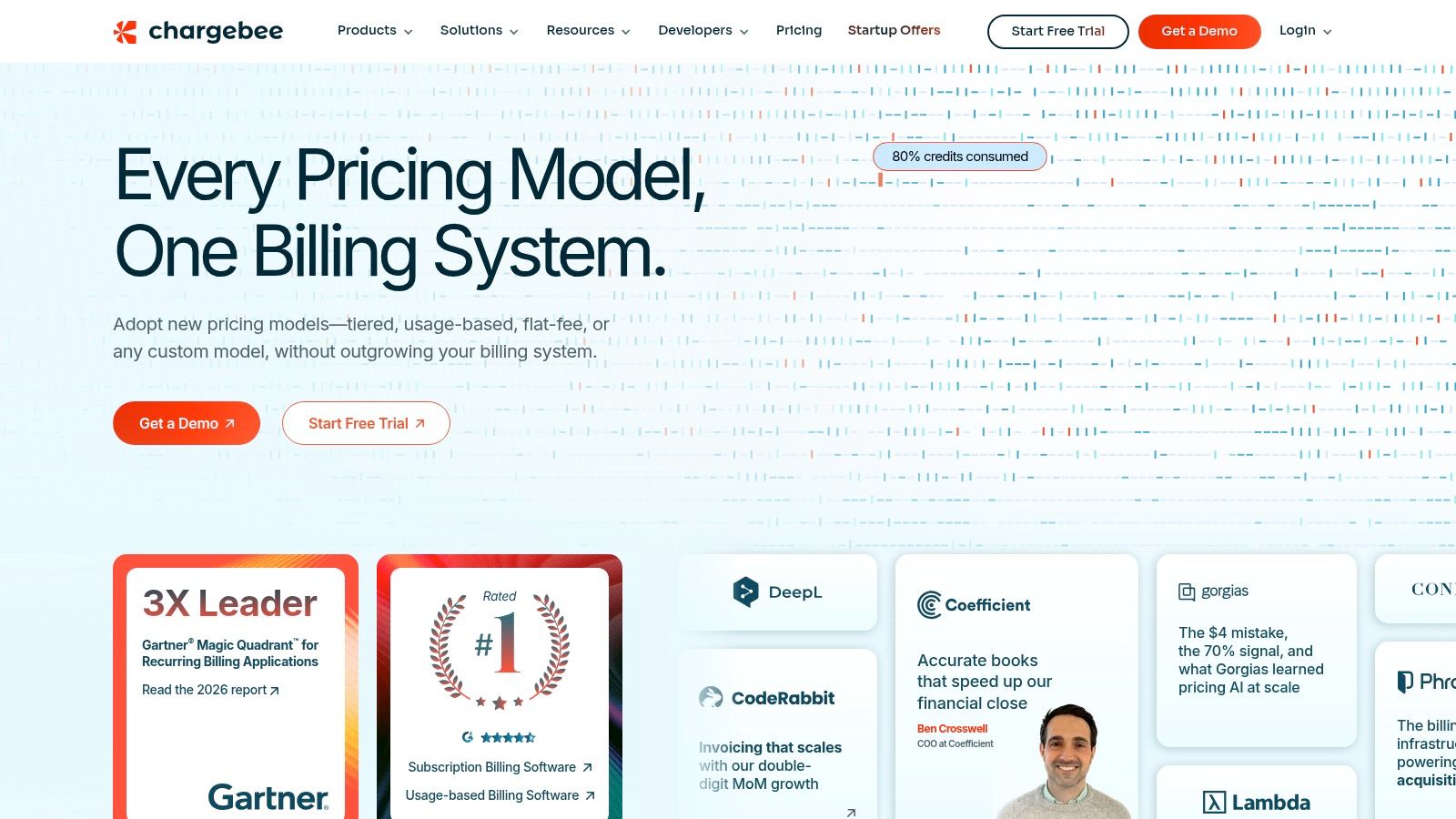
Your pricing model can outgrow your processor's subscription feature before payment acceptance becomes a problem. Chargebee addresses that billing layer, with subscription lifecycle management, invoicing, customer portals, dunning, analytics, and integrations with payment gateways.
It's relevant when product teams need recurring, usage-based, or hybrid pricing without rebuilding billing logic around each commercial change. According to a market report cited in Orb's usage-based billing statistics, more than 59% of SaaS businesses had implemented usage-based pricing in 2025.
What you still need
Chargebee generally connects to a processor rather than replacing it. That separation can help you preserve billing workflows while changing payment infrastructure, but it introduces another system to configure, monitor, and reconcile.
- Good fit: Complex catalogs, contract changes, hybrid pricing, and finance workflows that exceed basic recurring charges.
- Trade-off: More vendor management and integration work than a straightforward processor-native subscription setup.
- Critical test: Whether usage corrections, credits, prorations, and payment events produce the expected invoice and account balance.
For metered products, establish who owns usage collection and how late-arriving events are handled. A billing platform can calculate charges from submitted usage, but it can't fix an unreliable metering pipeline.
Choose Chargebee because your billing rules require it, not because you expect to grow.
7. Recurly
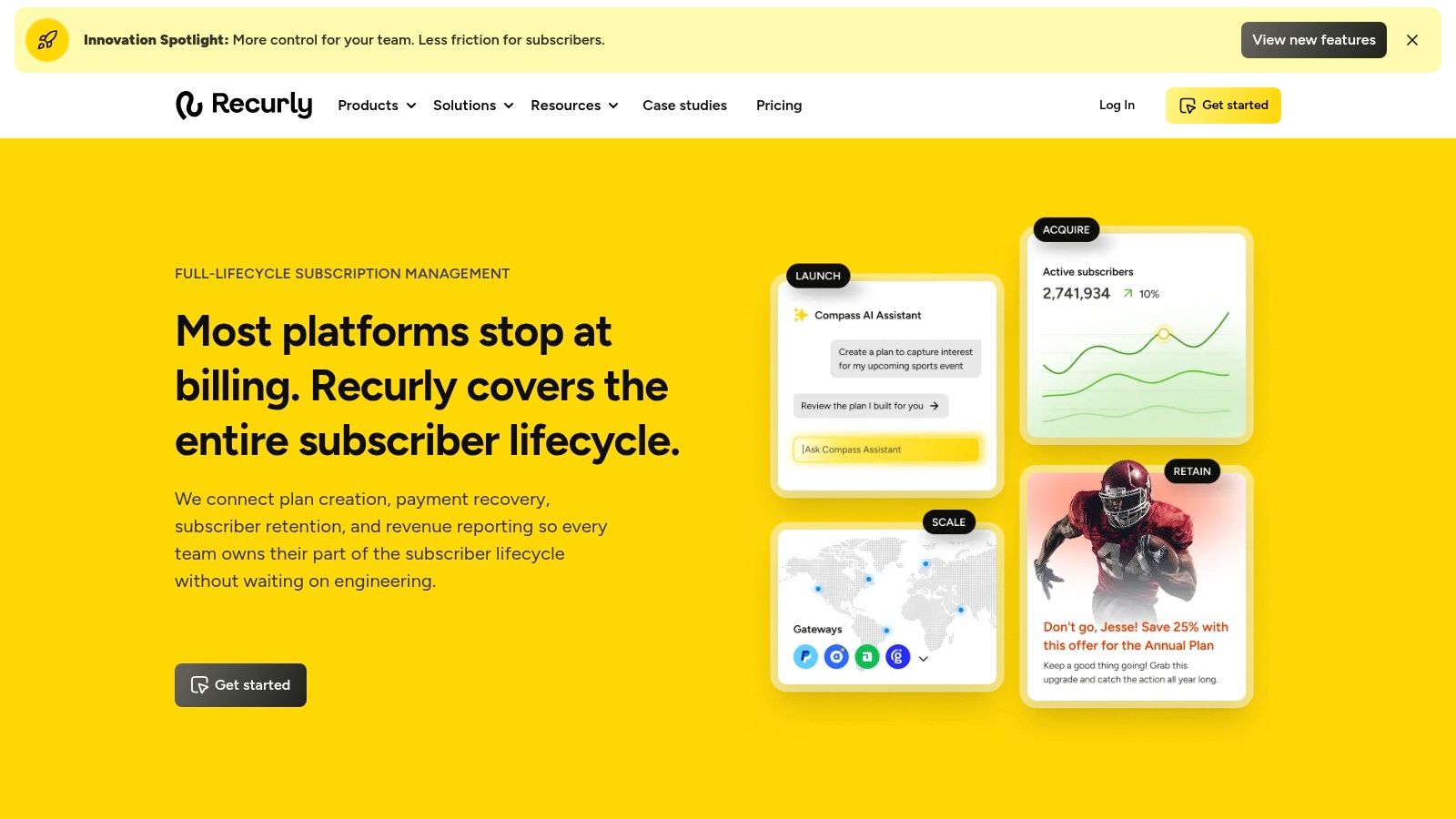
A failed renewal needs a recovery workflow, not just another charge attempt. Recurly combines subscription management with payment recovery, subscriber tools, analytics, and gateway integrations.
Its billing models include fixed, usage-based, hybrid, ramp, and prepaid arrangements. That makes it relevant when retention operations and subscription changes need more attention than a basic recurring-payment scheduler provides.
Recovery rule: Measure retained revenue after remediation, not just how many retries your system sends.
Benchmark summaries in Stripo's SaaS churn report place involuntary churn at approximately 20–40% of total SaaS churn. Treat that as an industry estimate, not a target for your own customer base.
Where to focus the trial
Recurly works with connected payment gateways, so processing remains a separate responsibility. During evaluation, trace a declined renewal through retries, customer notification, payment-method updates, and eventual recovery or cancellation.
Also inspect the application's grace-period behavior. A temporary payment problem shouldn't accidentally become an immediate, irreversible account closure.
The trade-off is added subscription infrastructure and cost. Recurly is easier to justify when your team needs coordinated lifecycle and recovery workflows than when you only need a simple monthly charge. Evaluate its operational fit against your current billing system, not against a gateway's transaction fee alone.
8. Adyen

Are you collecting your subscription revenue, or helping your customers collect theirs? Adyen becomes especially relevant to the latter through Adyen for Platforms, which supports user onboarding, verification, payment processing, split payments, and payouts.
That's a different purchase from subscription billing software. A vertical SaaS platform serving merchants may need to manage payment acceptance and payouts for those merchants, while maintaining separate software for its own subscription invoices.
Platform payments need their own design
The operational questions resemble those involved in payments for marketplaces: who receives funds, who can issue refunds, how balances are allocated, and what happens when a payment is disputed after a payout.
- Strong fit: Platforms needing merchant onboarding, split-payment logic, controlled payouts, and transaction reporting.
- Separate requirement: Subscription catalogs, metering, and invoice calculations may still need another system.
- Commercial caution: Business-model approval, payment-method fees, and any minimum invoice affect suitability.
Adyen also supports online and in-person processing, which matters when your software connects digital workflows with physical businesses. It's less persuasive as a replacement for a simple subscription scheduler.
For implementation, use deterministic transaction identifiers and reconcile webhook events against an internal ledger. A platform must know whose money it holds and why, not merely whether a checkout succeeded.
9. BlueSnap
BlueSnap combines payment processing, global payment orchestration, and subscription tools. It's worth considering when you want recurring charges and broader payment acceptance within the same commercial relationship.
Its subscription capabilities include configurable schedules, subscription changes, prorating, and order management. Supported recurring-payment options extend beyond cards to methods such as digital wallets, PayPal, ACH, and SEPA Direct Debit, subject to availability.
Recovery should follow the decline
Churnkey's State of Retention report found that insufficient funds represented 42.3% of declines overall in its subscription dataset, compared with 81% in Australia and 29% in Singapore. Those differences argue against applying an identical recovery schedule to every market.
BlueSnap's account-updater, retry, and failover capabilities can address some preventable failures. They don't remove the need to distinguish temporary funding problems from invalid credentials or fraud-related declines.
- Evaluate locally: Test the payment methods and recovery behavior relevant to your customer locations.
- Cost completely: Include processing, subscription-management charges where applicable, cross-border costs, and refund treatment.
- Reconcile carefully: Confirm how attempts, recoveries, refunds, and settlements appear in reports.
The appeal is consolidation without moving automatically to a merchant-of-record model. The limitation is that you still need to establish which billing, tax, and operational responsibilities remain with your team under the agreement.
10. Authorize.net
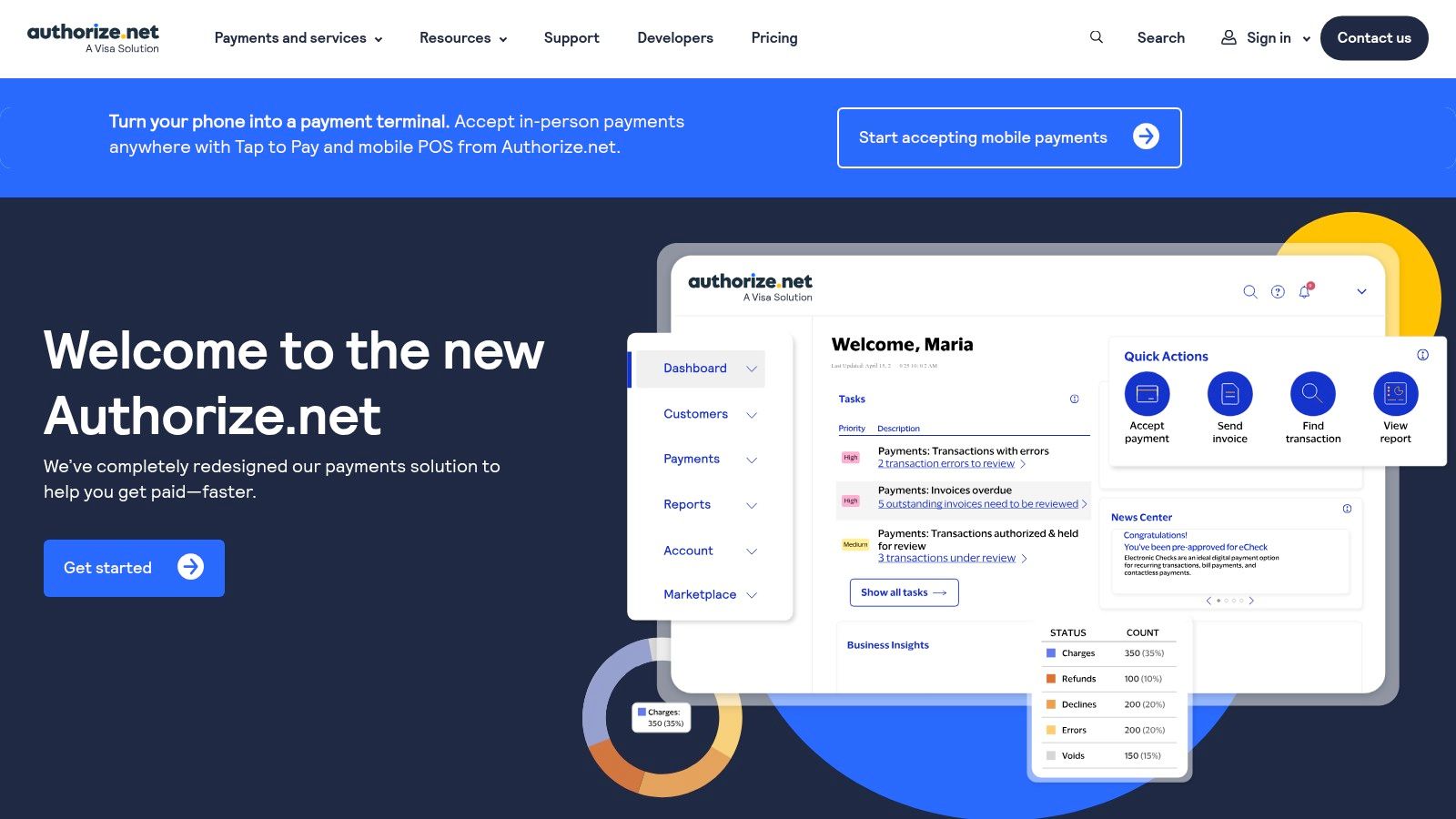
Not every SaaS needs a monetization platform. Authorize.net fits conventional payment acceptance and recurring charges, with automated recurring billing, digital invoicing, payment-data management, and fraud tools.
Its gateway-only and combined processing arrangements serve different starting points. If you already have a merchant account, the gateway decision isn't identical to selecting an entirely new processing relationship.
Keep the scope deliberate
Authorize.net is worth considering when your product sells straightforward subscriptions and your business already handles tax and accounting elsewhere. Its Customer Information Manager supports stored payment profiles, while recurring billing handles scheduled charges.
Use the same practical distinctions you'd apply when choosing a payment gateway for a small business: merchant-account requirements, supported methods, recurring-payment behavior, and the complete fee structure.
A recurring charge scheduler isn't a complete subscription operating system.
That limitation becomes important when customers need complex prorations, usage-based invoices, contract amendments, or international merchant-of-record coverage. Those requirements may call for another billing layer or a different commerce model.
Test customer self-service as carefully as authorization. Payment-method updates, cancellation requests, and failed-renewal notifications affect support workload even when the gateway processes charges correctly.
Authorize.net is a focused option when you want conventional acceptance. It's not a substitute for global SaaS tax handling or complex billing logic.
How the 10 SaaS payment solutions differ on model, published pricing and merchant-of-record responsibility
A low processing rate can still leave tax and settlement risk on your side. The columns separate the job being sold from who carries it when something breaks.
| Item | Model | Published Pricing | Merchant of Record | Best For |
|---|---|---|---|---|
| NexaPay | Crypto purchases and merchant crypto settlement | Starter: 4 provider integrations and up to $10,000/month processing; Professional: 15 available providers, 2 coming soon, up to $75,000/month processing | No | Crypto purchases and direct-to-wallet merchant settlement |
| Stripe Billing | Subscription and usage-based billing with payment processing | 0.7% of Billing volume; Managed Payments adds 3.5% per successful transaction plus processing | Optional Managed Payments for eligible transactions | SaaS businesses needing flexible billing and developer tools |
| Paddle | Payments, billing, and global commerce | 5% + $0.50 per checkout transaction; custom pricing available | Yes | SaaS and digital-product businesses seeking bundled global commerce |
| FastSpring | All-in-one digital commerce and billing | Volume-based, quoted pricing; no minimum transaction volume | Yes | Software and digital-goods sellers needing global tax and commerce support |
| 2Checkout (Verifone) | Payment processing, subscriptions, and digital commerce packages | 2Sell: 3.5% + $0.35; 2Subscribe: 4.5% + $0.45; other plans custom | Available through 2Monetize; package dependent | Businesses choosing among sales, subscription, and digital-commerce plans |
| Chargebee | Subscription billing and monetization software | Depends on plan and billing volume | No | Businesses with recurring, usage-based, or hybrid billing needs |
| Recurly | Subscription management and recurring-revenue tools | Starter: $249/month plus 0.9% of billing volume; larger plans custom | No | Businesses needing subscription lifecycle and payment-recovery tools |
| Adyen | Online, in-person, and platform payment processing | Fixed processing fee plus payment-method fee; minimum invoices may apply | No | Platforms needing payment processing, onboarding, and payouts |
| BlueSnap | Global payment processing, orchestration, and subscription tools | Market- and agreement-dependent | No | Businesses combining recurring payments with global payment processing |
| Authorize.net | Payment gateway, processing, and recurring billing | All-in-one: $25/month plus 2.9% + $0.30 per transaction | No | Merchants seeking conventional payment acceptance and recurring charges |
Matching Your Payment Stack to the Job It Needs to Do
Start by naming the missing layer: billing logic, payment acceptance, global tax handling, or settlement to a specific account or wallet. Shortlist a small group of tools that cover that job, rather than comparing every provider as though it sells the same service.
For billing complexity, evaluate Stripe Billing, Chargebee, and Recurly against your actual pricing rules. For merchant-of-record handling, compare Paddle, FastSpring, and the relevant 2Checkout package. For payment acceptance and platform funds movement, examine Adyen, BlueSnap, and Authorize.net according to your business model.
Test the exceptions before the happy path
A successful sandbox purchase proves very little about renewal operations. Run failed-payment recovery, payout reconciliation, and refund scenarios before committing, and use a limited live pilot for settlement behavior the sandbox can't reproduce.
Give engineering and finance the same test cases:
- Failed renewal: Confirm retry behavior, customer messaging, grace periods, and eventual access changes.
- Plan amendment: Check the invoice, credit balance, tax adjustment, and entitlement update.
- Refund after settlement: Establish who funds it, how it reaches the buyer, and how finance reconciles it.
- Repeated webhook: Confirm that replaying an event doesn't duplicate fulfillment or change the balance twice.
Refunds and disputes also depend on product design. Mastercard's chargeback outlook projected 261 million global chargebacks in 2025, across payments rather than SaaS alone. Clear renewal terms, recognizable billing descriptors, advance notices, and accessible cancellation help address confusion before a customer disputes a charge.
Assign ownership explicitly
Write down who owns the invoice, payment attempt, tax obligation, customer communication, and settlement record. Assign a system of record to each, then document how corrections propagate between systems.
If your priority is direct cryptocurrency settlement, our provider-connected model is relevant. We also serve merchants in supported high-risk sectors, but provider eligibility and customer verification still apply; this isn't guaranteed acceptance or a way around compliance.
Choose the smallest stack that covers your real responsibilities. A gateway can be enough for straightforward acceptance. A billing layer earns its place when pricing and lifecycle rules become complex. A merchant of record earns its place when transferring covered commerce responsibilities is more valuable than retaining direct control.
NexaPay connects familiar payment methods with cryptocurrency settlement through independent, licensed providers. Visit NexaPay to evaluate a payment-link or API integration for your SaaS, and map the checkout and webhook flow against the billing and tax systems you'll retain.