Payments for Marketplaces: How Seller Payouts Work
Payments for marketplaces explained: how buyer funds move through providers, how sellers get paid, and how to choose the right payment setup.
A buyer has a receipt, your dashboard says paid, and a seller is asking why nothing has reached their bank. Say the buyer paid 100 USD for a basket containing 60 USD of goods from Seller A and 40 USD from Seller B. A week later, Seller B is still waiting. Those amounts are illustrative, but the operational problem is real: a successful checkout doesn't tell you whether a seller's money is ready to leave.
Good payments for marketplaces start with that gap. Before choosing checkout buttons, decide who controls the proceeds, what each seller is owed, and who funds a refund after a payout.
Why Marketplace Payments Are More Than a Checkout
A conventional shop usually receives payment for its own sale. A marketplace coordinates payment for sales involving other businesses, so the buyer's purchase and each seller's payout need separate records and release decisions.
There are distinct responsibilities:
- The buyer authorizes payment and expects the order or a refund.
- The sellers fulfill their portions and expect the agreed proceeds.
- The marketplace calculates allocations, applies its commercial rules, and maintains the order record.
- The payment provider processes the card or wallet transaction and reports its status.
These roles don't necessarily mean the marketplace holds cash in its own bank account. A provider may maintain seller accounts and execute allocations, while the marketplace tracks the resulting obligations.
Buyers also reach checkout through overlapping channels: the Federal Reserve's 2025 Diary of Consumer Payment Choice found that 23% of U.S. consumer purchases and peer-to-peer payments were made remotely in 2024, while credit and debit cards represented 35% and 30% of payments by number, respectively. A mobile wallet can use a card underneath, so payment method and purchase channel aren't interchangeable categories.
The decisions behind the paid status
For the waiting seller, the important questions are practical. Where are the proceeds now? Which account model governs them? What must happen before the seller can receive them without leaving the marketplace unable to fund a return?
A checkout confirmation answers none of those questions on its own. It confirms a payment event, not an unconditional entitlement to withdraw.
Working rule: The payment and the payout are separate events. Most marketplace design work happens between them.
How Buyer Money Reaches a Seller Step by Step
A paid order creates several balances at once: the buyer's authorization, the provider's settlement amount, the platform fee, the seller payable, and whatever must remain available for refunds or reversals. The payout release rule sits on top of those balances. If it releases too early, the platform may end up funding a return from its own money; if it releases too late, sellers wait without a clear reason.
| Stage | Who holds the money | What the ledger records |
|---|---|---|
| Checkout authorization | Buyer's issuer or wallet controls the funds; provider manages authorization | Payment attempt ID and authorization status |
| Capture and settlement | Provider's processing flow, then platform or seller payment account | Settlement report line matched to the attempt |
| Platform fee | Platform payment account once allocated and available | Fee entry against the original order |
| Seller payable | Funds remain in the designated payment account; platform ledger records the liability | Payable balance per seller and currency |
| Seller payout | Payout rail during transfer, then seller's bank or wallet | Payout ID and receiving-account confirmation where available |
A ledger records ownership and obligations. It works like the scoreboard, while the money moves through issuers, providers, payment accounts, payout rails, and banks or wallets. Authorization also usually reserves spending capacity at the issuer; cash reaches the provider's flow later through capture and settlement.
The diagram separates the accounting stages from the eventual payout.
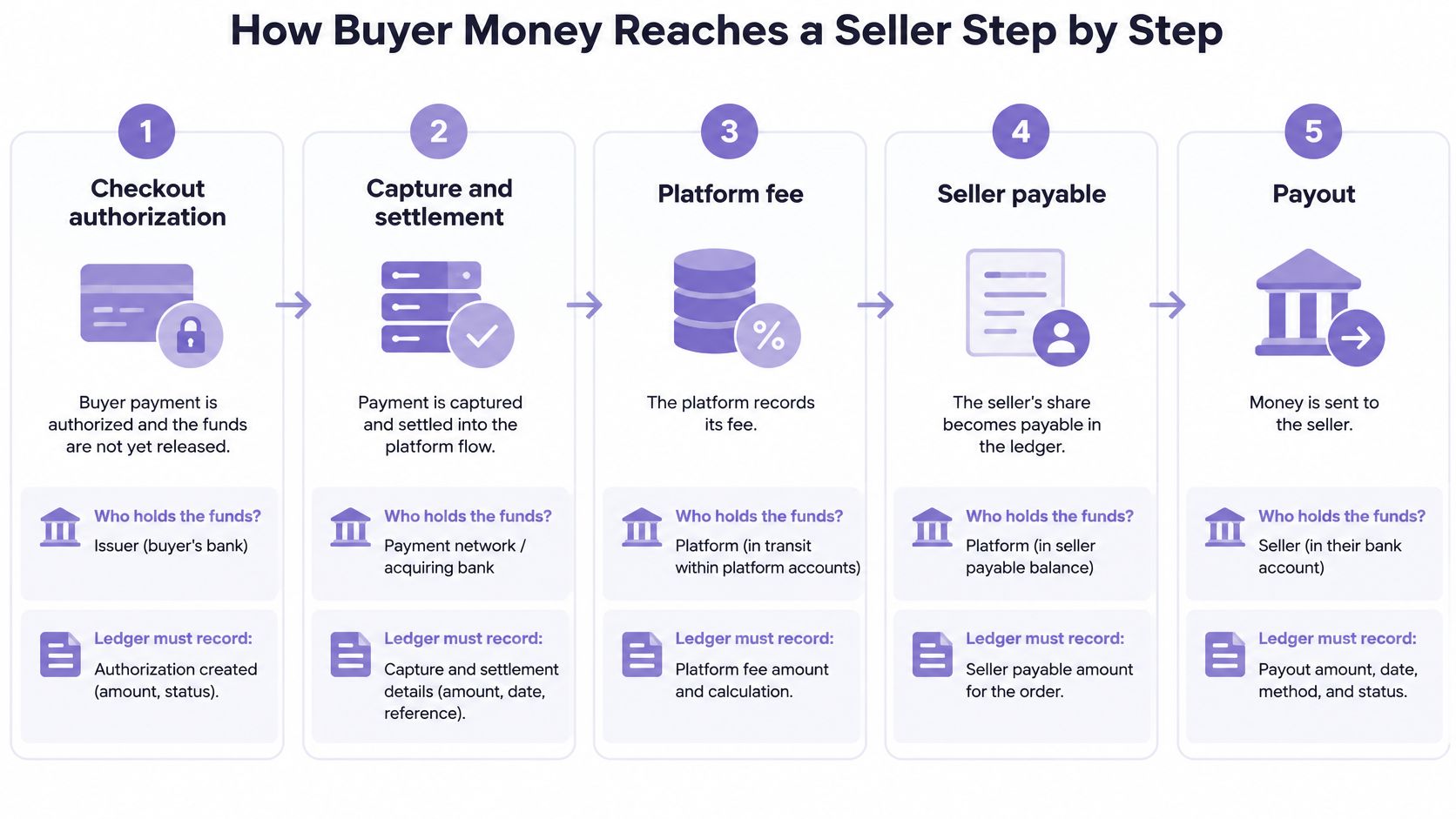
Follow the provider event into the ledger
- The buyer completes checkout. In a provider-checkout setup such as NexaPay, customers pay by card, Apple Pay or Google Pay on the payment provider's checkout, while the merchant follows the payment from one workspace. The marketplace receives a reference and status events, not custody of the buyer's card funds.
- The provider reports the result. Authorization indicates approval to proceed; capture initiates collection. Treat the browser's success page as a signal to verify, then wait for the provider event that your system can store and reconcile.
- The platform records the attempt. Create an immutable payment-attempt ID before submission, then attach provider references, capture results, fees, reversals, and payout outcomes to it.
- The proceeds settle. The receiving account belongs to the platform or seller under the selected model. Match the settlement report to the captured payment, including deductions and currency, so the order total can be traced to the last cent.
- The platform allocates the proceeds. Record the platform fee separately from each seller's payable balance. Allocation updates liabilities; it still leaves the release decision to the payout policy.
- The payout becomes eligible. Apply the release policy, keep enough exposure reserved for refunds and chargebacks under your rules, submit the transfer, and track its outcome separately from the original charge.
Make every movement replayable
The European Banking Authority's safeguarding guidance states that a payment institution must ensure relevant funds are safeguarded at all times and document how its safeguarding arrangements operate. That duty sits with the payment institution, so a marketplace should design records and permissions around the account model it uses.
Implement a double-entry ledger separating seller liabilities, platform fees, refunds, reserves, chargebacks, and funds in transit. Each posting needs an equal offset, an event reference, and enough context to reconstruct it. Keep currency subledgers and the exchange-rate record attached to conversions.
Provider webhooks need authentication, durable storage, deduplication, and idempotent processing. A repeated callback must return the existing result, not create another seller credit; an older callback must not overwrite a later reversal.
This video provides another view of the payment flow.
To trace an order, connect the buyer's receipt to its attempt ID, capture reference, settlement line, allocation entries, release decision, and payout reference. Finish at the seller's bank or wallet receipt, and make sure the remaining payable, reserve, refund, and fee balances still add back to the original settlement.
Routing, Fallbacks and Why Declines Need Rules
Payment orchestration is a risk-controlled routing layer, not a switch that sends every rejected payment elsewhere. More providers give you more possible paths, but they also create more opportunities for duplicate charges and inconsistent fraud decisions.
A router can consider geography, currency, card type, issuer response codes, risk score, processing cost, and provider availability. Those inputs need explicit priorities. A cheaper route isn't useful if it lacks the required authentication flow or cannot support the intended settlement destination.
The European Banking Authority's internet-payment security guidelines_Rev1.pdf) recommend formal security policies, updated risk assessments, strong customer authentication, and transaction monitoring. Treat those controls as routing constraints, not checks to bypass when approval rates fall.
Separate recoverable failures from stop signals
Use a provider-specific response map:
- Transient technical failure: Retry only after checking whether the original request succeeded.
- Authentication required: Complete the issuer-requested authentication flow using the provider's supported sequence.
- Hard decline: Stop automatic retries rather than sending the same request around other processors.
- Suspected fraud: Block automated fallback and follow the review policy.
A timeout deserves particular care. You may have lost the response while the provider successfully captured the payment. Query its status before creating another attempt.
Fraud signals also aren't necessarily portable between processors. Recalibrate each provider's fraud rules instead of copying a score threshold and assuming it means the same thing.
An approval recovered through another processor is valuable only if the resulting payment survives fraud review, disputes, and settlement.
Keep routing auditable
Preserve the original payment intent, a separate immutable ID for each attempt, and idempotency keys for supported operations. Record the route selected, the response received, and the rule authorizing any retry.
Monitor approval rate, soft-decline recovery, fraud rate, dispute rate, latency, and net settlement margin by provider and region. Approval rate alone can hide a route that creates expensive disputes or leaves finance with unmatched settlements.
Cross-border operations need corridor-specific rules because authentication expectations, issuer responses, local methods, and provider coverage differ. Don't treat a successful route in one country as a universal default.
This week, export last month's declines by provider and classify them as hard, soft, or technical. Investigate unclassified responses before enabling more fallbacks.
Four Payment Models Marketplaces Actually Use
Choose an account model around the commercial relationship, not an API name. Merchant of record means the party responsible for the buyer-facing sale and payment relationship; technical charge settings alone don't settle that legal question.
The following comparison describes common configurations. Provider contracts, regional rules, and the underlying seller relationship must support the arrangement.
| Model | Merchant of record | Who holds funds first | Best fit |
|---|---|---|---|
| Direct charge | Seller in a seller-led arrangement | Seller payment account, with platform fee taken | Sellers needing their own statements and chargeback handling |
| Destination charge | Platform in a platform-led arrangement | Platform payment account, then seller account | Marketplaces wanting platform-side refund control |
| Separate charges and transfers | Platform in the illustrated arrangement | Platform payment account, then transfers to sellers | Multi-seller baskets and delayed fulfillment |
| Gateway with third-party payouts | Platform in the illustrated arrangement | Collecting provider, followed by another payout rail | Eligible sellers without direct provider onboarding |
Match the model to the operating job
Direct charges fit independent sellers that need a clear payment relationship with their buyers. The platform earns a fee, while seller accounts carry the relevant transaction records under the provider's configuration.
A destination-charge arrangement suits a platform managing the purchase centrally and routing proceeds to a connected seller. Verify how refunds debit the platform and whether previously transferred proceeds can be recovered.
Separate charges and transfers give a multi-seller basket an explicit allocation layer. The marketplace can wait for fulfillment conditions before transferring proceeds, but it must maintain accurate liabilities throughout that interval.
A gateway with another payout rail can address coverage gaps, provided the collecting and paying providers permit the arrangement. It also creates a reconciliation boundary: a successful collection doesn't prove the separate payout succeeded.
Liability matters more than the label
The merchant of record commonly bears buyer-facing refund and chargeback obligations, but provider agreements can allocate losses and negative-balance responsibility differently. Document both the contractual liability and the account the provider debits.
Understanding what a payment facilitator does helps distinguish merchant onboarding and payment responsibilities from just supplying gateway software. Don't assume a branded checkout makes the platform a regulated payment intermediary.
In our operating model, card and other payments are handled solely by licensed third-party payment providers. Those providers may verify customers at checkout; a marketplace account model doesn't remove that possibility.
Before implementation, confirm supported countries, seller eligibility, statement descriptors, and refund permissions. Then ask the commercial question: which party should the buyer recognize as the seller on their card statement? Ensure the contract, checkout disclosures, and provider configuration tell the same story.
Seller Payouts, Reserves and Holds
The table below is an illustrative conservative payout policy, not a universal schedule or prescribed reserve requirement.
| Risk tier | Typical release | Reserve or hold | Rule that can stop payout |
|---|---|---|---|
| Low risk, established seller | Next payout cycle after refund window closes | None or minimal | Chargeback or fraud flag on a recent order |
| Medium risk, new seller | Delayed release until refund window closes | Rolling reserve on a share of sales | Dispute above the agreed threshold |
| High risk or digital goods | Staged release tied to delivery confirmation | Full reserve or clawback buffer | Any unresolved fraud or compliance review |
A reserve remains money owed under its release conditions, not platform revenue. A hold prevents withdrawal while a particular issue is investigated; it shouldn't become an indefinite reserve.
The visual groups sellers by release conditions rather than checkout method.
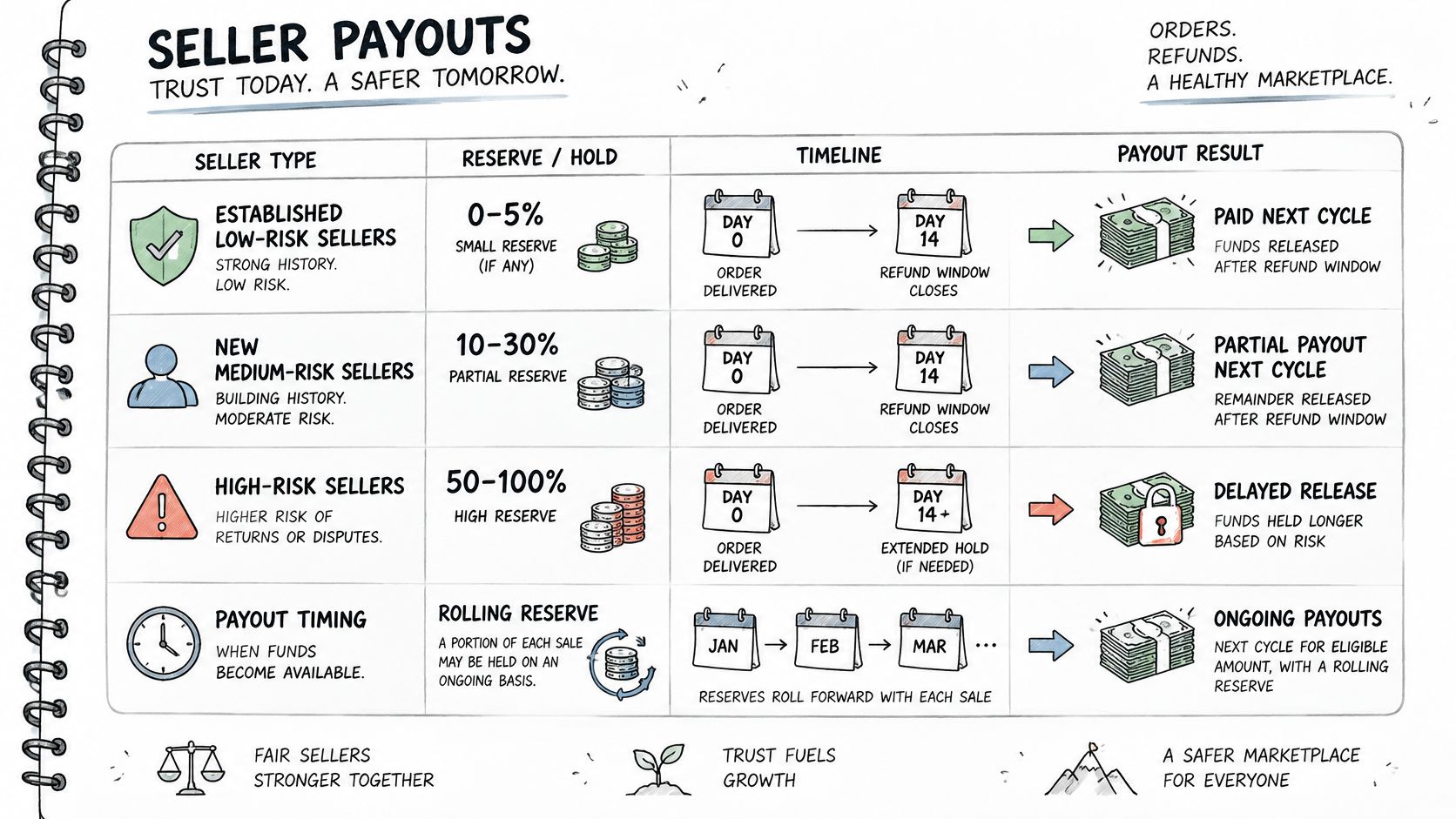
Decide what makes funds available
Evaluate settlement and payment finality, fraud results, refund-window rules, and the reserve calculation before releasing proceeds. Settlement doesn't eliminate later chargebacks, so eligibility must reflect the remaining exposure rather than promise absolute finality.
Low-risk transactions may qualify for immediate release under a policy that accepts residual refund risk. Higher-risk sellers may need delayed or staged releases, with clear reserve release dates and review conditions.
A 2025 academic case study on global marketplace onboarding identifies fragmented experiences, inconsistent security controls, technical debt, and limited scalability as cross-border problems. Operationally, seller verification must connect to ongoing monitoring and payout decisions rather than end at registration.
For categories needing closer review, distinguish the payment provider's account requirements from your seller policy. A guide to high-risk merchant accounts can help frame that distinction, but it doesn't establish a marketplace's reserve percentage.
Assign recovery before releasing money
Write a recovery policy that names the evidence and funding source:
- Refund: Keep the return request, order allocation, delivery record, and refund reference. Reverse unpaid seller proceeds first; after payout, use the authorized reserve or offset future sales.
- Chargeback or fraud claim: Preserve authentication results, fulfillment evidence, buyer communications, and the dispute outcome. Draw from the seller reserve where contractually permitted; record any unrecoverable amount as the platform's loss.
- Failed identity or sanctions review: Retain screening results, review decisions, and provider notices. Hold affected payouts and assign review costs under the seller terms; don't release restricted funds merely to close an account.
If recovery creates a negative seller balance, specify whether future proceeds offset it, withdrawals stop, or a permitted recovery process begins.
Before accelerating payouts: Name the account that will fund a refund after the seller has withdrawn.
Currency needs the same precision. Record the executed exchange rate, converted amount, fees, and any later refund conversion difference instead of treating them as unexplained adjustments.
In our flow, all fiat payments are automatically converted to cryptocurrency at the current market rate and settled to the merchant's configured wallet address without manual intervention. A marketplace must separately establish how its seller liabilities and recovery obligations are funded; wallet settlement alone doesn't provide that policy.
One Order From Checkout to Seller Payout
Use a hypothetical order to test the accounting. The buyer purchases 60 USD from Seller A and 40 USD from Seller B, with an assumed 10% platform fee on each share.
For this example only, exclude taxes, shipping, provider charges, and currency conversion. Assume a 14-day refund window, with settlement matching capture on the following day; these are scenario assumptions, not promised payment timings.
The basket has a single buyer-facing total but separate seller allocations.
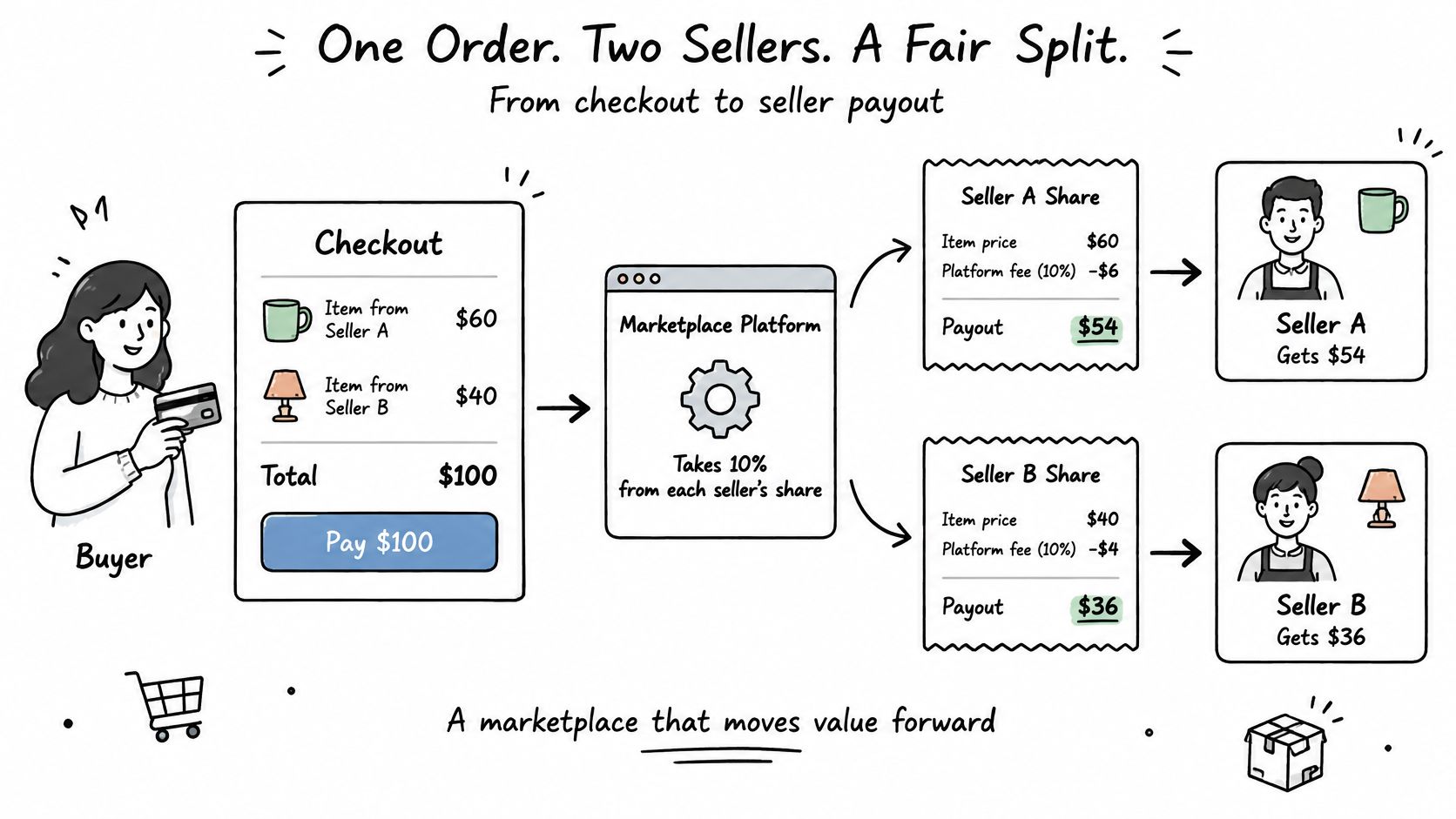
Capture, return, and release
On day 0, the provider captures 100 USD. The platform records 10 USD in fees, 54 USD payable to Seller A, and 36 USD payable to Seller B.
On day 1, the settlement report matches the capture. Nothing changes in the allocation merely because the proceeds have moved from in-transit to settled.
On day 5, the buyer returns Seller B's item. Under this example's fee-refund policy, the platform reverses B's 36 USD payable, reverses its 4 USD fee, and sends the buyer a 40 USD refund.
| Event | Buyer net paid | Platform fee |
|---|---|---|
| Day 0 payment captured | 100 USD paid | 10 USD |
| Day 1 settlement matches capture | 100 USD paid | 10 USD |
| Day 5 Seller B item returned | 60 USD net paid | 6 USD |
| Day 14 window closes, payout cycle | 60 USD net paid | 6 USD |
At the next eligible cycle after the window closes, Seller A receives 54 USD. Seller B receives nothing because its entire allocation was reversed.
The completed order reconciles as 100 USD collected = 40 USD refunded + 6 USD platform fee + 54 USD paid to Seller A. No seller payable remains.
A separate reserve variant without a return
Now assume B's item isn't returned and B has an illustrative 10% reserve applied to its net payable. That reserve basis matters: applying it to gross sales would produce a different result.
B's 36 USD allocation becomes 32.40 USD available for payout and 3.60 USD reserved. After paying both sellers' available proceeds, the reconciliation is 100 USD collected = 10 USD fees + 54 USD paid to A + 32.40 USD paid to B + 3.60 USD still owed in reserve.
When the reserve becomes eligible, its release reduces both cash and the remaining seller liability. Don't count a paid seller amount again as an outstanding payable.
Choose Your Payment Setup Before You Launch
Resolve these decisions before committing to checkout integration:
- Merchant of record: Identify who contracts with the buyer and bears the relevant payment obligations.
- Countries and methods: List the buyer markets and seller destinations you need.
- Seller liquidity: Establish when sellers need usable funds, not merely an available dashboard balance.
- Loss capacity: Decide how much refund and chargeback exposure the platform can finance.
- Provider coverage: Identify corridors requiring another collecting or payout provider.
Payment localization matters: DHL's 2025 e-commerce research found that one in three shoppers abandoned a cart when their preferred payment method was unavailable. But adding every method can fragment refund rules, transaction references, settlement currencies, and payout timing.
Build a country-level scorecard ranking checkout abandonment, authorization rate, dispute exposure, settlement currency, payout speed, and provider redundancy. Prefer a locally relevant set that finance and support can operate reliably over an exhaustive list nobody can reconcile.
Use this checklist to turn those decisions into launch requirements.
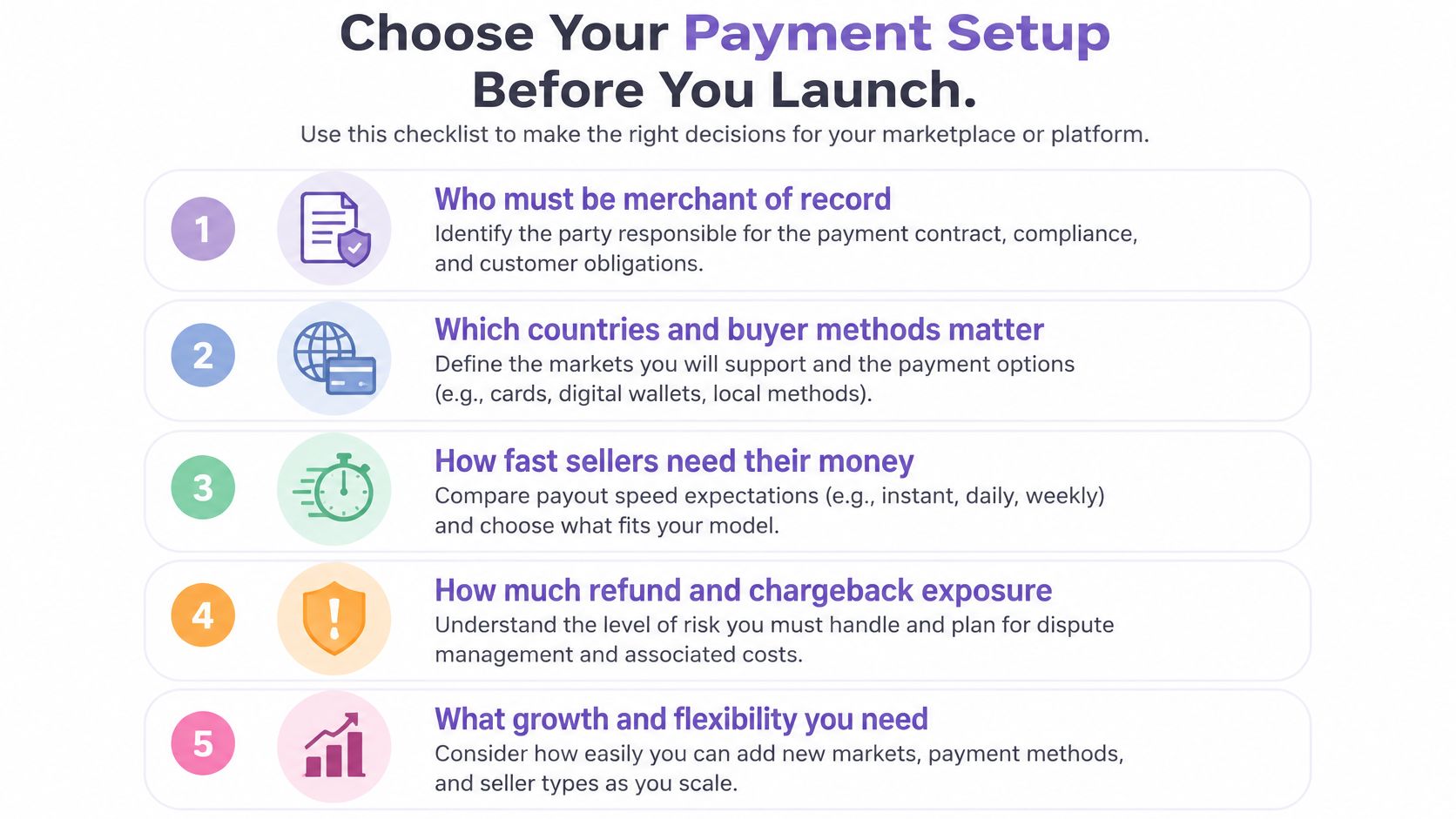
Test the operating arrangement
Use the merchant-of-record decision to select the account model, then assign each seller a documented release policy. Evaluate a white-label payment gateway against those requirements rather than assuming branding includes split payments, safeguarding, or dispute recovery.
With us, merchants can start taking payments as soon as their account is set up, with no approval queue. That setup speed doesn't replace provider checkout checks or establish a marketplace's seller-payout permissions.
Before launch, write a payout rule for every seller tier, confirm the merchant-of-record arrangement with the processing provider, and run a refund end to end. Match the refund, fee reversal, seller liability, and bank or wallet movement before accepting live orders.
NexaPay connects provider-hosted card and digital-wallet payments with cryptocurrency settlement directly to merchant wallets, while its White Label offering supports a merchant network under your own brand and commission rates. Visit NexaPay to compare that operating model with your marketplace's collection, settlement, and seller-payout requirements before integrating.