7 Best Payment Gateway for Small Business: Fees Compared
Compare the best payment gateway for small business options by fees, payment methods, integrations, regional reach and settlement speed to find your fit.
Two tabs are open, two quotes are on the screen, and the order you're pricing is $50. The first gateway advertises 2.9% to process it. The second advertises interchange plus half a percent, which sounds cheaper until you learn that interchange itself lands on top of that half percent. Neither number tells you what the sale costs.
Cost is also the lever that changes behavior, not just margin. Analysis of World Bank enterprise survey data covering small firms with 5 to 19 employees in 56 economies found those businesses made 71% of their payments electronically where transaction costs stayed below 1% of payment value, 38% where costs ran 2% to 5%, and 19% where costs passed 5% (Visa's report on the World Bank data). Friction decides whether a payment happens at all.
The best payment gateway for small business isn't the one with the prettiest rate. Every option below gets judged on three questions. What does a $50 sale cost after every listed fee? Who holds the money, and for how long? Can you start selling without an approval queue? Features come fourth.
1. NexaPay
Approval is the first fee many gateways charge: time. NexaPay skips that queue, so payments can start as soon as the account is set up. For a small business trying to launch this week, that can matter more than a glossy rate.
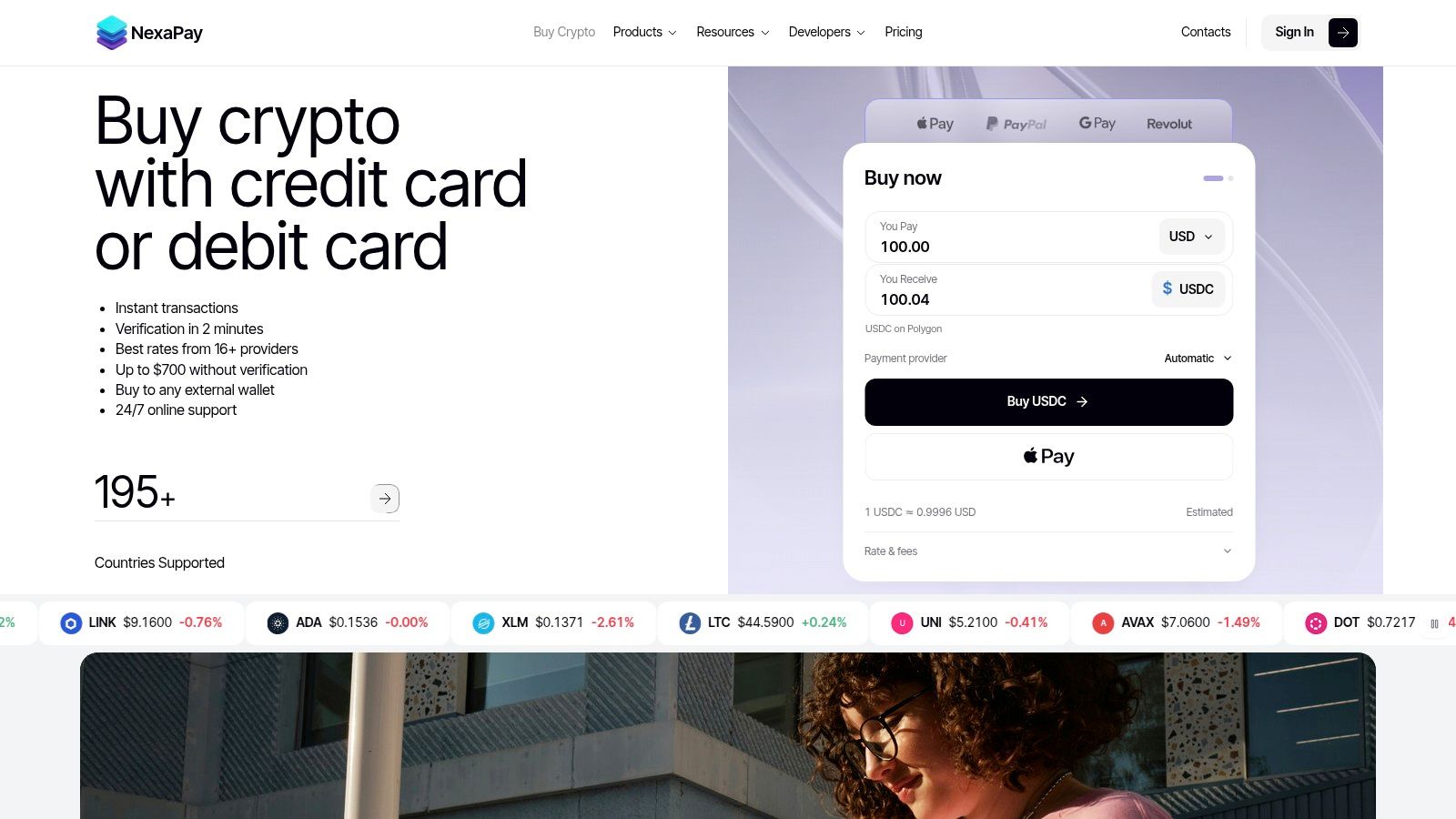
Card, Apple Pay and Google Pay payments run through licensed third-party provider checkouts, and proceeds settle to the merchant's own wallet in USDC on Polygon. Settlement does not depend on a conventional bank payout. Crypto transfers are typically initiated within one to two minutes after payment confirmation.
What a $50 Order Really Costs
There is no public merchant rate card to multiply by $50, so the cost is the provider checkout fee behind the transaction plus the plan ceiling you choose. Starter includes four provider integrations, Transak, Banxa, Binance Pay and Ramp, with up to $10,000 a month. Professional raises that to 15 available providers, two more coming soon, and up to $75,000 a month. On a $50 sale, ask which provider will serve the buyer's region before you sign; that provider's pricing sets your floor, and smart routing helps only when your plan has enough providers to choose from.
Integration answers a different cost question: can your existing store take it without a rebuild. In a 2025 Global Innovation Forum poll of small and midsize businesses, 89% said digital payments were important to their business, yet 43% found it difficult to integrate different payment systems across online, in-store and international channels (Global Innovation Forum poll results). The connection options are direct: a prebuilt checkout, payment links from the dashboard, a REST API, webhooks and a WooCommerce plugin that can put a store live in minutes.
Practical rule: judge this gateway on two clocks. Time to first payment can be minutes after setup. The money clock runs through the provider checkout until confirmation, then the crypto transfer is typically initiated within one to two minutes.
Before you compare it with a conventional processor, ask the provider how refunds, disputes and customer verification are handled at checkout. Payments use PCI DSS Level 1 certified providers with 256-bit encryption, and NexaPay never stores card details. The company reports 50,000+ active merchants across more than 195 countries.
2. Stripe
Run a $50 order through Stripe's listed U.S. rate of 2.9% + 30¢ and you pay $1.75, which is 3.5% of the sale rather than 2.9%. Drop the basket to $20 and the same rate takes $0.88, or 4.4%. The percentage holds steady. The cost doesn't.
Stripe earns its place on the build. Hosted checkout, developer APIs, a long payment-method list, recurring billing and fraud tooling, all pay-as-you-go with no monthly processing subscription. If you sell software, subscriptions or anything with a login and an invoice, the plumbing is already there and you're not stitching three tools together.
Who holds the money matters as much as the fee. Stripe aggregates the merchant account itself and then pays out on a schedule tied to your account history and risk profile. A brand-new account with no processing history should plan for a longer first hold, so don't schedule supplier payments against week-one sales.
The fraud controls are where small merchants get caught. The Merchant Risk Council's 2025 Global eCommerce Payments and Fraud Report put global order-rejection rates at 5.0%, down from 5.8%, with 14% of merchants still reporting false-positive rates above 10% and 32% sitting in the 2% to 5% range (2025 Global eCommerce Payments and Fraud Report). A blocked good order costs you the fee and the sale.
Ask any provider to break decline reasons out by country, payment method and customer type. If the reporting can't split those, you can't tell a fraud rule from a broken checkout.
Two cautions. Configuration is real work for a nontechnical owner, and some business categories are prohibited or restricted, so confirm eligibility before you build. Rates and setup sit at Stripe.
3. Square
Picture a business that sells at a weekend market and takes online orders the rest of the week. Square's free plan covers both channels with no monthly subscription, at 2.6% + 15¢ for tap, dip or swipe and 3.3% + 30¢ online.
On a $50 sale that's $1.45 in person and $1.95 online, a 50-cent gap on the same basket. If most of your revenue runs through a card reader, Square's math is competitive. If it runs through a checkout page, you're paying for point-of-sale software you may never open.
Square is a payment facilitator rather than a merchant account provider, and that distinction is worth understanding before you sign. You operate under Square's umbrella account, so what a payment facilitator is and how it handles holds, reserves and account freezes is your real contract, not the marketing page.
The channel demand is there. The World Bank's Global Findex 2025 reports that 42% of adults in low- and middle-income economies made a digital merchant payment in a store or online in 2024, up from 35% in 2021 (World Bank Global Findex 2025). Selling in both places is no longer optional for a growing shop.
- In person first: tap, dip and swipe are the cheapest channel Square offers, which suits market stalls, counters and pop-ups.
- Online second: the online rate plus a higher keyed rate for manually entered cards makes typed-in payments your most expensive path.
Payouts follow Square's calendar, and same-day or instant transfers cost extra. Availability outside Square's supported markets needs checking before you buy hardware. Details sit at Square.
4. PayPal Checkout
PayPal is the fastest checkout to bolt on and the one where the fixed fee bites hardest. U.S. card rates are 2.99% + 49¢ for standard Checkout and 2.89% + 29¢ for Expanded Checkout, with no monthly or setup fee listed.
On a $50 order, standard Checkout costs about $1.99, or 4% of the sale. On a $10 digital download it costs $0.79, which is 7.9%. That's the steepest small-ticket cost on this list, and it's the reason to route low-value products through Expanded Checkout or a different gateway entirely.
Disputes are the other half of the PayPal experience. Refund and policy abuse is climbing: 57% of merchants reported an increase in refund or policy abuse in 2025, according to the Merchant Risk Council's Global eCommerce Payments and Fraud Report, which surveyed 1,082 merchant professionals in late 2024 (MRC 2025 Global Payments and Fraud Report). A gateway that freezes a balance while a claim is open changes your cash flow, not just your fee line.
Settlement deserves the same scrutiny. PayPal holds funds in your balance and moves them to a bank account on its own timeline, and a new seller without history can wait longer than the checkout button suggests.
The test: run your smallest real order through the fee calculator first. Fixed fees are a tax on cheap products.
If you keep cards on file for subscriptions, what PCI DSS requires for stored card data is your responsibility to understand, not the gateway's. PayPal is fiat only, so it isn't the answer if you want crypto settlement. Details sit at PayPal Checkout.
5. Shopify Payments
If your store already runs on Shopify, this is the default and usually the right call, because the alternative is paying Shopify a fee for using somebody else's gateway on top of that gateway's own processing charges.
Rates fall as the plan rises. Standard U.S. online card processing starts at 2.9% + 30¢ on Basic, 2.7% + 30¢ on Grow and 2.5% + 30¢ on Advanced. On a $50 order that's $1.75, $1.65 and $1.55 before the subscription, which is billed separately and is the number most comparisons leave out.

Run the full stack before you decide. A merchant on Basic paying a monthly plan fee plus 30 cents on every small basket can spend more than a merchant paying a slightly higher headline rate with no subscription at all. Model your own monthly volume rather than comparing percentages in isolation.
Payouts follow a schedule set inside Shopify and vary by country and business risk profile, so a first-year store shouldn't assume daily deposits. The payment methods offered inside the checkout also vary by market, which matters if you sell internationally.
Two limits. Shopify Payments is only useful if you're on Shopify, and using an external provider instead can trigger Shopify's third-party transaction fee, which changes the math completely. Plan rates are listed at Shopify Payments.
6. Helcim
Helcim suits owners who want the processor's margin printed on the statement as its own line, visible and checkable against each sale. For U.S. merchants under $50,000 in monthly volume, Helcim lists its online and keyed margin as interchange + 0.50% + 25¢, with interchange and network fees added on top (Helcim).
On a $50 sale the visible markup is 25 cents plus 25 cents, so $0.50 before interchange. That is both the appeal and the problem. Debit and basic credit cards pull your effective cost down, rewards cards push it up, and the number moves month to month as your card mix shifts. Merchants above the $50,000 threshold should confirm which margin applies to their volume before signing.
Compare that markup with the flat-rate options, where you know the exact cost of a $50 sale before it happens.
Predictability carries a price. For a business on thin margins, it is often worth paying.
Satisfaction data says the fee isn't the whole decision. A 2025 small-business survey reported 77% satisfaction among businesses using fintech payment providers against 44% among those using large banks, and Capgemini's 2025 global merchant research found 70% of merchants rated high payment-success rates and reliable infrastructure as important (Mandala Partners analysis). A processor that shaves a few basis points off each sale and then declines one order in twenty has cost you money.
Watch the card mix, not the brochure. Pull three months of statements and divide total fees by total volume. That's your real rate, and it's the only one worth comparing.
Because the margin is published rather than quoted by sales call, you can run the math above before you apply. Total cost still varies by card and transaction, so confirm country and industry eligibility directly.
7. PaymentCloud
Some businesses can't get past the first screen anywhere else. If a mainstream processor has declined you, or your industry sits on a restricted list, a merchant-account provider that underwrites case by case is a practical option rather than a last resort.
PaymentCloud prices by quote instead of a public rate card, which is neither a red flag nor a shortcut. The numbers you get are specific to your industry, volume and risk profile, and you can't compare them to the flat rates above until you convert the quote into the same terms.

The risk environment explains the caution. In 2025, 77% of surveyed merchants reported that fraud had increased over the previous year, according to a January 2025 Qualtrics survey of 1,466 fraud and payments professionals published by Ravelin (Ravelin fraud survey). Underwriters price that risk into reserves, and reserves are where small merchants get caught short.
Get these in writing before you sign anything:
- The processing rate and its basis. A quoted 2.5% means nothing until you know whether interchange sits on top of it.
- Gateway and statement fees. Many merchant-account providers bill these as separate line items.
- Reserve terms and release conditions. A rolling reserve held for months is working capital you don't have.
- Cancellation terms and equipment commitments. Ask what leaving in month four costs.
A high-risk merchant account is a different product from a checkout button, and it's worth reading what a high-risk merchant account involves before you hand over underwriting documents. Quotes are issued at PaymentCloud.
Listed pricing, best use case, settlement and setup at a glance
Four things decide fit: the published rate, the use case, who holds the money after a sale, and whether you can start without an underwriter.
| Item | Listed U.S. pricing | Best for | Settlement or payout | Setup or approval |
|---|---|---|---|---|
| NexaPay | Merchant pricing varies by plan and provider; the provider's fee sets each sale's cost; plan processing caps run from $10,000 to $75,000 a month | Merchants taking card, Apple Pay or Google Pay payments that settle to a crypto wallet | USDC on the Polygon network sent to the merchant's wallet; transfers typically initiated within 1–2 minutes of payment confirmation | No approval queue; an account is required, and Instant needs no merchant identity verification to start |
| Stripe | 2.9% + 30¢ per successful domestic online card payment | Online businesses, subscriptions, and custom websites or apps | Funds collect in the Stripe balance, then pay out to your bank on a set schedule | Hosted checkout or API integration; business eligibility restrictions may apply |
| Square | Free plan: 2.6% + 15¢ in person; 3.3% + 30¢ online | Small businesses selling in person and online | Card funds settle to a linked bank account on Square's payout schedule | Free plan includes POS and basic online tools; availability depends on market |
| PayPal Checkout | Checkout: 2.99% + 49¢; Expanded Checkout: 2.89% + 29¢ | Merchants adding PayPal and card options to online checkout | Funds land in the PayPal balance; moving them to a bank is a separate transfer | No monthly or setup fee listed; methods depend on product and eligibility |
| Shopify Payments | Online cards: 2.9% + 30¢ Basic; 2.7% + 30¢ Grow; 2.5% + 30¢ Advanced | Businesses running a Shopify store | Payouts go to the bank account on file through Shopify's payout schedule | Requires a Shopify plan; availability and pricing vary by country |
| Helcim | Under $50,000 monthly volume: interchange + 0.50% + 25¢ online/keyed | Businesses seeking interchange-plus pricing for online and in-person payments | Card and ACH funds deposit to the linked business bank account | No monthly fee or long-term contract listed; confirm eligibility |
| PaymentCloud | Custom quote; no universal public rate | Some high-risk or underserved businesses | Settlement terms are written into each approved account | Case-by-case underwriting; approval is not guaranteed |
Two rows need converting before they can rank. NexaPay's per-sale cost depends on which provider handles the checkout, and PaymentCloud's rate only exists once underwriting produces a quote. The other five publish a number, so weigh their settlement columns instead: in each case the funds sit in a processor balance until a scheduled payout reaches your bank.
Match the Gateway to Your Sales Pattern, Not the Headline Rate
Start with your own average order, not somebody else's ranking. A business selling $50 baskets and a business selling $9 downloads should not land on the same gateway, because the fixed fee behaves completely differently at each size. On a $9 sale, 30 cents is 3.3% before the percentage rate even starts.
Ask each candidate four questions in writing: the full fee estimate on your average order including every line item, the settlement timeline and who holds funds in between, the payment methods accepted in your country, and any reserve, hold or approval condition attached to your account. Vague answers are answers.
Then run the same sample sale through your top two. Take one real order value, apply every listed fee, subtract the reserve if there is one, and note when the money would reach your bank. Do it before you migrate, not after your first payout.
Three tiebreakers usually settle it. If margins are thin and volume is high, interchange-plus wins on cost and loses on predictability. If your average order is small, the fixed fee matters more than the percentage, which pushes you toward the lowest per-transaction charge. If you sell across borders or in a category other processors won't touch, eligibility and settlement beat both.
One cost that never appears on a rate card is your time. A gateway that needs a developer for every price change costs more than the gap between 2.7% and 2.9%, and that gap on modest monthly volume is a couple of coffees.
The best payment gateway for small business is the one whose worst month you can survive. Pick on that basis, not on the rate card.
NexaPay connects card, Apple Pay and Google Pay checkouts to settlement in your own wallet, with USDC on Polygon available and no approval queue standing between signup and your first sale. If you've been declined elsewhere, or you'd rather measure settlement in minutes than banking days, it's worth pricing against your current provider. Start at NexaPay.